We're on the second third of our safari with Avijit Sarkhel of Vana Safaris. Our travels have taken us from the state of Gujarat to the neighboring state of Rajasthan by way of Jaipur. A 3-hour drive brought us to the city of Sawai Madhopur on the edge of Ranthambore National Park. We had visited this Park back in 2004 and I must admit I was a little wary about returning. We did see tigers on our first visit but only after booking a jeep safari. We didn't realize that the standard safari involved riding in a canter, an open-top bus that sits 20 typically noisy passengers! At that time, a canter had to stick to a prescribed route and complete it in a certain amount of time. This meant no stopping to photograph birds or other animals. This time around Avi had booked two full-day safaris in a private jeep for us. The full-day safari option was new starting this year so we were Avi's first clients to try it out. We were allowed to go into the park at 6:30, a half-hour earlier than the canters and other jeeps on the morning safari. Atule, our forest guard who accompanied us, got a radio call around 7:00 that a tiger had been spotted. We rushed off to the location where several other jeeps were parked and saw our first tiger lying in the tall grass!
His name is Pacman and he's about 3 years old. Pacman disappeared in the long grass so we went off in search of more wildlife. There were plenty of Spotted Deer, Sambar, Blue Bull, Wild Boar, Peafowl and even a few Indian Gazelle or Chinkara and a Ruddy Mongoose.
We got another call around 9:00 that a second tiger had been spotted at the edge of a small pond. This time it was a female, T41, called Laila. There were several jeeps vying for a view as she walked down a dry river bed, crossed the road calling to her cubs and went out of view about 30 minutes later.  |
| Pacman - Our 1st Tiger Sighting! |
His name is Pacman and he's about 3 years old. Pacman disappeared in the long grass so we went off in search of more wildlife. There were plenty of Spotted Deer, Sambar, Blue Bull, Wild Boar, Peafowl and even a few Indian Gazelle or Chinkara and a Ruddy Mongoose.
 |
| Wild Boar |
 |
| Laila Crossing the Road |
Being on a full day safari meant we got to stay in the park when most other vehicles had to leave. At 10:42 we found Laila sitting in a pool with her huge paws resting on a rock.
This time we had her all to ourselves. She got up and walked along the road and turned off onto a path through the forest scent-marking along the way.  |
| Laila Resting in a Pool |
 |
| Laila Scent-Marking |
We followed her until the path petered out. We were hoping to find her two cubs, about a month and a half old, but did not not see them. She left us an hour and 15 minutes later. What a great sighting!
Around 1:00 we encountered Pacman on the road coming toward us. We had to back up when he got too close. He left the road about 10 minutes later. Again, we had a private viewing! It was only early afternoon and we already had 4 sightings, 2 of which were private with 2 different tigers!
 |
| Pacman Coming Toward Us |
Other vehicles started to return to the park around 2:30. At 5:15 we had a call that Pacman had been spotted again. When we arrived, jeeps were already jockeying for position. He crossed the road and we all got good views but had to leave in order to be out of the park by 5:30. What a great first day, 5 sightings of 2 different tigers!!
 |
| Pacman |
Wildlife viewing didn't end once the sun went down. After dinner we went off in search of nocturnal animals. We drove down the main road and spotted a Common Palm Civet and her 2 cubs sitting on the border wall of the Park.
 |
| Common Palm Civet and Cubs |
We visited the town dump where a Striped Hyena was known to hang out, maybe not the most pristine place but we did get a great view of this normally shy nocturnal creature.
 |
| Striped Hyena |
We left the lodge at 6:00 the following morning for our second full day safari and we were first into the park at 6:30. The morning started off with our first tiger sighting at 7:13. It was T83 or Lightning, Pacman's sister. We followed her for 20 minutes and amazingly had her all to ourselves.
 |
| Lightning |
We also saw all the regulars: Spotted Deer, Sambar, Langurs, Blue Bull, Chinkara and some Painted Spurfowl.
 |
| Sambar Stag |
Around 9:50 we heard a Spotted Deer alarm call and drove off toward the source of the sound. I spotted the tiger first. It was a new female called Krishna, the current queen tigress of Ranthambore. She eventually came out to the road. We were joined by 2 other jeeps who were also able to get good views. The other jeeps had to leave because they were on a morning safari and we had her all to ourselves. She came onto the road and we followed her to the same path that Laila had taken yesterday. This caused some confusion on our part. Could this be the same tiger, Laila, we saw yesterday? Or was the tiger we saw yesterday really Krishna? Avi insisted they were the same tiger since she was scent marking the same exact route. We followed her to the same point we had left Laila the day before. Our encounter lasted 45 minutes!
 |
| Krishna |
At 1:45 we had our 8th tiger sighting. It was Lightning again. She was lying next to a stream just off the main road. We parked and watched her for about an hour on our own.
 |
| Lightning |
We got a call late in the afternoon that Pacman had been sighted by the lake. When we arrived there were already many vehicles so Marc took a few photos of Pacman from a distance and we left. This was our 9th sighting.
 |
| Pacman in the Lake |
When we returned to the lodge we were able to review side-by-side photos which revealed that the female tiger we saw today was indeed Krishna, the mother of Pacman and Lightning.
 |
| Laila Krishna |
This is highly unusual behavior for two unrelated female tigers to be scent marking the same exact territory especially when one is thought to have cubs. A closer look at photos of Laila revealed that she has an injury on her right foreleg and some recent facial wounds.
 |
| Laila with Right Foreleg Injury |
Could Laila and Krishna have already engaged in a few skirmishes? Was Laila challenging Krishna's reign as queen tigersess of Ranthambore? Who would be the victor and where would the loser end up? Only time would tell.
To reach the Kainaderi Sanctuary where Hanuman does most of his work, we had to pass through several villages where few westerners venture.
We arrived at the plateau overlooking the edge of the Sanctury late in the afternoon and could not venture further as we had a long drive back to our lodge. After dark I glimpsed an animal crossing the road. A closer look revealed a Jungle Cat in a villager's plowed field.
 |
| Cattle Herder |
We arrived at the plateau overlooking the edge of the Sanctury late in the afternoon and could not venture further as we had a long drive back to our lodge. After dark I glimpsed an animal crossing the road. A closer look revealed a Jungle Cat in a villager's plowed field.
 |
| Jungle Cat |
We also saw Small Palm Civet, Common Palm Civet, Asiatic Jackal, Indian Hare and possibly a Desert Cat. The following morning we were able to add a third full-day safari in the Park. We were first in and spotted a Sloth Bear lumbering away into the forest.
 |
| Sloth Bear |
We also saw Wild Boar, Spotted Deer, Sambar, Langur, 5-stripped Palm Squirrels, an Indian Scops Owl, Blue Bull, Wooly-necked Stork and a Black Stork eating fish.
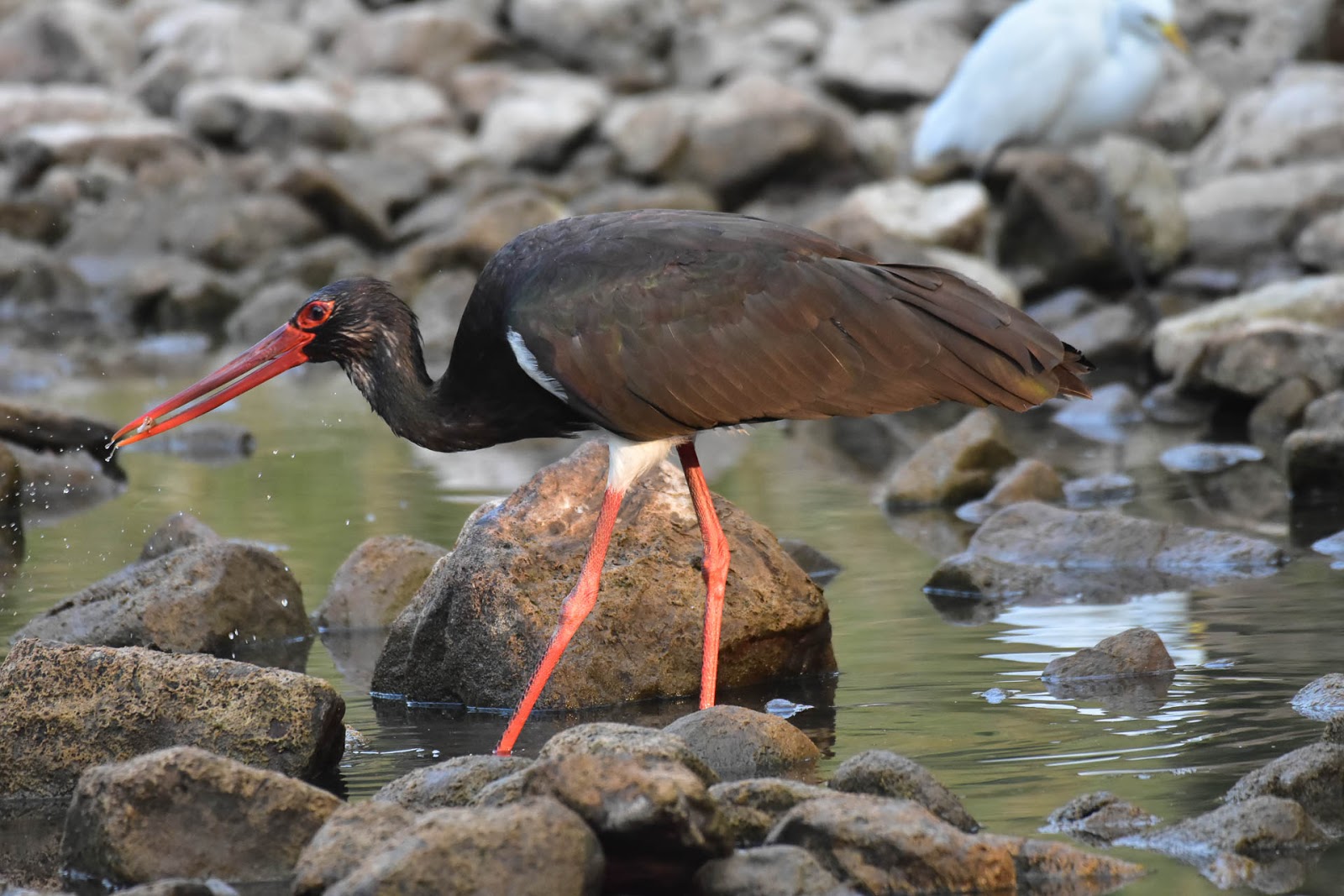 |
| Black Stork Eating a Small Fish |
Around noon I spotted a tiger lying next to the road. It was Laila and our 10th sighting. We watched her for awhile before she got up, drank and went to sit in the tall grass. We left her 45 minutes later.
 |
| Laila Drinking from a Pool |
At 3:25 Avi and I spotted another tiger in a rocky wash. We drove around to intercept the tiger and found it was Laila again. She came out on the road and followed us before heading off into the forest 45 minutes later. This was our 11th and final tiger sighting in Ranthambore National Park.
 |
| Laila Checking a Scent Mark |
The Park wasn't always a safe haven for tigers and other wildlife. In 1973, very concerned about the dwindling number of tigers due to hunting, Project Tiger (PT) was started at the insistence of Indira Gandhi. Nine reserves were created under PT with Ranthambore being one of them. At that time the area looked very different. There were 16 villages dotting the area and the Park's largest lake, Padam Talao, had been drained for agriculture. All the vegetation had been eaten by domestic cattle and wild animals were rarely seen.
In comes Fateh Singh Rathore, the assistant field director at that time. With a high amount of tact and patience he convinced the villagers to move out of the park. It wasnt always easy. At one point he was beatened by angry villagers and left for dead. He recovered and continued his important conservation work. Largely because of Mr. Rathore, "Ranthambhore became the place which brought the tiger to the consciousness of people the world over."
On our last morning in Ranthambore we explored a different area, Zone 6. There were quite a few other vehicles traveling the same route. We waited for them to leave before proceeding. Suddenly the line of jeeps and cantors was heading back in our direction. They were pursuing something. Marc and Avi spotted a leopard as it ran away. I missed it.
Our time in Ranthambore had come to an end. What an amazing privledge to spend so much private time in the company of wild tigers! Never in my wildest imagination did I expect such intimate and lengthy encounters or to witness such unusual behavior of these magnificent cats. Thank you Avi for making this possible!
Little did we know that another unexpected surprise awaited us that evening. Stay tuned to find out what it was and how we fare in our next destination, Panna National Park.
We hope all is well with everyone.
Peggy and Marc

Ranthambore Map:

We later learned that Lightning had ventured outside of the park after our departure and fell into a 45-foot well in Khandoj Village. A team of forest guards rescued her without injury and released her back into the forest. Tiger Watch provided all the equipment necessary for the rescue. There is a video on the Facebook page of Tiger Watch.


