Showing posts with label Sambar. Show all posts

Thursday, November 24, 2016

Tiger! Tiger!

Greetings All,
We're on the second third of our safari with Avijit Sarkhel of Vana Safaris.  Our travels have taken us from the state of Gujarat to the neighboring state of Rajasthan by way of Jaipur.  A 3-hour drive brought us to the city of  Sawai Madhopur on the edge of Ranthambore National Park.  We had visited this Park back in 2004 and I must admit I was a little wary about returning.  We did see tigers on our first visit but only after booking a jeep safari.  We didn't realize that the standard safari involved riding in a canter, an open-top bus that sits 20 typically noisy passengers!  At that time, a canter had to stick to a prescribed route and complete it in a certain amount of time.  This meant no stopping to photograph birds or other animals.  This time around Avi had booked two full-day safaris in a private jeep for us.  The full-day safari option was new starting this year so we were Avi's first clients to try it out.  We were allowed to go into the park at 6:30, a half-hour earlier than the canters and other jeeps on the morning safari.  Atule, our forest guard who accompanied us, got a radio call around 7:00 that a tiger had been spotted.  We rushed off to the location where several other jeeps were parked and saw our first tiger lying in the tall grass!


Pacman - Our 1st Tiger Sighting!

His name is Pacman and he's about 3 years old.   Pacman disappeared in the long grass so we went off in search of more wildlife.  There were plenty of Spotted Deer, Sambar, Blue Bull, Wild Boar, Peafowl and even a few Indian Gazelle or Chinkara and a Ruddy Mongoose.


Wild Boar

We got another call around 9:00 that a second tiger had been spotted at the edge of a small pond.  This time it was a female, T41, called Laila.  There were several jeeps vying for a view as she walked down a dry river bed, crossed the road calling to her cubs and went out of view about 30 minutes later.  


Laila Crossing the Road


Being on a full day safari meant we got to stay in the park when most other vehicles had to leave.  At 10:42 we found Laila sitting in a pool with her huge paws resting on a rock.  


Laila Resting in a Pool

This time we had her all to ourselves.  She got up and walked along the road and turned off onto a path through the forest scent-marking along the way.  


Laila Scent-Marking

We followed her until the path petered out.  We were hoping to find her two cubs, about a month and a half old, but did not not see them.  She left us an hour and 15 minutes later.  What a great sighting!
  
Around 1:00 we encountered Pacman on the road coming toward us.  We had to back up when he got too close.  He left the road about 10 minutes later.  Again, we had a private viewing!  It was only early afternoon and we already had 4 sightings, 2 of which were private with 2 different tigers!  


Pacman Coming Toward Us


Other vehicles started to return to the park around 2:30.  At 5:15 we had a call that Pacman had been spotted again.  When we arrived, jeeps were already jockeying for position.  He crossed the road and we all got good views but had to leave in order to be out of the park by 5:30.  What a great first day, 5 sightings of 2 different tigers!!

Pacman

Wildlife viewing didn't end once the sun went down.  After dinner we went off in search of nocturnal animals.  We drove down the main road and spotted a Common Palm Civet and her 2 cubs sitting on the border wall of the Park.


Common Palm Civet and Cubs

We visited the town dump where a Striped Hyena was known to hang out, maybe not the most pristine place but we did get a great view of this normally shy nocturnal creature.


Striped Hyena


We left the lodge at 6:00 the following morning for our second full day safari and we were first into the park at 6:30.  The morning started off with our first tiger sighting at 7:13.  It was T83 or Lightning, Pacman's sister.  We followed her for 20 minutes and amazingly had her all to ourselves.   


Lightning

We also saw all the regulars: Spotted Deer, Sambar, Langurs, Blue Bull, Chinkara and some Painted Spurfowl.  


Sambar Stag


Around 9:50 we heard a Spotted Deer alarm call and drove off toward the source of the sound.  I spotted the tiger first.  It was a new female called Krishna, the current queen tigress of Ranthambore.  She eventually came out to the road.  We were joined by 2 other jeeps who were also able to get good views.  The other jeeps had to leave because they were on a morning safari and we had her all to ourselves.  She came onto the road and we followed her to the same path that Laila had taken yesterday.  This caused some confusion on our part.  Could this be the same tiger, Laila, we saw yesterday?  Or was the tiger we saw yesterday really Krishna?  Avi insisted they were the same tiger since she was scent marking the same exact route. We followed her to the same point we had left Laila the day before.  Our encounter lasted 45 minutes! 


Krishna

At 1:45 we had our 8th tiger sighting.  It was Lightning again.  She was lying next to a stream just off the main road.  We parked and watched her for about an hour on our own. 


Lightning

We got a call late in the afternoon that Pacman had been sighted by the lake.  When we arrived there were already many vehicles so Marc took a few photos of Pacman from a distance and we left.  This was our 9th sighting.


Pacman in the Lake

When we returned to the lodge we were able to review side-by-side photos which revealed that the female tiger we saw today was indeed Krishna, the mother of Pacman and Lightning.


Laila                                         Krishna

This is highly unusual behavior for two unrelated female tigers to be scent marking the same exact territory especially when one is thought to have cubs.  A closer look at photos of Laila revealed that she has an injury on her right foreleg and some recent facial wounds.


Laila with Right Foreleg Injury


Could Laila and Krishna have already engaged in a few skirmishes?  Was Laila challenging Krishna's reign as queen tigersess of Ranthambore?  Who would be the victor and where would the loser end up?  Only time would tell.

The following morning we explored the buffer area to the northwest of the Park.  We met our local guide, Hanuman, who volunteers for Tiger Watch, an NGO whose mission is to "promote sustainable coexistence between people and tigers by combining community participation and science".  In 2013 Tiger Watch started the Village Wildlife Volunteers (VWV) program where villages supplied information such as cattle kills, human-wildlife conflict and the movement of straying big cats as well as illegal activities such as poaching, logging and mining.  The VWV's were also trained in the use of camera traps and smartphones to identify and track animals.  The data provided by the VWV's was extremely helpful in protecting wildlife and their habitat as well as combating poaching.  To learn more about Tiger Watch and the Village Wildlife Volunteers Program go to:


To reach the Kainaderi Sanctuary where Hanuman does most of his work, we had to pass through several villages where few westerners venture.


Cattle Herder

We arrived at the plateau overlooking the edge of the Sanctury late in the afternoon and could not venture further as we had a long drive back to our lodge.  After dark I glimpsed an animal crossing the road.  A closer look revealed a Jungle Cat in a villager's plowed field.

Jungle Cat


We also saw Small Palm Civet, Common Palm Civet, Asiatic Jackal, Indian Hare and possibly a Desert Cat.  The following morning we were able to add a third full-day safari in the Park.  We were first in and spotted a Sloth Bear lumbering away into the forest.  


Sloth Bear


We also saw Wild Boar, Spotted Deer, Sambar, Langur, 5-stripped Palm Squirrels, an Indian Scops Owl, Blue Bull, Wooly-necked Stork and a Black Stork eating fish.  
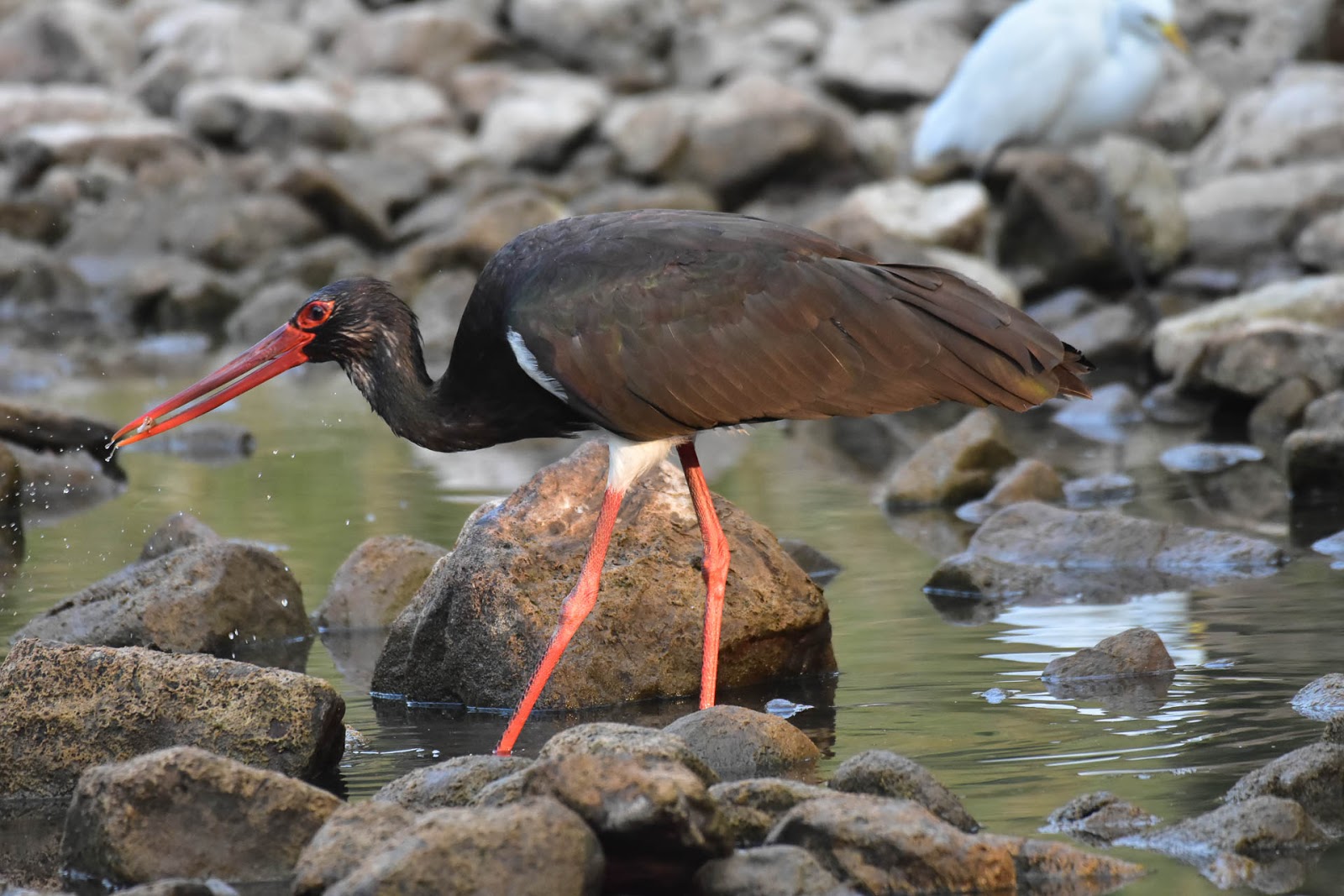

Black Stork Eating a Small Fish

Around noon I spotted a tiger lying next to the road.  It was Laila and our 10th sighting.  We watched her for awhile before she got up, drank and went to sit in the tall grass.  We left her 45 minutes later. 


Laila Drinking from a Pool

At 3:25 Avi and I spotted another tiger in a rocky wash.  We drove around to intercept the tiger and found it was Laila again.  She came out on the road and followed us before heading off into the forest 45 minutes later.  This was our 11th and final tiger sighting in Ranthambore National Park.


Laila Checking a Scent Mark 

The Park wasn't always a safe haven for tigers and other wildlife.  In 1973, very concerned about the dwindling number of tigers due to hunting, Project Tiger (PT) was started at the insistence of Indira Gandhi.  Nine reserves were created under PT with Ranthambore being one of them.  At that time the area looked very different.  There were 16 villages dotting the area and the Park's largest lake, Padam Talao, had been drained for agriculture.  All the vegetation had been eaten by domestic cattle and wild animals were rarely seen. 

In comes Fateh Singh Rathore, the assistant field director at that time.  With a high amount of tact and patience he convinced the villagers to move out of the park.  It wasnt always easy.  At one point he was beatened by angry villagers and left for dead.  He recovered and continued his important conservation work.  Largely because of Mr. Rathore, "Ranthambhore became the place which brought the tiger to the consciousness of people the world over."

On our last morning in Ranthambore we explored a different area, Zone 6.  There were quite a few other vehicles traveling the same route.  We waited for them to leave before proceeding.   Suddenly the line of jeeps and cantors was heading back in our direction.  They were pursuing something.  Marc and Avi spotted a leopard as it ran away.  I missed it.  

Our time in Ranthambore had come to an end.  What an amazing privledge to spend so much private time in the company of wild tigers!  Never in my wildest imagination did I expect such intimate and lengthy encounters or to witness such unusual behavior of these magnificent cats.  Thank you Avi for making this possible!

Little did we know that another unexpected surprise awaited us that evening.  Stay tuned to find out what it was and how we fare in our next destination, Panna National Park.

We hope all is well with everyone.
Peggy and Marc

Our route map:


Ranthambore Map:


Postscript:

We later learned that Lightning had ventured outside of the park after our departure and fell into a 45-foot well in Khandoj Village.   A team of forest guards rescued her without injury and released her back into the forest.  Tiger Watch provided all the equipment necessary for the rescue.   There is a video on the Facebook page of Tiger Watch.


Wednesday, March 19, 2014

Oh Maya!

Greetings All,
From New Delhi we flew south to the city of Nagpur in central India.  A 3-hour drive brought us to Tadoba National Park.  Declared a national Park in 1955, Tadoba has now merged with the Andhari Game sanctuary to create a 1700 square km reserve.  Legend has it that back in the 17th century the Gond King Taru who ruled this part of the Deccan Plateau was killed by a tiger while traveling to his outlying districts through the forests of Tadoba.  Today about 70 tigers roam these forests and we headed out in search of them.  There were a few safari jeeps parked along some rice paddies in a now-abandoned village.  The occupants told us they had spotted a tiger in the fields. We searched with binoculars and spotted her about 300 meters away.  More and more jeeps arrived to get a glimpse of the tiger.  "She'll never come closer with all these vehicles parked along the road" I thought.  Amazingly she got up and started to approach the road!

A Tiger is Spotted in the Distance

She stopped and appeared to be stalking something.  A ruddy mongoose ran past her and she gave chase into the forest.

Tiger Chasing a Ruddy Mongoose


She returned a few minutes later empty handed and continued heading toward us.

Tiger Approaching

By now there were about 15 jeeps parked along the road but that did not deter her.  She boldly continued her approach coming to within 10 feet to the nearest jeep! 


A Close Encounter

She came so close that Marc could only capture her huge head with his long lens.


Bengal Tiger

We pulled out in front of her and she followed us down the road.  You can see how close she is to the other safari jeeps.


A Great View for All!

Marc got one last shot before she strutted off into the forest.


Maya, a female Bengal Tiger

It wasn't until after she had disappeared that our guide Ved told us that her name was Maya and that she was suspected of recently killing a man that had gone into the forest illegally to cut bamboo.  No action was taken against her since it wasn't  certain that she was the killer and tigers are protected in India under most circumstances.  Wow!  I can't imagine that we'd be so tolerant if a grizzly bear killed someone even if that person illegally entered an area where the bears are protected.

The next day we weren't so lucky.  Another jeep had spotted a male tiger lying in the jungle.  He was so well camouflaged that I could barely make him out even with my binoculars.  Can you spot him in the photo below?

Amitabh, a male Bengal Tiger

His name is Amitabh and he arrived in the area in January 2010.  He was spotted again on the evening game drive lying under a tree next to a water hole.  Twenty or more jeeps lined up waiting for him to come out so they could get a better look.  We moved on in search of some of  Tadoba's other inhabitants.  Troops of Gray Langurs were cavorting next to the road.  Sisters or maybe an auntie were clutching newborn babies until mom came along and rescued the tiny infants from the "mom-want-to-be's". 

Gray Langur and Baby

In the evenings herd of Gaur or Indian Bison emerged from the forest to graze along the roadside.  one herd had several newborn calves on wobbly legs sticking close to mom.


Gaur Cow and Calf

One of our evening drives was cut short by a powerful thunderstorm.  Just after Marc took this photo of a Sambar buck scent marking a tree with his preorbital gland (located just under his eye), a bolt of lightning struck nearby.

Sambar Stag 

We rushed off to the Park headquarters where we took refuge from the pouring rain.  The following morning the weather had cleared and we were treated to a view of Tadoba's other majestic cat, the Indian Leopard.  She appeared in a clearing about 100 feet from the road and lingered in the open for a good 15 minutes.  She stayed in the area most of the morning affording most jeeps passing by with a great sighting. 

Indian Leopard

Also seen during our six jeep safaris were Spotted Deer, Ruddy Mongoose, Sloth Bear, Dhole or Indian Wild Dogs, Wild Boar, Chousingha or Four-horned Antelope, Indian Hare, Nilgai or Blue Bull and Marsh Crocodile.  Tadoba is also home to 195 species of birds.  Following are some of our favorite bird photos.


Painted Sandgrouse

Indian Roller

Paradise Flycatcher

Jungle Owlette

Black-headed Ibis

Thanks to Rick, Ved and the staff at Tiger Trails Lodge for making our visit to Tadoba National Park a most memorable one!

Tomorrow we fly from Nagpur to Kolkata where we'll spend the night before heading to the Sunderbans Tiger Reserve.

We hope all is well back home.
Peggy and Marc             

Thursday, March 06, 2014

Blessed by an Elephant

Greetings All,
We started our India trip in the temple city of Madurai, among the oldest continuously inhabited cities whose date of origin goes back 2500 years!  The main draw here is the 7th century Hindu temple of Meenakshi Amman.  It is dedicated to the Hindu goddess Pavarti, known here as Meenakshi, and her consort Shiva, named Sundareswarar here.  We arrived around 9:00 PM to witness the evening ceremony.  We were told that cameras were not allowed but when we arrived people were taking photos with their cell phones which were OK.  Unfortunately, we left our cell phone behind so we don't have any photos of the ceremony.  I will try to describe it briefly.  Every night, around 9:30 a statue of the Hindu god Shiva is removed from his shrine and carried to his wife, Parvarti's shrine. The ceremony starts with the ringing of a bell and the statue of Shiva emerges from his chamber in a silver palanquin (covered litter for one passenger, consisting of a large box carried on two horizontal poles by four or six bearers). 
 

Carrying Shiva in a Silver Palanquin (I stole this photo from the web)

He is preceded by a priest carrying a lit torch and followed by men playing drums and blowing a horn.  We rushed ahead of the procession and took up a strategic place in front of Pavarti's chamber to watch the rest of the ceremony.  The palanquin with Shiva arrived and was set on the ground in front of Pavarti's chamber.  A priest fanned the smoke from burning incense on it all the while the drums were beating and the horn blowing.  The symbolic feet of Shiva were brought and placed on the floor next to the palanquin.  A priest washed them and placed garlands of jasmine and lotus flowers on top.  Finally the statue of Shiva was carried inside Pavarti's chamber where they would spend another blissful night together.

The next morning we returned to the Meenakshi Amman Temple, this time with a cell phone.  We entered through the north gopuram or gateway tower.  There are 5 gorpurams one at each of the north, south and west entrances and 2 at the east entrance.  The tallest is the south gopuram at 170 feet and the oldest is the east tower built during 1216-1238.   Each tower is multi-storied, covered with thousands of stone figures of animals, gods and demons painted in bright colors.


North Gopuram

Close-up of Stone Figures

In one of the outer courtyards of the temple complex was an elephant!  She was trained to "bless" you after you gave her a donation.  It was kind of hokey but I couldn't resist.


"Blessed" by the Temple Elephant


I tried to gauge if she was happy or not but couldn't tell.  She appeared to be well cared for.  Inside the temple complex are shrines surrounded by corridors with carved stone pillars and brightly colored ceilings.


Inside Meeakshi Ammam Temple
  
The figures on the gopurams and the murals on the ceilings are repainted every 12 years except for this one original mural depicting the marriage of Shiva and Pavarti.

Mural of Marriage of Shiva and Pavarti

The marriage of Pavarti and Shiva is also depicted in this carving where Pavarti's brother Vishnu is giving her away in marriage to Shiva.

"Marriage of Meenakshi" Sculpture

The architectural masterpiece is The Meenakshi Nayakkar Mandapam ("Hall of 1000 pillars") built in 1569. 

The Meenakshi Nayakkar Mandapam ("Hall of 1000 pillars"). 

The pillars (actually 985) are carved with gods, figures that are half man and half woman, and yali (mythological beast with body of lion and head of an elephant.


Close-up of one of the Sculptures


We left the temple and  climbed to the top of one of the nearby shops for a better view of the whole complex.  Three of the 10 gopurams and the golden shrine over the Meenakshi sanctum are in this view.


Three Gopurams at Meenakshi Temple

We left Madurai and drove for 4 hours to Periyar National Park.  The sanctuary is India's largest protected area covering 357 square miles.  In the center of the park is Periyar Lake where we would spend the next 3 nights in the former summer palace of the King of Travancore.  The lake was formed when the Mullaperiyar Dam was erected back in 1895 by the British.

Periyar Lake with the Western Ghats in the Background

Boat trips are offered 5 times a day and we were able to get 2 seats on the last departure.  During the dry season animals congregate around this crucial water source.  We saw herds of Sambar deer grazing along the edge of the lake.

Sambar Deer

Periyar is home to 900 to 1000 elephants but we saw only one.  Also grazing along the lakeshore were herds of Guar or Indian Bison, the world's largest bovine. 

Gaur Herd

Bulls can weigh up to a massive 3300 pounds.


Gaur Bull

Bonnet Macaques, endemic to southern India, were feeding in the trees behind the Lake Palace.

Bonnet Macaque


The next day we drove about 26 miles in an open jeep to the other side of the park.  Along the way we spotted this beautiful Blue-winged or Malabar Parakeet feeding on some pods in a tree next to the road.  These parakeets are endemic to the Western Ghats of southern India.  You can easily tell a male from a female as males have a red beak while the females have a black one.


Male Blue-winged Parakeet

We also spotted a Malabar or Indian Giant Squirrel in another roadside tree.


Malabar Giant Squirrel


We reached a place called Gavi from which we were to do a walk in the jungle.  We arrived late so all the boats to take us across Gavi Lake were in use.  Our guide told us we'd have to walk along the road to get around the lake.  "Oh well..." I thought.  About 20 minutes into our walk our guide spotted some monkeys in the trees.  Suddenly, he became very excited!  They are Lion-tailed Macaques, among the rarest and most threatened primates in the world!  They allowed us to approach very closely and we spent at least 20 minutes with them.  There was a big male, a female carrying a baby on her belly and some juveniles.  What a privilege to see such a rare and magnificent creature!


Lion-tailed Macaque

We went off in search of Nilgiri Langurs.  Although not as rare as Lion-tailed Macaques they were proving to be more elusive.  We caught glimpses of them in the forest canopy.  On the drive back we found them in some trees near to the road.


Nilgiri Langur


We returned to the Park's west entrance and caught the last boat trip of the day.  One of the rangers on board told us that Dholes or Indian Wild Dogs had recently killed a sambar on the lakeshore and that we were approaching the site.  One of the dogs had moved off but one was still on the kill.


Dhole at a Kill
The endangered dhole is the only member of the Cuon genus which differs from the Canis genus by having fewer molars and more teats.  They hunt in small packs tiring out their prey after a long chase and kills by disemboweling them as is evidenced above.  

Wow, what a great start to our trip to India!

We hope all is well back home.
Peggy and Marc