Tuesday, December 13, 2022

Mission Monkey - Leg 2

Greetings Everyone,
We’re in Colombia with Rob Smith of "Wild About Colombia" on a mission to find some of the country’s rare and endemic primates. On our first leg we found 10 species (see our previous blog post) and we expected more in this trip segment. On December 13 we flew from Bogota to Puerto Asis in the south close to the border with Ecuador. We checked into our hotel right across the street from the airport and had lunch. Later that afternoon, we were met by Diego, our local guide, for a short boat ride across the Putumayo River to a village where we hoped to see some different monkeys. 

Crossing the Putamayo River

We soon spotted our first primate in this new area, an Ecuadorian Squirrel Monkey, another subspecies of Humboldt’s Squirrel Monkey. We continued past village houses and a school to a cow pasture but didn’t encounter any more monkeys. We started to head back when Diego heard tamarins! They were Black Mantle Tamarins, new to the trip but not a lifer. 

Black Mantle Tamarin

We returned the way we had come to look for our next quarry, the Red Titi Monkey, on the other side of the village. We encountered barking village dogs and cows that blocked the path but no titis. We headed back to the area where we had seen the tamarins but now the trees were empty. Suddenly a woman from the village shouted that they had found the titis! Sure enough, not far from where we had docked the boat was a family of 4 Red or White-tailed Titi Monkeys including a mom with a very young baby. We had just walked 3.5 miles and the titis were right by our boat!

 Red or White-tailed Titi Monkeys

We left early the next morning toward the town of Mocoa and our next destination the Donde se Oculta el Sol Nature Reserve. We were greeted by the manager, Corentin who gave us a brief history of the 70-hectare reserve. The current owner acquired the property 20 years ago from the government and gave it to her to relocate from a conflict area. Twelve years ago, the owner decided to conserve the forest rather than clear it for farming and 5 years ago she started an ecotourism project. There are 8 species of primates in the reserve and we set off after breakfast to see how many we could find.

Donde se Oculta el Sol Nature Reserve

We climbed up a steep hill and into the forest. Last night’s storm had left the trail wet and slippery and there were a few downed trees to get around. Possibly due to the storm, the monkeys didn’t vocalize this morning so Corentin had no idea where they were located. We continued to climb finally reaching a more level ridge. We veered off onto a trail good for Miller’s Saki but found none. Corentin knew a tree with a Spix’s Night Monkey nest, so we climbed down to investigate. No one was home. We hiked back up toward the main trail. It had now been 2 hours without any trace of a monkey. Finally, one was spotted in the canopy, a Miller’s Saki we were told. We tried to follow it to get a better view. I managed to get a brief look to confirm it was a saki but Marc was unable to get a photo.

Searching for Miller's Saki

The monkey moved off and we continued on. Finally, we heard titis vocalizing in the distance and we headed in their direction. Their calls grew louder but stopped as we approached so we couldn’t find them. Foiled again! Corentin knew of another location for the titis and we headed there. Finally, we spotted a small family group high in the canopy. Not a great sighting but we could see their hands and they were Colombian Black-handed Titis, another endemic and a new species for us! 

Colombian Black-handed Titi

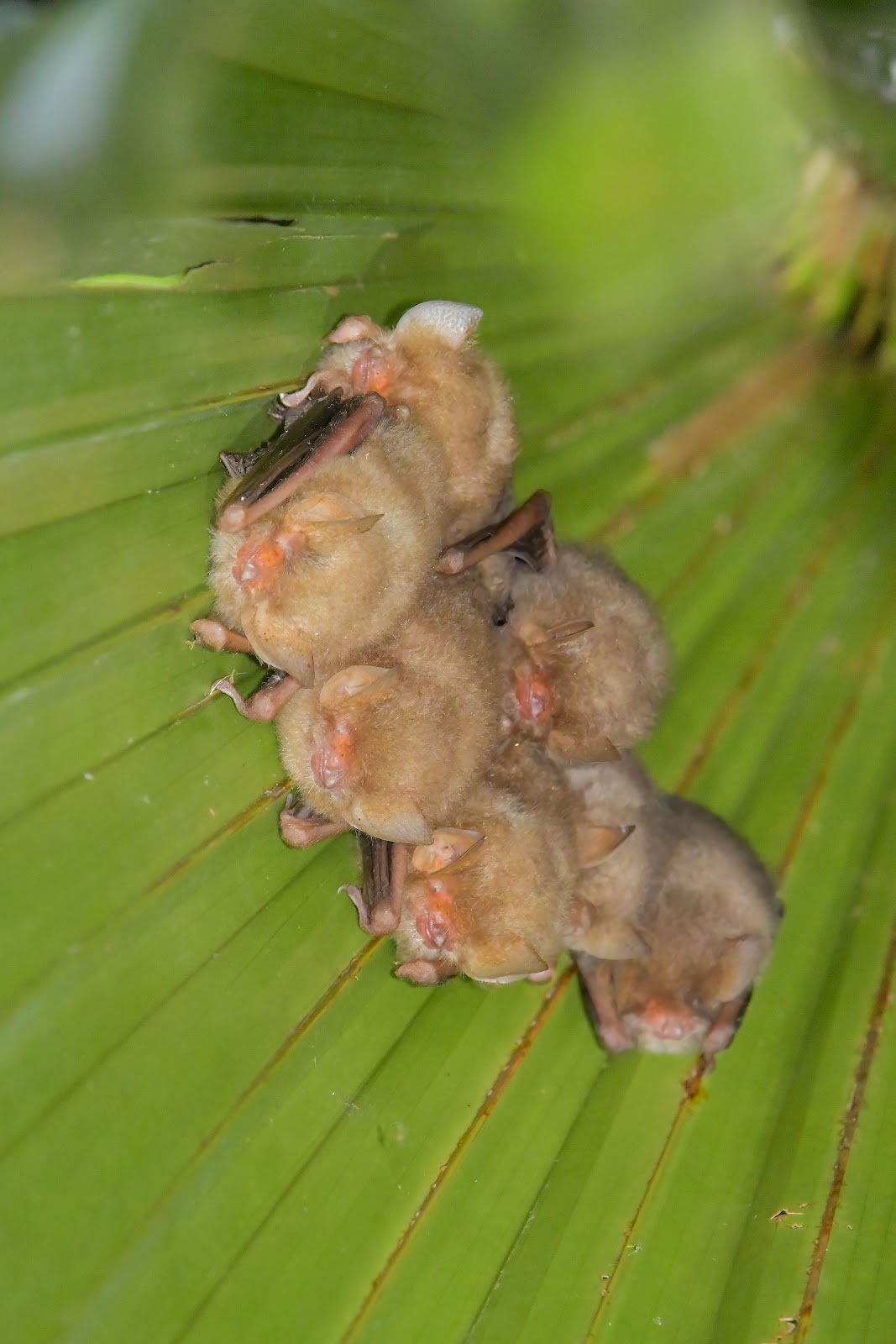
After lunch, we drove past the town of Villagarzon to Dantayaco, our accommodation for the next two nights. We met our new local guide, Edilson who took us to the nearby Puway Reserve. It had closed during the pandemic but access was still possible. We entered the forest on a path lined with slippery rocks to a rock overhang where a few Lesser Sac-winged Bats were roosting. 

Lesser Sac-winged Bat

We continued to climb on a steep, slippery ill-defined path that Rob assured us would level out. Just as it did, it began to pour! We rushed to get our pack flies and ponchos on and now had to make the slippery descent in the rain. We got down without incident and returned to the hotel for “easy monkeys”. We hung out in the dining area waiting for Pygmy Marmosets or Ecuadorian Squirrel Monkeys to show up now that we put out bananas for them. The hotel staff kept saying  “mañana, mañana”. 

Waiting for Monkeys

In the morning it was still raining so the “easy monkeys” were a no-show. Finally, the rain let up and we decided to revisit Puway Reserve. We climbed up to the top of the ridge when Rob shouted “wasps, move back!”. Marc was in the back and wasn’t sure what was going on but we ran a safe distance from the wasps. Marc thought Rob was shouting about the titi monkey that Marc had spotted low down in a nearby tree. Edilson and Rob missed it being distracted by the wasps. By the time we had moved around the wasps, the titi had moved high into the canopy and it was hard to tell if it was a Black or Yellow-handed Titi. The trail climbed down, crossed a stream, and reached the now abandoned buildings of the reserve or so we thought. We then heard dogs barking and were greeted by the caretaker. He had decided to stay on all by himself throughout the pandemic to keep an eye on the place. Surprisingly there was a friendly troop of Lesson’s Saddle-back Tamarins in the vicinity, a new species for us! 

Lesson’s Saddle-back Tamarin

After lunch, we returned to Donde se Oculta el Sol Reserve to look for monkeys along the road. Not long after we started, Rob spotted a Western Pygmy Marmoset high up in a tree, nice find! Edilson was able to relocate it or possibly a second individual and Marc got some photos for identification. This species has recently been split and we were seeing the western species.

Western Pygmy Marmoset

We managed to find some Ecuadorian Squirrel Monkeys and Lesson’s Saddle-back Tamarins but the Yellow-handed Titi Monkeys eluded us. At least we had seen them in Ecuador back in 2017.

The next morning the weather had cleared so the “easy monkeys” had no excuse for not showing up. We waited until 8:00 but gave up and went to our room to pack.  Just as we were heading out the door, Rob shouted “there are monkeys behind your room!”. A large troop of Ecuadorian Squirrel Monkeys had descended upon the hotel. We followed them to the dining area where they had found the bowl of bananas! It didn’t take them long to devour the entire lot. What’s more fun than a barrel of monkeys? A bowl-full of Ecuadorian Squirrel Monkeys!

Ecuadorian Squirrel Monkeys

We drove back through Villagazon before turning off the main highway toward Miraflor, our next destination. We bumped along a dirt track to the Caquetá River. To get to the village, we had to be ferried across the river. We sat in the back of the boat with the local passengers while cargo including 4 motorcycles with their riders was being loaded up front.

Caquetá River Ferry

On the other side of the river, we were met by Harold, the owner of the hotel we’d be staying, and Miller, the driver of an old Toyota pickup. The Tursan Hotel looked like a riverboat docked on land and maybe it was.


The Tursan Hotel

After settling in, we drove back to town for lunch. While waiting for our guide, Alexis, we watched as a wall of rain approached and engulfed the town. The rain let up so we decided to go to the community forest to look for our main primate target, the critically endangered Caquetá TitiAlexis caught up to us not long after we set off and we passed a few fincas with grazing herds of Brahma cattle but no primates were seen or heard. Finally, we spotted some Ecuadorian Squirrel Monkeys and Lesson’s Saddleback Tamarins but no titis. We arrived at Alexis’ house where we had a great view of an Ecuadorian Squirrel Monkey in the open.

 Ecuadorian Squirrel Monkey

On the return, we encountered more squirrel monkeys and tamarins but frustratingly no titis. Rob was confident we’d find them in the morning. We stopped at a street vendor to pick up fried chicken and potatoes for dinner and with a cold can of beer we had a satisfying meal.

Picking Up Dinner

When we arrived at the community forest the following morning all was quiet. Without the titis vocalizing, we’d have to find them the hard way. We searched all their known haunts with Alexis but they were nowhere to be found. We took a break for breakfast at Alexis’ house before resuming our search.

Breakfast at Finca Mirasol

We ventured off the main path into areas that had once been cleared to grow bananas but the titis weren’t home. We even ventured into Alexis’ family’s organic cacao plantation where we stopped to enjoy some fresh cacao fruit.

Fresh Cacao Fruit

After nearly 8 hours of searching, we hadn’t yet seen one monkey! We were about to give up when Alexis returned from a foray in the forest and excitedly reported he had found titis! We followed him to the spot but unfortunately, they had moved off. We searched in vain in the dense vegetation but retreated to the main path empty-handed. They did make another brief appearance and Marc was able to get a glimpse but I wasn’t so lucky. We’d make a last-ditch effort to find them in the morning.

Near Finca Mirasol

The weather had cleared in the morning and the Caquetá Titi Monkeys were much more vocal. At least we knew what general area they were in but they were too far away. We returned to the area where we had seen the titis yesterday. We could hear them calling so we entered the forest and walked to a cleared cornfield. Here we got our best views and Marc was able to get a photo of the tails of 2 of the 3 titis present. Sadly this would be our best encounter. At least we got a glimpse. With less than 100 remaining, not many people can claim to have seen a Caquetá Titi Monkey in the wild!

Caquetá Titi Monkey Tail

We returned to the hotel to pack up for the trip back to Villagazon where we’d catch a flight back to Bogota. Leg 2 of “Mission Monkey” had come to an end. Although more challenging than Leg 1, we did manage to see another 8 species of primates, 3 of which were lifers for us. Stay tuned for our final leg of "Mission Monkey."
We hope all is well with everyone,
Peggy and Marc

Our route map:


Sunday, December 04, 2022

Mission Monkey in Colombia

Greetings Everyone,
After a nearly 3-year hiatus, it was time to get back out in the field to continue exploring this wondrous world. We had been in touch with Rob Smith of Wild About Colombia since 2019 and it was time to make the return trip to Colombia a reality. Our focus would be on searching for rare and endemic primates. We met Rob in Bogota on December 4 and set off early the following day for Villavicencio and our first primate target, the endemic Ornate Tití Monkey. 

Leaving Bogotá

Surprisingly these monkeys don’t live deep in the jungles of a national park but prefer the forest edges along cattle pastures. A local NGO is working with ranchers to protect these monkeys and we were granted permission to search for them on a private finca or farm. It didn’t take long to spot our first primate, not a titi but a Colombian Squirrel Monkey, a subspecies of the widespread Humboldt’s Squirrel Monkey.

Colombian Squirrel Monkey

Shortly after, Rob spotted another monkey, an Ornate Tití! These titi monkeys are classified as vulnerable by the IUCN and occupy a small range in eastern Colombia. It was a treat to view this tiny family group and another on the finca.

Ornate Tití Monkey


We spent the night at Rancho Camaná, another finca that owners Martha, Nathalia, and Elvis are preserving for conservation. The family has chosen to transform their cattle ranch into a nature reserve and invite guests to visit their bird feeders, gardens, and forest. Their most notable residents were a family of Brumback’s Night Monkeys, another Colombian endemic species. Nathalia showed us their roosting place high up in a big stand of bamboo. As night approached the family left the roost and promptly went to feed in a mango tree nearby. 

Brumback’s Night Monkeys

Like so many other animals these monkeys are vulnerable due to habitat loss. Their forest home is being cleared for cattle ranching, agriculture, and human habitation. It was heartening to see Rancho Camaná doing their part to protect the Brumback’s Night Monkeys' forest home and working with others in the community to do the same.

Elvis joined us the next day to visit another finca near the town of Vista Hermosa where Colombian Woolly Monkeys are known to live. To reach this remote village, we transferred to a 1981 Toyota Landcruiser for the bumpy ride and river crossings.

1981 Toyota Landcruiser 

We hiked a half mile along a stream when Rob spotted the Colombian Woolly Monkeys! They were quite relaxed and allowed us to approach closely for good views and photos, an indication that they are not hunted in this area. They are much darker than other woolly monkeys we’ve seen. Some scientists believe they are a subspecies of the Common Woolly Monkey while others ascertain they are a separate species. Whatever the case, they are classified as critically endangered and to see them so relaxed close to a village was amazing!

Colombian Woolly Monkey

The next day brought us to another finca in search of our next primate species, the endangered White-bellied Spider Monkey. We were joined by Cesar, a local rancher who like Elvis has become more interested in conservation and ecotourism. He led us to a ridge on his farm from which we had a good view of the forest on the other side of a stream. We sat and waited for the monkeys to appear but they didn’t show. After 2 hours I had about given up hope when Cesar spotted them feeding in a tree alongside a waterfall! They were quite a distance away so we hiked along the stream to the base of the waterfall. We couldn’t get any closer but we did get good views of this family group.

Spotting the Monkeys


White-bellied Spider Monkeys

We went to lunch at another farmhouse where we were treated to a local feast of sancocho, the traditional soup full of potatoes, yuca, and plantains, grilled chicken, and rice. It was a novel wildlife viewing experience for us searching for animals on privately owned fincas and then having lunch at a different farmhouse. It was Rob’s way of spreading our tourist dollars around and encouraging the locals to protect the forest and wildlife in it. If the farmers can generate income from ecotourism, they are less apt to cut the forest and hunt the wildlife.

Sancocho

After such a hearty meal, it was off to Cesar’s lodge for a siesta. Although not quite complete, Cesar is constructing a tiny ecolodge which he hopes one day will be used by tourists visiting the area to see wildlife instead of just the waterfall. We did a bit of birding and Cesar took us to a tree behind the lodge where a Linné's Two-toed Sloth was snoozing.

Linné's Two-toed Sloth

We said goodbye to Cesar and wished him the best of luck with his new endeavors. We all got a bit teary-eyed when he informed us we were his first foreign guests!

The next day we said goodbye to Elvis and continued on to San Jose del Guaviare where we met our new local guide, Wilma. Not far from town was a patch of forest with a surprising diversity of primates. We saw 4 species of monkeys, three new to our trip: the Colombian Red Howler Monkey, Black-capped or Tufted Capuchin, and Common Woolly Monkey.

Common Woolly Monkey

We had to venture further afield to the village of Cerro Azul to locate our next primate targets. On the long drive, we did manage to find one, the Collared or Black Titi Monkey in a patch of forest alongside the road. They were high in the forest canopy but came closer out of curiosity affording us a good view.

Collared or Black Titi Monkey

Our next two monkey species proved to be more difficult to find. We searched for the first in Cerro Azul Reserve but encountered more Common Woolly Monkeys and Tufted Capuchins before reaching the end of the trail. We headed back hoping to see our prime target on the return. Rob and Wilma heard something on the trail ahead. Could it be the elusive Golden-backed Uacaris? No, it turned out to be the even more elusive South American Tapir! Wilma and another local guide Norbe had not seen one here before. We got good views and photos despite the fading light.

South American Tapir

We returned to the forest after dark but a night walk only produced an opossum, most likely a Brown-eared Wooly Opossum and a Linné's Two-toed Sloth that we nearly missed in a tree over our heads. We had one more day to find the uacaris so the pressure was on. We revisited the same trail the following morning with no luck so we tried another trail with the same result. We returned crestfallen to the farmhouse for lunch. Time was running out, we had to find the uacaris this afternoon or choose between them and the Mottle-face Tamarins on our final morning in the area. We set off after lunch and patrolled the same trail where they had been seen in the past. 

Setting Off

We stopped short of the trail's end and waited in vain for the monkeys to show up. We accepted defeat and started our return to the farmhouse. I turned back and noticed that Norbe was urgently trying to get our attention. He had found the Golden-backed Uacaris! We rushed back to his location and caught glimpses of them high in the trees. Not satisfied with our encounter we followed them deeper into the forest. Finally, they paused long enough to give us a proper look and for Marc to get an extraordinary photo! Unlike most New World Monkeys, they have short, non-prehensile tails. Why a monkey would evolve without a prehensile tail which comes in very handy with an arboreal lifestyle is beyond me.

Golden-backed Uacari

The next morning we visited another finca to search for our final primate target, the Mottle-face Tamarin. The locals refer to them as "Diablitos" or "Little Devils" and I hoped they wouldn’t be difficult to find as the uacaris. We were met by the farmer who owns the finca who would hopefully guide us to the Diablitos. We were joined by Norbe and our 3 local guides who went into the forest to search for the Little Devils while we walked the forest edge on the more open pasture side. Wilma found 3 Collared Titis but no tamarins. We were seeing plenty of birds, an Ornate Hawk Eagle, a Laughing Falcon, and White-throated Toucans but no mammals. The crafty Little Devils outmaneuvered us and we returned to the farmhouse for breakfast. There were old Ocelot skins hanging on the walls. It’s a good thing that the farmers are no longer hunters and are getting into ecotourism. Just as we were finishing breakfast, Anderson, one of the farmer’s sons ran up excitedly. He had found the tamarins! We rushed off after him into the forest to the location. Sure enough, they were there, high up in the trees! We followed them, getting clear views when they paused on an open branch to screech at us. 

Mottled-face Tamarin

What a relief, we had seen our 10th primate target for this section of the tour. We returned to the farmhouse satisfied with our experience. We said goodbye to the family thanking them for their hospitality and of course for the Mottle-face Tamarins! It was still early enough to return to Cerro Azul to finally see the rock art for which the reserve is famous. 

Hiking to Cerro Azul

We climbed 400 feet to the main panel, an impressive collection of human and animal figures thought to be 12,000 years old! Little is known about this site including who the artists were.

The Main Panel at Cerro Azul

To get to the upper panel we followed the trail to a cave. You can bypass the cave but we wanted to see the bats inside. Our Covid masks came in handy here and we put them on before entering the cave.

Masking Up

There were many bats hanging from the ceiling and we could identify the Common Vampire Bat, Lesser Dog-like Bat,  Lesser Spear-nosed Bat, and Seba’s Short-tailed Bat. It was hot and I was sweating into my mask. Between the slippery rocks, the bats flying around, and trying to avoid hitting my head on the ceiling, I was relieved to see light at the other end.

Bats in the Cave

We continued to a viewpoint overlooking the rainforest. It was good to see such a large swath of forest after seeing so much cleared for pasture and agriculture. 

Rainforest Panorama from Cerro Azul

From here we visited the upper panels, one with impressive tapir figures and another with a giant ground sloth now extinct.


Giant Ground Sloth

As we headed back down, we saw something moving next to the trail. It was a Southern Tamandua! We got a brief, partially obstructed view but waited to see what the tamandua would do. Amazingly, it came back out onto the trail in full view only 20 feet away! We watched as it climbed a palm tree searching for ants. Marc got great photos although he had too much lens.

Southern Tamandua

We drove back to San Jose del Guaviare that afternoon making one detour to see the Orinoco River Dolphins. They weren’t far from the dock and Marc played whack-a-mole catching a few fins and beaks only.

Orinoco River Dolphin

The first leg of “Mission Monkey” had come to an end. We had been successful in seeing all 10 of our primate targets in addition to other mammals and many birds. Stay tuned for the second leg of our search for Colombia’s rare and endemic primates!

We hope all is well with everyone.
Peggy and Marc


Our route map:


Sunday, March 01, 2020

Awesome Animals of Aledeghi & Awash

Greetings Everyone,
After our intrepid journey into the Danakil Depression, it was time to return to a less alien world. On our way to Semera, we passed a wrecked car on the side of the road and Kasaye came to a screeching halt. He said he had seen something under the vehicle. He backed up and lying under the car was what could only be an African Golden Wolf!

African Golden Wolf Under Car

We were hoping to get a good sighting of this canine. Although the African Golden Wolf is widespread in the northern and north-eastern parts of Africa, we had yet to come across one on our travels. The species has only recently been recognized as morphologically and genetically distinct from the Eurasian Golden Jackal (Canis aureus). The wolf got up and plodded to the side of the road, giving us an even better view. 


African Golden Wolf

We reached the town of Afrera and visited its great salt lake to look for birds. The best find turned out to be an endangered Egyptian Vulture along the highway. 


Egyptian Vulture

Sadly, it was time to say goodbye to Rufael as he was to return to Axum and we were to continue our drive to Semera. We encountered another roadside surprise, a troop of Hamadryas Baboons! It was another species I was hoping to see, having missed them on our first two trips to Ethiopia. Apparently, motorists feed them creating a dangerous situation as the baboons line the busy highway for a handout.


Hamadryas Baboon

We reached Semera, the new and fast-growing capital of the Afar Region, in the late afternoon and checked into a posh but nearly empty resort.


Our Hotel in Semera

Early the next morning, I was eager to leave the Afar Region and reach Animalia Lodge to resume our search for more wildlife. The drive was unpleasant to say the least. The truck traffic along the main route from Djibouti to Addis was unbelievable. We had to pass tandem trucks while avoiding trucks coming in the other direction. The buses were crazy, traveling at breakneck speed and passing haphazardly. We encountered many wrecks and I had my teeth clenched the whole way. I tried to capture the experience on a video but was only mildly successful.


Finally, we reached the turnoff for Animalia Lodge and I was able to breathe a sigh of relief. That afternoon, Yani, the lodge owner, and Mohamed his tracker took us out in an ancient Land Rover on a game drive. 

Ancient Land Rover

We explored Yani’s concession spotting Beisa Oryx, Northern Gerenuk, African Golden Wolf, and Salt’s Dik-dik. The Gerenuk is a long-necked gazelle found in the Horn of Africa and drier parts of East Africa. This was only our third time encountering this near-threatened species.

Northern Gerenuk

Yani took us to a nearby hot spring near sunset. A large flock of Northern Carmine Bee-eaters was coming in to drink and possibly to roost.

Northern Carmine Bee-eaters

That night I lay awake listening for lions. They often frequent the nearby marsh where they hide in the sugar cane but tonight they were silent. The following morning we were off to explore the Aledeghi Plains, part of the 1800-square kilometer Aledeghi Wildlife Reserve. Here large herds of Soemmerring’s Gazelle grazed on the vast grasslands. This vulnerable species is restricted to isolated parts of the Horn of Africa. They were quite wary and it was difficult to get close for good photos.

Soemmerring’s Gazelle

The species I was hoping to see was the endangered Grevy’s Zebra. We had not seen these rare equines since our first trip to Africa in 1990! We searched in vain until spotting a small family group near the woodlands. They, too, were wary and it was impossible to approach closely, so we had to settle for distant views and photos. It was still great to see them again after 30 years!

Grevy’s Zebra

Beisa Oryx, African Golden Wolf, Common Warthog, and Abyssinian Hare rounded out our mammal list before we returned to the lodge for a midday break.

African Golden Wolf

Abyssinian Hare

An afternoon game drive in a different part of the reserve yielded more of the same species of mammals. We stayed out after sunset to look for nocturnal mammals. I hoped that we might find the lions that hang out in a nearby sugar cane plantation. We stopped to chat with some locals who said a lion had been spotted not far away a few nights ago. We weren’t so lucky, depending on how you look at it. We wished to see a cat rarely sighted in Ethiopia, but the locals and their livestock have to contend with them daily. We did spot African Civet, Spotted Hyena, and White-tailed Mongoose, so we didn’t come up empty-handed.

White-tailed Mongoose

The next morning we left Animalia Lodge and drove to the nearby and much more popular Awash National Park. This was our third visit, the first back in 1995 and the second in 2011. I was hoping that things would have improved since 2011, but they continued to deteriorate. More and more locals encroach into the park to graze their livestock. The landscape is being denuded, leaving very little food for wildlife. This doesn’t seem to bother the number of tourists visiting the park. If you hadn’t experienced the park 25 years ago, you might not notice the amount of destruction going on. On the drive in, we did manage to see a few Soemmerring’s Gazelle, Salt’s Dik-Dik, and Beisa Oryx, but it was nearing midday and most animals would be resting.

Beisa Oryx

We had lunch at the lodge where the Grivet Monkeys have become quite a pest. You have to watch them constantly or they will jump on your table and steal your bread!

Grivet Monkey

The lodge is situated on the bank of the Awash River. The nearby Awash Falls tumble a 100-feet over the rocks into a pool with lurking Nile Crocodiles. It’s hard to believe we made a raft trip down the Awash in 1995 before the lodge had been built. I must admit it was more relaxing watching the crocs from an observation platform high above the river rather than clinging to a raft in the hopes we wouldn’t get tossed into the river! Such great memories!

Awash Falls

We went out for a game drive in the late afternoon hoping to see more animals, but other than Salt’s Dik-dik, a few Beisa Oryx and Common Warthog, we saw very little. We stayed out after the sunset hoping that once the locals left with their livestock, the nocturnal animals would emerge. Abyssinian Hares were by far the most abundant and we spotted around a dozen Bat-eared Foxes. They were quite skittish, though, and it was difficult to get a good photo.

Bat-eared Foxes

The following morning it was time to leave Awash National Park and return to Addis Ababa. Our third trip to Ethiopia was coming to an end. We want to extend a big thank you to our guides Mangay and Rufael for sharing their fascinating country with us. We are grateful to our driver Kasaye for his long hours on the road getting us safely from one destination to the next. Finally, I’d like to thank friend and guide Yigo for coming up with this itinerary and to Yared of Dreamland Ethiopia for making it happen. Stay tuned for our next destination, a visit to Zakouma National Park in Chad.

We hope all is well with everyone.
Peggy and Marc

       Ethiopia Mammal List: February 17 to March 1, 2020
    
 No Species Scientific Name  Comments
 1 Klipspringer  Oreotragus oreotragus  Simien Mts. 
 2Gelada  Theropithecus gelada Simien Mts.
 3 Kaffa Side-striped Jackal  Canis adustus kaffensis Simien Mts.
 4 Walia Ibex Capra walie Simien Mts.
 5Abyssinian Grass Rat  Arvicanthis abyssinicus Simien Mts.
 6 Oribi Ourebia ourebiKafta Sheraro  
 7 Eritrean Gazelle Eudorcas tilonuraKafta Sheraro 
 8 Greater KuduTragelaphus strepsicerosKafta Sheraro 
 9 Defassa Waterbuck Kobus ellipsiprymnus defassa  Kafta Sheraro
 10 Striped Ground Squirrel  Xerus erythropus Kafta Sheraro 
 11 Common Warthog Phacochoerus africanusKS, Aledeghi, Awash  
 12 Olive Baboon Papio anubis Kafta Sheraro, Awash
 13 Eastern Black-backed Jackal Canis mesomelas schmidti  Kafta Sheraro 
 14 African Wildcat Felis lybica Kafta Sheraro
 15 Spotted Hyena Crocuta crocutaKafta Sheraro, Awash  
 16 Cairo Spiny Mouse Acomys cahirinus KS, Animalia
 17Rock Hyrax  Procavia capensis Gheralta
 18 Abyssinian Hare Lepus habessinicusGheralta, Aledeghi, Awash 
 19 Dorcas Gazelle Gazella dorcas Danakil 
 20 African Golden Wolf Canis lupasterDanakil, Alideghi 
 21 Hamadryas Baboon Papio hamadryasAfar Region 
 22 Salt’s Dik-dik  Madoqua saltiana Aledeghi, Awash
 23 Beisa Oryx Oryx beisa beisa Aledeghi, Awash
 24 Northern Gerenuk Litocranius walleri sclateri  Aledeghi 
 25 Grevy’s Zebra Equus grevyi Aledeghi 
 26 Soemmerring’s Gazelle  Nanger soemmerringii Aledeghi, Awash
 27 Lesser Kudu Tragelaphus imberbis Aledeghi, Awash
 28 White-tailed Mongoose Ichneumia albicauda Aledeghi, Awash
 29 Bat-eared Fox Otocyon megalotis Awash
 30 Unstriped Ground Squirrel Xerus rutilus Animalia, Awash
 31  African Civet Civettictis civetta Aledeghi, Awash
 32 Abyssinian Genet? Genetta abyssinica Animalia
 33 Egyptian Mongoose? Herpestes ichneumon Awash
 34 Grivet Chlorocebus aethiops Awash
 35  Mantled Guereza Colobus guereza Awash


For the 137 bird species seen and photographed by Marc during our last two trips to Ethiopia go to his list on iNaturalist:


Our route map: