Showing posts with label gaur. Show all posts

Monday, April 04, 2016

Khao Sok - "The Light of the Kingdom"

Greetings Everyone,
On March 20 we were to fly from Mae Hong Son to Chiang Mai but the smoke from all the local forest fires obscured the runway and our flight was canceled.  We piled into a van along with 6 other stranded passengers for the 5-hour drive to Chiang Mai.  Our route took us along narrow winding roads and after popping four Dramamine tablets, Marc was able to curb his car sickness while the guy next to him read on his tablet.  The draw to Chiang Mai is the 1000's of temples that adorn the city.  We chose to visit 5 of the more well-known sites.  Our guide, Arm, picked us up early the next morning so we could avoid the worst heat of the day.  Our first stop was Wat Chedi Luang (lit. temple of the big stupa).  The construction of the temple started in the 14th century, when King Saen Muang Ma planned to bury the ashes of his father there and it took until the mid-15th century to be finished.  It was then 82 meters high and had a base diameter of 54 meters, at that time the largest building in the medieval kingdom of Lanna.  In 1545, the upper 30 meters of the structure collapsed after an earthquake.

Wat Chedi Luang

Wat Chiang Mai was built by King Mangrai in 1297 as the first temple of Chiang Mai.  Chedi Chang Lom, the 'Elephant Chedi', is the oldest construction within the temple complex. The square base supports a second level which has the front half of 15 life-sized brick-and-stucco elephants (not original) emerging from it.

Chedi Chang Lom

The most interesting temple was made of silver.  We're not sure of its silver quality, whether it is silver plating or even silver paint but Wat Sri Suphan had a lot of it.  Women weren't allowed inside the main chamber but it didn't matter for me as it was closed for restoration work.

Wat Sri Suphan

Our fifth and final temple was Wat Suan Dok.  This is a very important temple in Chiang Mai as there is a large gold chedi where supposedly relics of the Buddha are enshrined.  The smaller whitewashed stupas contain the remains of Chiang Mai's royalty.  


Wat Suan Dok


We went inside sala kan prian, the main assembly hall built in 1932 by the famous monk Phra Krubra Srivichai.  A large group of novice monks were attending school.  At the end of class they appeared to be taught how to tie their robes.

Novice Monks Folding Robes


The final stop on our Thailand tour was a treehouse resort, Our Jungle House, at the entrance to Khao Sok National Park.  To get here we flew from Chiang Mai to the island of Phuket and drove two hours north to the resort.  Most people come here to relax or visit the National Park to swim in its lake but our main objective was to get our last fix of Asian wildlife.  Thailand's animals are very difficult to see as they are very wary of humans and tend to stay hidden in the last few tracts of protected rainforest.  Khao Sok National Park provides a unique way to see wildlife without having to trek for hours through the dense jungle.  


Map of Cheow Lan Lake


The park was established in 1980 by The Royal Forest Department.  Two years later Khao Sok was changed forever by the construction of the Rajjaprabha Dam, meaning "the light of the kingdom" coined by the King at the opening ceremony on his 60th birthday.  At the time the future of the park did not seem so bright.  The dam blocked the Klong Saeng River and it took about one year until it completely flooded the 165 square metres (1,780 sq ft) basin.  To flood this large area, 385 families of Ban Chiew Lan village were resettled.  A resettlement of animals took place by boat and helicopter to prevent them from drowning or starving on newly created islands.  Today Cheow Lan Lake attracts tourists from all over the world and has become a bright spot for Thailand's endangered wildlife. When we got to the dock it was a zoo.  There were many long-tail boats waiting to take hordes of people onto the lake.  A big group of kids on spring break, some from the US, were already drunk.  They were yelling and using foul language.  It was not the nature experience I was expecting.  

Busy Pier at Cheow Lan Lake

Once we got out on the lake the boat traffic dispersed and it was actually pleasant.  The limestone formations lining the lake were reminiscent of Halong Bay in Vietnam, creating some pretty dramatic scenery.

Limestone Formations on Cheow Lan Lake

Most people spend a night or two on the lake in floating bamboo huts.  It took about an hour to reach our raft house, Krae Son.  

Raft Houses at Krae Son

At 2:00 PM we left with our guide, Dang, for our first boat safari into Khlong Saeng Wildlife Sanctuary deep within the Park.  It was still hot so we weren't seeing much except for birds: Osprey, Lesser Fish Eagle, White-bellied Sea Eagle and lots of swifts/swallows.  We saw elephant tracks along the lake and then suddenly an elephant appeared.   A lone male was bathing in the mud near the shore.  We got a little too close and he disappeared into the forest. 

Lone Male Elephant Mud-bathing

We continued to the far reaches of the reservoir where we stopped to wait for the sun to get a little lower.  While waiting I spotted some macaques on the far shore.  We went closer and could see they were Pig-tailed Macaques.  There were also 2 Wild Boar, Dusky Leaf Monkeys also known as Spectacled Langurs, a Gaur or Indian Bison on the far shore and Long-tailed Macaques.  The animals were beginning to reveal themselves.  

Gaur or Indian Bison


Unfortunately, we had to head back to the raft house before it got dark.  Navigating these waters in the dark can be treacherous due to the many submerged trees and logs.  On the way Dang spotted another elephant along the shore and we headed straight for him.  I thought for sure he would run away like the previous elephant but he appeared to be approaching us!  Dang explained that this elephant is Kankluy and that he was orphaned at the age of 3.  No one expected him to survive but against all odds he did.  Over the past 9 years he has been adopted by the rangers and guides who bring him pineapples.  Dang had brought a pineapple which he tossed to the waiting elephant.   

Dang Offering a Pineapple to Kankluy


Kankluy is still a wild elephant so you have to keep your distance but it was amazing to watch a wild Asian Elephant that had grown to trust humans and to even seek their company!

Kankluy Eating a Pineapple

The next morning we went to search for Lar Gibbons whose wailing calls we could hear from our raft house.  The Lar Gibbon, also known as the White-handed Gibbon, is an endangered primate classified as a lesser ape.  They are true brachiators, swinging from tree limb to tree limb using only their arms.  They were quite low but hidden in the vegetation.  We waited and a youngster showed himself and then we got a quick look at mom.  

Lar Gibbon

After breakfast we headed for the mountainous side of the Lake.  Here limestone cliffs towered above us creating beautiful scenes.  

Limestone Pinnacles near Pra Kay Petch Cave


We turned into a small lagoon and docked at Pra Kay Petch Cave or Diamond Cave.  We were the only ones there.  We climbed up some rocks then up some metal steps to enter the cave.  

Pra Kay Petch Cave


There were many small bats and a cave spider protecting her egg sac with spiderlings emerging inside.


Bats in the Cave


Cave Spider Protecting her Egg Sac

We returned to "Our Jungle House" for the night but had already made plans to return to Cheow Lan Lake the following day and stay at the Klong Saeng Raft House deep within the Sanctuary.  The following morning we drove with our new guide, Ed, to the dock where it was even more of a zoo than on Friday.  We met our boat driver, Pau, who was with us on our first visit and cruised to the Khlong Saeng Wildlife Sanctuary.  Being mid-day we weren't expecting to see much but there were 2 Gaur or Indian Bison on the shore.  As we neared the raft house we ran into 2 elephants, the one with tusks was new to us.  

Elephant with Tusks

The one with the missing tail tassel was named Cha Ba Kao whom we had seen on our first visit was also there.  We got to the raft house around 1:30 and were shown to our cozy bamboo hut.

Our Bamboo Hut at Klong Saeng

At 3:00 PM we headed down the same channel that Dang had taken us down two evenings ago.  We didn't see much at first but then the Wild Boar, Long-tailed and Pig-tailed Macaques, Spectacled Langur (one with a baby) and Sambar Deer started to show up.  

Mother and Baby Spectacled Langur

We also saw a few new birds: Black-capped and Stork-billed Kingfisher, Rufus Woodpecker, Red-wattled Lapwing and Greater Coucal and Water Monitor lizards.  We stopped at a sandbar and waited for darkness so we could head out with spotlights to look for nocturnal mammals.  It was tricky navigating through the dead trees killed by flooding the basin back in 1982.  We didn't see much except for Sambar Deer and a Buffy Fish Owl on the bank.

Buffy Fish Owl

The next morning was very quiet.  The scenery was beautiful with the mist rising from the lake but there weren't many animals.  

Morning Mist over Cheow Lan Lake

We saw the usual wildlife:  Wild Boar, Sambar, Long-tailed Macaque and Spectacled Langur.  We heard the Lar Gibbons but did not see them. We headed up the main channel and found a fruiting fig tree where a pair of Oriental Pied Hornbills were feeding.  We watched as a troop of Long-tailed Macaques walked along the bank and climbed up to eat the figs.  We went to see if Kankluy was home and he was.  He was almost completely submerged in the lake but came out as we approached and Ed gave him 2 pineapples.

Kankluy in Cheow Lan Lake


On our last afternoon boat safari we spotted some Pig-tailed Macaques on the bank.  We stopped to take some photos and noticed a troop of Long-tailed Macaques nearby.  The two groups appeared to be interacting, something Ed claims does not happen.  Surprisingly a male Pig-tailed Macaque approached a female Long-tailed Macaque and proceeded to mate with her!  

Male Pig-tailed Macaque and Female Long-tailed Macaque

What on earth is going on?  This female mated with at least 2 different young Pig-tailed Macaque males.  She even groomed one.  If I'm interpreting their behavior correctly when a young female Pig-tailed Macaque displayed herself to one of these young males she was aggressively chased off by the dominant male Pig-tailed Macaque.  A group of female Long-tailed Macaques comforted an infant that was clearly frightened by all the commotion.  It was very interesting behavior to watch!

Long-tailed Macaque Females and Babies

When we returned to the raft house I did some research on whether or not Long and Pig-tailed Macaques interbreed (yes, even in this remote location we have access to the Internet!).  I found an article written by a professor at  Chulalongkorn University in Bangkok that implied that they might.  I found that she was on Facebook and sent her a message.  Almost immediately she replied, confirming that it was possible.  Ah - the marvels of modern technology!  We carried on an electronic conversation.  She was deeply touched that I had reached out to her and offered to send her photos even though I didn't know her.

On our last morning boat safari we returned to the fruiting fig tree.  There were a few langurs and macaques still feeding but the gibbons were in a tall tree behind.  Two youngsters were swinging through the trees while an adult rested nearby.  


Lar Gibbon Juveniles


We thought they had finished eating but as we were getting ready to leave one of the adults, came back to the fig tree to feed.  

Lar Gibbon Adult


We returned to "Our Jungle House" where we showed our photos to some of the staff.  They were amazed at the wildlife we saw.  Most tourists that go to the lake don't venture far enough into the Sanctuary or take the time needed to spot wildlife.  We gave Nat many photos to use for their marketing materials:  Facebook, their web site and possibly a poster of the Park's wildlife.  Hopefully Marc's photos will inspire others to seek out Thailand's elusive mammals and provide incentive to protect this unique haven of nature in Khao Sok National Park.  Thanks to our wonderful guides Dang and Ed for showing us some of  Thailand's amazing animals.  Thanks to Pau who drove us all over Cheow Lan Lake day and night in our wildlife quest.   Finally thanks to Nat, Mandy and all the staff at "Our Jungle House" for taking such good care of us and for accommodating our wildlife watching whims!

We hope all is well back home,
Peggy and Marc


Our route:


      Khao Sok National Park Mammal List

 No. Species Scientific Name Notes
  1Asian Elephant  Elephas maximus  Khao Sok
  2Gaur Bos gaurus Khao Sok
  3Southern Pig-tailed Macaque.  Macaca  nemestrina  Khao Sok
  4Wild Boar Sus scrofa  Khao Sok
  5Spectacled Langur Trachypithecus obscurus  Khao Sok
  6Long-tailed Macaque  Macaca fascicularis  Our Jungle House, Khao Sok 
  7Lar Gibbon Hylobates lar Khao Sok
  8Bat Sp.? Khao Sok
  9Sambar Deer Rusa unicolor Khao Sok
 10Himalayan Striped Squirrel Tamiops  macclellandii  Our Jungle House

Monday, March 14, 2016

On Patrol in Pakke

Greetings Everyone,
From the snowy mountains of Ladakh our travels have brought us to the lush forests of Arunachal Pradesh in northeastern India.  Most tourists don't venture here.  In fact our trip leader, Avijit Sarkhel, had to get special permission to bring foreigners into Pakke National Park.  We weren't sure what to expect as there is little to no tourist infrastructure in this park.  Avi had to arrange for a driver, Konwar to bring his open jeep from Kaziranga National Park, about a 3-hour drive away.  We stopped at the park headquarters in the village of Seijosa where the Nykhum Festival had just taken place.  An old man was wearing a traditional Hornbill headdress and we stopped to take his photo.

Nyishi Man with Traditional Hornbill Headdress

At the entrance to the park we picked up Ohey, our local guide and two forest guards, Laguna and Rasambarah who would accompany us during our stay in the park.  We all piled into the Gypsy along with our bags for the drive into the core of the park.

Piled into the Gypsy (photo taken by Avijit Sarkhel)


We passed a very comfortable rest house at Upper Dekorai, about 20 km in, but were told that we wouldn't be staying here.  "Oh well, too bad" I thought as we continued our drive into the park.  We drove through forests and crossed dry river beds before reaching Tarzan Anti-poaching Camp.  To our surprise a small herd of wild Asian Elephants were hanging out there.  They were underneath the camp which is built on concrete stilts and were in the process of doing some damage.

Naughty Elephants at Tarzan Camp


Fortunately they moved off at our approach.

Off You Go!


By the time we arrived at our destination, Nameri East Anti-poaching Camp, it was dark.  Yes, we were going to stay with the forest guards at an anti-poaching camp, possibly the first foreign tourists to do so.  There were two buildings built on concrete pillars to keep us safe from the elephants.  We were to stay in the smaller building in a room where all our food supplies had been stored.  The guys had to move the supplies out and a second wooden bed platform in.  We had sleeping bags but no mattresses or pillows.  We would have to manage with a thin foam pad as a mattress and spare clothes as a pillow.

Marc in our Cozy Room
There was no electricity and dinner was being prepared by the forest guards over a wood fire.  We were served a simple but delicious fare of rice, dahl and curried vegetables.

Typical Meal

 
The next morning we headed out on foot to explore the area beyond camp.  Not far along the road we encountered a herd of wild elephants on the road. We backtracked and Laguna and Rasambarah readied their rifles as a precaution.  Nothing gets the heart pumping like encountering wild Asian Elephants while on foot!  We gave them a wide berth and they moved off into the forest.


Elephants on the Road!
We were on the road by 3:30 AM the next morning to look for nocturnal mammals.  We saw Barking and Hog Deer but no felines.  The road ended at the Nameri River.  On the other side was the town of Bhalukpong.  The guys took a dugout canoe across the river to get more petrol and fresh vegetables.  On our drive back to Nameri East we encountered a troop of Capped Langurs crossing the road.  They were not happy that we had split their group and screamed at us.  We moved on and the troop reunited.

Capped Langur

 
At night Pakke becomes a different world as a whole host of nocturnal creatures become active.  We were given permission to move around after dark, something which isn't usually allowed in Indian National Parks.  On our first night drive we encountered a Large Indian Civet and a Malayan Porcupine.

Large Indian Civet


Malayan Porcupine

 
We headed out at 4:15 the next morning to explore a new road.  It was pretty sketchy and led to a very steep pitch.  We had to turn around because "Gypsy" couldn't make it.  We drove back to the river crossing and started walking.  Just then, the forest guards pointed out a Northern Red Muntjac behind us.  

Northern Red Muntjac

 
We walked out to the main river channel where we spotted a lone elephant in the distance.  Marc, Avi, Laguna, Rasambarah and I decided to walk back to camp.  Our route took us along a side river channel into the forest.  The elephants had created some nice trails for us to explore. There were several mixed flocks of birds including minivets, broadbills and a Sultan Tit.
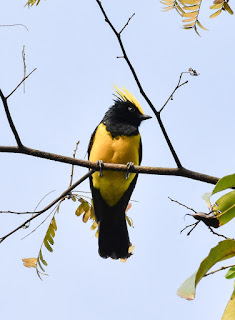
Sultan Tit


As we approached the road Laguna paused to listen.  He had detected an ominous sound in the forest.  About 50 feet away he saw a lone elephant feeding.  We backtracked and waited.  Had he detected us?  If he had he gave no alarm calls.  He moved off slightly and we quickly passed with hearts racing.  We reached a dry river bed where a second Northern Red Muntjac spotted us and moved nimbly off through the rocks.  We reached the road and breathed a sigh of relief.  At least here it was more open and you could see elephants.  We returned to camp around 8:00 where Ramu was preparing breakfast.

Ramu Preparing Breakfast

After resting during the day we headed out around 4:00 for our second night drive.  Just as soon as it got dark the action started.  We spotted a Common Palm Civet posing nicely in a tree above us.

Common Palm Civet

Laguna spotted what he thought was a Slow Loris.  When we stopped to take a closer look, Avi thought it was another Common Palm Civet but something didn't look quite right.  After careful inspection after the arboreal creature moved into a better position, Avi could make out it was a Binturong!   It is uncommon in much of its range, and is listed as vulnerable by the IUCN due to its declining population  (30% over the last three decades).  The Binturong is the only Old World mammal and one of only two carnivores with a prehensile tail (the other is the kinkajou).

Binturong!

On our epic night drive we also saw Sambar and Northern Red Muntjac, Wild Boar, Elephants, Gaur or Indian Bison and Avi spotted the eye shine of a tiger some distance away!

Gaur

We didn't return to camp until 11:15 and had a very late dinner of noodles.  It had been a very long but exhilarating day!

The next morning we headed out at 6:30 for Upper Dekorai Camp.  We saw some beautiful Scarlet Minivets along the way.


Scarlet Minivet

At Upper Dekorai, Chestnut-headed Bee-eaters were swooping along the cliffs high above the river.


Chestnut-headed Bee-eaters


We kept talking about moving to this more comfortable camp but Nameri East had become our home and the forest guards and mahouts our family.  Back at camp I sat on a bench overlooking the floodplain of the river.   I could see a herd of elephants approaching, first 6, then 2 more and finally 2 more for a total of 10!  


Herd of Wild Asian Elephants Approach

They were here for the salt.  At one time there was a natural salt lick here but now Dharmasour, the head mahout, threw supplemental salt down to them.  Everyone from camp was out to see the elephants.  It was thrilling to watch wild Asian elephants at such a close distance but we were 40 feet above them and perfectly safe.  After about 30 minutes they disappeared back into the forest.

Watching the Elephants!


Elephants at the Salt Lick

Our late afternoon game drive was cut short by thunderstorms.  We returned sullenly back to camp where Konwar made us French fries to cheer us up.    What a scene! The guys were huddled around the fire in our cozy camp protected from the storm.

Cozy Campfire
Fortunately, the storms cleared and we were able to do a night drive.  The recent rain turned out to be a gift as it brought out some new mammals.  As were we turning around in a dry river bed, I spotted a Chinese Pangolin scurrying across the rocks!  Sadly, pangolins are the most heavily poached mammal in this area, so seeing one in the wild was a rare privilege.  I hope that humans will smarten up and stop hunting these amazing creatures before it's too late.

Chinese Pangolin!

The night also yielded Slow Loris, Sambar and Hog Deer, Common Palm Civet, Large Indian Civet, Malayan Porcupine and Himalayan Yellow-throated Marten.  What a night!

The plan was to leave Nameri East the following morning but we couldn't bring ourselves to leave this magical place so opted to stay one more night.  Yippee!


Nameri East Anti-Poaching Camp


In addition to seeing Pakke's amazing wildlife, spending time with the forest guards and mahouts was a real treat.  We got a full appreciation of the hard work they do to protect the park while living in very basic conditions.  Most of the patrols are done on foot but some are done on elephant back.  I wanted to pet Vijoya one of the camp elephants but was told by Amir her assistant mahout that she was too unpredictable and had killed 3 of her previous mahouts.  Yikes!

Amir with Vijoya
I will also miss the 3 camp cats, Gundha, Meow and Meekour.  They scurried around underfoot never allowing us to pet them.  Living in the jungle had made them semi-wild.


Gundha, King of the "Camp Cats"


Our last night and early morning drives did not yield any new mammals but we got better views of some we had already seen.  After spending 6 nights here, it was time to leave Nameri East.  We said our final goodbyes and thanked the team for a once in a lifetime experience to spend nearly a week at an anti-poaching camp in Pakke National Park!


Our Team at Nameri East (photo taken by Avijit Sarkhel)

We hope all is well back home,
Peggy and Marc


Map of Pakke National Park and our location at Nameri East Camp: