Showing posts with label Western Australia. Show all posts

Saturday, March 02, 2019

Dugong! Dugong!

Greetings Everyone,
We’ve driven 823 kilometers north from Perth to Shark Bay in the hopes of seeing a Dugong. We read that Shark Bay is one of the best places in the world to find these marine mammals resembling what many of us as know as a Manatee. We had booked a tour the following morning and set off early for the Monkey Mia Jetty. When we arrived, the Indo-Pacific Bottlenose Dolphins that frequent the bay were being fed by park staff and we went down to the beach to watch the show. Seven dolphins were eagerly waiting for fish. A woman gave a talk about the dolphins over a loudspeaker.

Indo-Pacific Bottlenose Dolphins

While watching the show, Marc got a call on his cellphone. Wildsights, the company conducting our dugong tour had just canceled because we were the only two signed up. Bummer, had we come all this way for nothing! We left the dolphin show and went to the gift shop to try and get on the other tour company’s (Perfect Nature Cruises) boat heading out at 10:30. Luckily they had space and I told Marc to go photograph the dolphins while I paid for the tickets. I returned to the show just as the volunteers were coming out to feed the dolphins. People are selected from the audience to feed them. I was chosen, even though I had pants on. I waded in to feed Puck, a female with a calf. I placed the fish in the water in front of her and she gently ate it.

Peggy Feeding a Dolphin

Following the dolphin feeding, we went to the jetty to board a large catamaran, the Aristocrat 2, for our dugong cruise. The water was very choppy and murky. “How were we to see Dugongs in these conditions?” I wondered. One of the deckhands said that the water was dark to a recent algae bloom. Normally it would be a clear emerald green instead of an inky blue. Finally, our deckhand spotted a Dugong off the starboard side. I caught a quick glimpse as we motored past. “I hope that wasn’t it?” I thought. We did find another Dugong with a calf and this time I could make out her head and nostrils when she came to the surface to breathe. 

Dugong

She was up for a few seconds before diving with a flip of her fluke-like tail.

Dugong Tail

We encountered another cow with a calf, seeing 5-6 Dugongs in all. Shark Bay is home to more than 10,000 dugongs, about 10% of the world’s population of this vulnerable species. This was an excellent time to see Dugongs in Shark Bay as they come here in the summer to enjoy the warm shallow waters of the inner gulfs.

On the way back we encountered a large pod of dolphins and they joined us to ride our bow wake. They swam back and forth from one pontoon to the other, sometimes swimming upside down and other times porpoising through the water. It was great fun to watch.

Dolphins in Our Bow Wake

On the drive back to Denham, we stopped to check out Francois Peron National Park. We could only drive as far as the Peron Homestead, a working sheep farm in the early 1900s, without a high clearance  4-wheel drive vehicle. On the way back we encountered a male Emu with 12 grown chicks! The males actually incubate the eggs and guard the chicks until they are up to 7 months old! 

Emu Family

We returned to the Peron Homestead at dusk to look for Common Wallaroos or Euros as they are called locally and to stay after dark to look for nocturnal mammals. As the sun set, we heard some stomping in the bushes, so we knew the Euros were around but they were playing hard to get. After dark Marc spotted an animal in the beam of his headlamp. It turned out to be a rather sizeable feral cat, the first one we encountered on this trip. There were also European Rabbits hopping around, so just introduced animals and no native ones.

We were up before dawn to visit the Peron Homestead to see if we’d have better luck with the Euros. Once in the park, we were very fortunate to come across a Woma Python crossing the road. These snakes have become critically endangered in the Wheatbelt area.

Woma Python

When we arrived at the Peron Homestead we finally caught a Euro in the open and Marc was able to get a great photo.

Common Wallaroo (Euro)

Along the trail to the bird hide, I spotted a Short-beaked Echidna, the first seen since we were in Dryandra Woodland a month ago.

Short-beaked Echidna

Since Wildsights canceled our Dugong tour yesterday, they booked us on today’s cruise. Fortunately, we had built a contingency day into our schedule and were able to go out again. When we arrived at Monkey Mia, both catamarans were moored. Would we go out today? A dingy motored out to our boat and it was brought to the jetty. We met Quinn our skipper and Toby our deckhand for the day's excursion on the "Shotover," once a racing catamaran in the ’70s.

The "Shotover"

Toby gave us a safety briefing and we were on our way. Quinn said it would be an hour before we reached the outer seagrass beds where the Dugongs had been feeding a few days earlier. We entered the “hot zone” and scanned the inky waters but there were no Dugongs in sight. Finally, Toby exclaimed, “Dugong! Dugong!”. Everyone crowded to the front of the boat to watch the Dugongs come to the surface to breathe. They came closer to the boat than the ones we saw yesterday.

Dugongs

Dugongs belong to the order Sirenia or sea cows. The name Sirenia comes from Greek mythology meaning mermaid. Historical accounts of mermaids, reported by mariners, may have been inspired by Dugongs or Manatees. 


Dugong Tail

Mission accomplished! We saw Dugongs on not one but two excursions into Shark Bay. What a rare treat to see these mythical creatures in their natural habitat. It was now time to begin the long drive back to Perth.
We hope all is well with everyone.
Peggy and Marc


Friday, February 22, 2019

Shark! Shark! No, it's a Dolphin!

Greetings Everyone,
From the Albany area on the southern coast of Western Australia, we continued west toward Margaret River. We made a stop at Walpole-Nornalup National Park to visit the Valley of the Giants. A 130-foot high walkway had been constructed so you could get a bird’s eye view of these towering trees.

Tree Top Walk

They are a species of Eucalyptus called Red Tingle (Eucalyptus jacksoniiand can grow to a height of 180-feet and live as long as 400 years!

Red Tingle Tree

We reached the bustling town of Margaret River in the afternoon and located our accommodation, Bussells Bushland Cottages, about 4 kilometers away. We settled into our cottage nestled among native bushland for a 4-night stay.

Our Cottage Near Margaret River

After dinner, we headed out for a night walk on the nearby trails. We saw Common Brushtail and Western Ringtail Possums, but unfortunately, we didn’t find a Brush-tailed Phascogale.

Common Brushtail Possum

The next day we followed Caves Road south to explore some limestone caves found in the area. We stopped at the first cave, Calgardup and decided to visit it. We were given helmets and lights for the self-guided tour. The formations weren’t spectacular. At one section there was a low roof which forced us to crouch for 10 meters but it was nothing extreme, and we really didn’t need helmets.

Going Low Inside Calgardup Cave

The next cave was called Mammoth owing to some enormous chambers. It was also a self-guided tour, but the cave was lit up so we didn’t need lights.

Mammoth Cave

Our final cave was called Jewel Cave where we had to wait 20 minutes to go on a guided tour. You’re not allowed to go into this cave unguided. As we entered the cave our guide warned us about high CO2 levels and that we’d have to climb 500 stairs. This cave was discovered in 1957 and was opened to the public in 1959. It was the most impressive with a lot of calcite formations including the longest straw formation in any Australian cave. It was 5.4 meters long and was formed drop by drop over many years.

Straw Formations

There were formations resembling coral, organ pipes, popcorn or cauliflower. There was a huge area of flowstone that resembled a karri forest and a massive stalagmite weighing some 20 tons!

Calcite Formation

Our next stop was Cape Leeuwin Lighthouse. When we arrived the last tour was in 5 minutes and we rushed off to the lighthouse where Ron, our guide, and another couple were waiting.

Cape Leeuwin Lighthouse

The tour allowed us to go inside the lighthouse and to climb the circular staircase to the top. Cape Leeuwin Lighthouse was built in 1895 to prevent further shipwrecks on the point where the Southern and Indian Oceans meet. Near the top was the chariot, the wheeled carriage at the bottom of the Fresnel lens assembly which allowed the lenses to rotate around a circular iron track. The lenses magnified the light from ~20 LEDs, allowing the light to be seen 40km away!

LED Lighthouse Light

Ron opened the door and allowed us to go outside on the deck. The wind was blowing so hard we could barely make our way around the lighthouse.

Peggy on the Lighthouse Deck

The view was stupendous over the boiling Southern and Indian Oceans.

Southern Ocean (left) and Indian Ocean (right)

On the way back to our car a snake crossed our path. It was probably one of the venomous ones that the signs posted on the lawns warned visitors about. We asked the guy in the gift shop and he confirmed it was a Dugite (Pseudonaja affinis). The venom of the Dugite is potentially one of the most lethal in the world but they are not aggressive and tend to avoid humans. 


Dugite 

We stopped at Cozy Corner to have a picnic supper and to watch the sunset over the Indian Ocean. We decided to return to Bussells Bushland by way of Boranup Road so we could do a bit of spotlighting for nocturnal animals. We saw Common Brushtail and Western Ringtail Possums and our second snake of the day, a South-western Carpet Python.

South-western Carpet Python

The following day we chose to visit the Eagles Heritage Raptor Center, a facility that’s involved with the conservation and rehabilitation of injured raptors. We walked the 1-kilometer trail with cages containing various eagles, hawks, and owls in them. We arrived at the area where at 1:30 a flight display was to take place. The owner of the center came carrying a Barn Owl on his gloved arm. Her name was Ivy and she was born and raised at Eagles Heritage. She’s now 4 years old and her keeper explained all about her uncanny sense of hearing and eyesight. After he allowed us to hold her. It was a thrill to hold such a beautiful and gentle owl.

Peggy with a Barn Owl

Ivy was returned to her cage and the owner let three Black Kites out of their cage. They flew around but seemed under his voice control. I’ve never seen birds kept in captivity exercised this way. The owner went on to explain that these kites are persecuted because it’s believed that they kill chickens. They are often referred to as chicken hawks but they eat insects and mice. He tossed them bits of food which they caught midair in their talons and Marc was able to capture a stunning photo.

Black Kite Catching a Morsel

We had read that Indo-Pacific Bottlenose Dolphin often visit the bay around Bunbury so we made the 1-hour drive north the next day to search for them. We ended up at Leschenault Waterways to look for them. We walked a 1-kilometer causeway that led out into the bay, perfect for spotting dolphins but we saw none. We did see a lot of birds; cormorants, darters, herons, pelicans, gulls, and a Black Swan.

Australian Pelicans

Marc called the Dolphin Discovery Center and they said the dolphins were there! We rushed off but by the time we got there maybe 10 minutes later they had moved off. To add insult to injury, we found out that the only boat tour to see the dolphins had left about 45 minutes ago. A couple of volunteers suggested we visit “The Cut” to see them and one volunteer gave Marc a map on how to get there. Before leaving, I bought tickets for tomorrow’s boat tour, the only sure way to see the dolphins. We drove around to “The Cut” where a few other people were looking for dolphins. Sure enough, they were there but were far away. We spent a couple of hours hoping to get a better view but we saw mostly dorsal fins.

Dolphin Dorsal Fin

We returned to Bussells Bushland and that night I went out to inspect the West Australian Peppermint Trees Near our cabin. The leaves are the favorite food of the critically endangered Western Ringtail Possums. I spotted two feeding on leaves in the upper branches!

Western Ringtail Possum Near Our Cabin

We left Bussells Bushland in time for our noon dolphin tour in Bunbury. We boarded the boat from the beach and stayed near shore while the captain gave us an informative talk about the dolphins. He confirmed that these are Indo-Pacific Bottlenose Dolphins, a different species than the Common Bottlenose Dolphin. A resident pod of about 50 have been studied in the bay for 20 years. We headed for “The Cut” where the dolphins tend to hang out and a pod was there frolicking in the water. A little boy on board kept crying “Shark, Shark!”. Their dorsal fins did look a bit shark-like. They approached our boat and we got excellent views and photos. 

Pod of Dolphins

We spent about 45 minutes with the dolphins. Toward the end of our tour, a newborn calf with its mom finally revealed itself. At this time of year, the dolphins are breeding and giving birth.

Mother and Calf

We returned to shore and continued our drive to Mandurah where we stopped to visit our friend Sue before continuing north to Eglington our final destination.

We hope all is well with everyone.
Peggy and Marc

Our route map:


Monday, February 18, 2019

Mission Honey Impossumable!

Greetings Everyone,
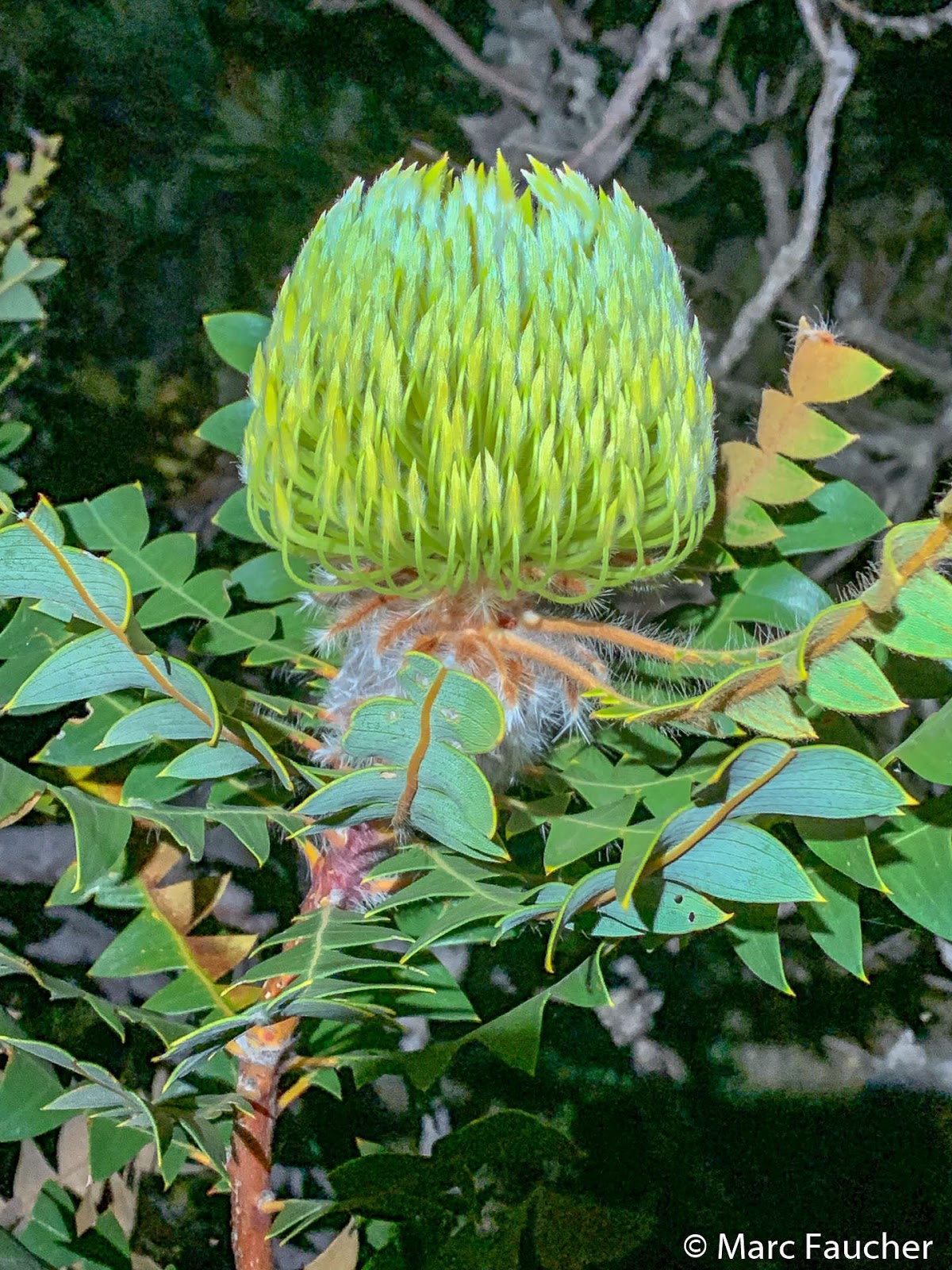
After our wildly exciting visit to Bremer Bay to see Orcas, we headed west along the southern coast of Western Australia. Our next stop was Cheynes Beach, a small coastal settlement surrounded by Waychinicup National Park. We had read that Cheynes Beach is a great place to search for Honey Possums. These tiny marsupials feed exclusively on nectar and require a year-round supply. At Cheynes Beach different species of Banksia boom at different times of the year providing a constant amount of nectar. This time of year, the Bird’s Nest Banksia were in bloom and we spent the day scouting likely places to look for Honey Possum tonight. 


Cheynes Beach

As dusk approached, the Western Grey Kangaroos emerged to graze on the lawns around our cabin. One female had a very large joey in her pouch. He didn’t look very comfortable, time to strike out on your own!


Western Grey Kangaroo and Joey

After dark, we donned our headlamps and went off to search for Honey Possums. We had found two large groves of Banksia that looked particularly promising, but we scanned each bloom to no avail.


Bird's Nest Banksia in Bloom

The next morning we were up early to do a bit of birding. Cheynes Beach is a good spot for the extremely rare Noisy Scrub-bird. We didn’t find the Noisy Scrub-bird, but we did see some Rock Parrots. 


Rock Parrot

Sadly we only had one night here and continued west toward Emu Point. We made a stop at Little Beach in Two Peoples Bay Nature Reserve, it was an idyllic spot with an isolated white sand beach. 


Little Beach

We arrived at Emu Cottage and settled in. Built around 60 years ago, it is one of the only original beach cottages in the area. 

That evening we drove back to Two Peoples Bay Nature Reserve to look for nocturnal animals. We had read that the picnic area near the visitors center was a good place to find Quenda and Quokka. We arrived before dusk to stake out the territory in our car. Sure enough around 7:15 a Quokka emerged from the bushes. But when we got out of our vehicle to get a closer view it bounded off. We’d have to rethink our stakeout strategy. We walked to the visitors center spotting a Western Ringtail Possum and Motorbike Frogs on the road. When we got back to the picnic area, we found not one but three Quokkas! They appeared to be a female with two joeys, but Quokka give birth to only one young at a time. The youngsters scurried back into the bush, but mom remained long enough for Marc to get a photo.

Quokka

We drove up to Little Beach. As we were entering the parking lot, Marc said there was a Quenda on his side of the car. I couldn’t see it but told Marc to get a photo. Unfortunately, the flash scared it off, and I never saw the animal. Not expecting to see an animal in the parking lot, Marc had the wrong setting on his camera, and the photo was overexposed. When we returned to Emu Cottage, Marc put the image on his laptop. We couldn’t make out what the animal was, but it wasn’t a Quenda. Two Peoples Bay is home to Australia's most threatened mammal and one of the rarest animals in the world, the Gilbert’s Potoroo (Potorous gilbertii). This potoroo was thought to be extinct until the population at Two Peoples Bay was discovered in 1994. It is estimated that there are fewer than 40 individuals left in the wild. Could this mystery animal be a Gilbert’s Potoroo?!! Marc tried several software techniques to improve the quality of the photo. We’re leaning toward Quokka. What do you think?

Gilbert's Potoroo?

The following evening we returned to Two Peoples Bay to look for the Quokkas again. This time we conducted the stakeout from a bench in the picnic area. The Quokkas appeared very close by but behind us so Marc couldn’t swing around for a photo without frightening them off. Foiled again. We went for a walk and when we returned the Quokkas had re-emerged, and Marc was able to get a great photo of mom with her joey.

Quokkas

As we were returning to our vehicle, Marc spotted two Western Ringtail Possums in a tree next to the carpark. These critically endangered marsupials posed in the open for a terrific photo.

Western Ringtail Possums

We drove back to Little Beach hoping to get another view of the mystery animal, but the parking lot was empty.

The next day we explored nearby Torndirrup National Park. The draw here is the coastal scenery and some unusual rock formations. First, we went to the Natural Bridge Viewpoint. The bridge was formed over millions of years by the penetration of groundwater into the joints of the gneiss. The joints widened to eventually form blocks which fell into the sea completing the formation of The Natural Bridge.

Natural Bridge

We moved on to The Gap. A viewing platform had been built 40m above the Gap. A grated floor allowed you to look at the pounding surf below which gradually eroded away the granite in this location.

The Gap

We drove to the end of the road to the site of Albany’s Historic Whaling Station. The Cheynes Beach Whaling Company was the last whaling company to cease operations in Australia, closing in 1978. It’s a morbid place with the whale chasing ship, the Cheynes IV complete with its harpoon mounted on the front and the big oil tanks and boilers. A staggering total of 1136 Humpback Whales and 14,695 Sperm Whales were caught from the station between 1952 and 1978! Sadly, a few countries still conduct this barbaric practice.

Whaling Ship

I was more interested in seeing the 22 m (72-foot) Pygmy Blue Whale skeleton on display. The whale presumably died of natural causes in Princess Royal Harbour in 1973. The station was still operating so the whale was towed to the whaling station, flensed and buried with the intention that it be displayed in the future. It’s the only way to get a feel for how massive Pygmy Blue Whales are!

Pygmy Blue Whale Skeleton

That evening we decided to drive the hour back to Cheynes Beach to give the Honey Possums one more go. Scanning Banksia blossoms at night with a headlamp looking for a mouse-sized animal that disappears at the slightest disturbance may seem like a fruitless task, but we were willing to give it one last try. We arrived near dusk and waited for it to get dark before embarking on mission impossible. We scanned every Banksia bloom in the vicinity for eyeshine or the slightest movement but sadly come up empty-handed. We had to admit defeat and continue our journey to the west tomorrow.

We hope all is well with everyone.
Peggy and Marc

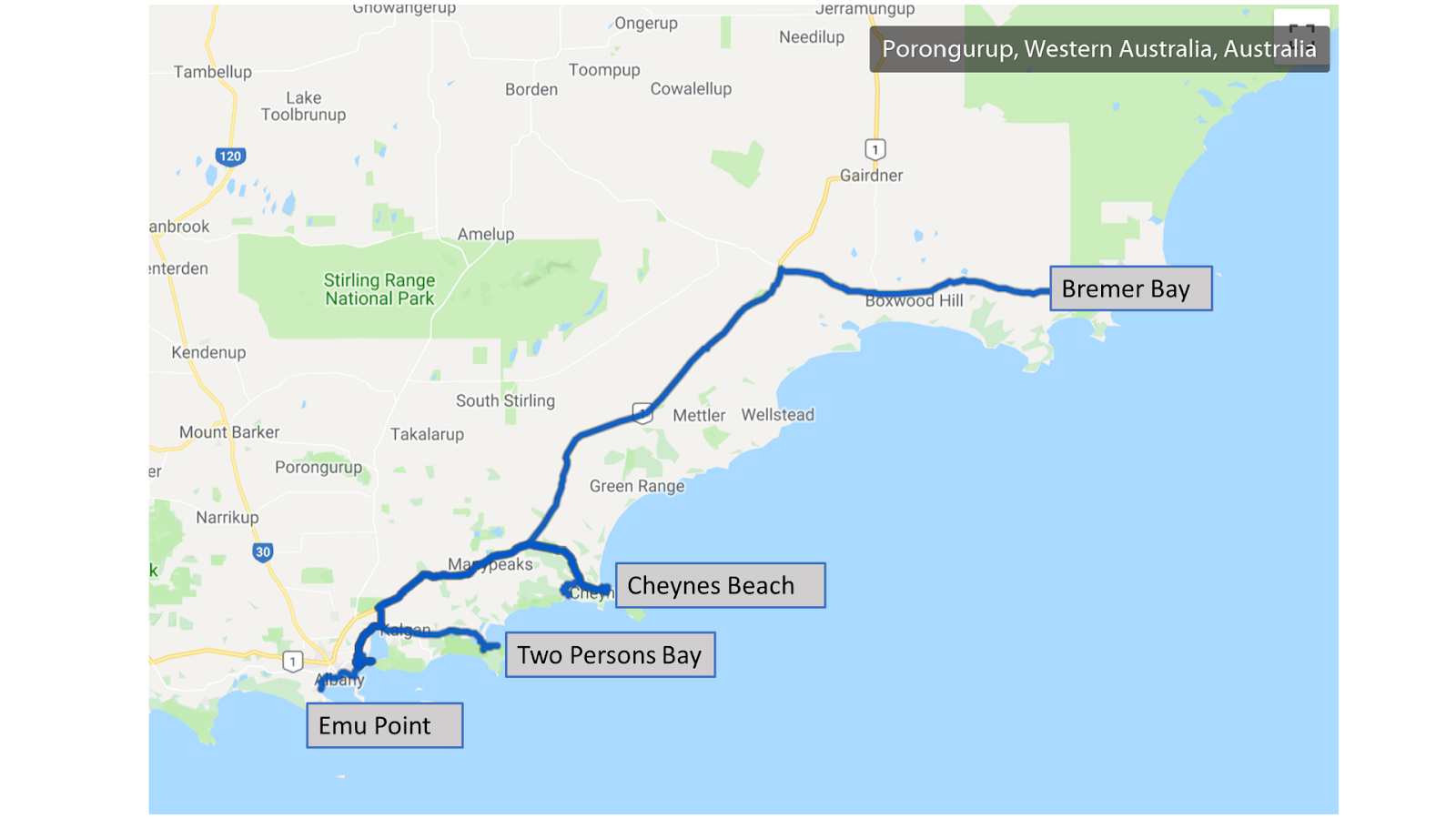
Our route map:


Thursday, February 14, 2019

Killers of the Deep!

Greetings Everyone,
We’re in Western Australia exploring diverse habitats and looking for rare and endangered animals. Our explorations have led to Bremer Bay, the farthest east we’d travel on this trip. We were drawn to this sleepy coastal town to see Orcas. We arrived around noon on February 11 and after lunch set off to explore nearby Fitzgerald River National Park. We decided to visit Point Ann. It was a long drive on a mix of paved and dirt roads. Along the way, we encountered a flock of ~20 Baudin’s Black-Cockatoos. This was the third species of black-cockatoos seen on this trip with the other two being Red-Tailed and Carnaby’s Black-Cockatoo. They were feeding on nuts that they were extracting from pine cones with their long bills. Like Carnaby’s Black-Cockatoo, Baudin’s Black-Cockatoo is endangered primarily due to loss of nesting and feeding habitat.

Baudin's Black-Cockatoo

We continued on our way entering the park and rattling down a dirt road with a deep washboard. We saw some interesting vegetation like Royal Hakea and Bird's Nest Banksia (Banksia baxteri) some of which was still in bloom.

Bird's Nest Banksia

Royal Hakea

We arrived at Point Ann and the place was pretty much empty. We walked the Point Ann Heritage Trail, a 1-km loop. Along the way were remnants of the No. 2 rabbit-proof fence built in 1905 to keep introduced rabbits from entering West Australia. The fence ran north from Point Ann, 1164 km to join the No. 3 fence northeast of Geraldton! At the time, it was the longest unbroken fence in the world. The fence was maintained until 1960 by boundary riders who used horses, camels or bicycles to monitor the fence. Following the introduction in the 1950s of myxomatosis, a virus used to control rabbits, the fence was no longer needed.


Remnants of No. 2 Rabbit Fence

We enjoyed sweeping views over Point Charles Bay. In the winter Humpback and Southern Wright Whales congregate here to give birth to their calves. Today the bay was empty.

Point Charles Bay

We were up early to have breakfast and to pack up for a day on the Southern Ocean. To see Orcas, you have to venture 24 nautical miles offshore to Bremer Canyon where Orcas and other marine mammals congregate this time of year. When we arrived at the dock, there was already a line waiting to board our boat.

Marc at the Whale Boat

We boarded around 8:00 and sat in comfortable seats in the front of the inside cabin where we were given a safety drill and information about the Orcas and canyon. Once underway we went upstairs and were standing on a deck outside the bridge. It was quite breezy and rough with 4-meter swells so we went inside and chatted with Jamie, the captain. After about an hour and a half, we reached the shelf and plunged over the edge into very deep waters of Bremer Canyon. Now we were in the “hot zone” for the Orcas. It wasn’t long before we encountered our first pod of Killer Whales! At first, it was just dorsal fins but then the Orcas began to reveal themselves. It was a thrill to see these majestic creatures for the first time. The pod had just made a kill, most likely a Beaked Whale and were feeding on the carcass below the surface. One Orca came alongside us with a big chunk of meat in his mouth. Brodee, the marine biologist on board identified him as the sub-adult male named Slater. It was the first time they had seen him this season.

Slater with Breakfast

Throughout the day we encountered at least three pods. The marine biologists on board are able to identify individuals by the shape of their dorsal fins, eye patch or saddle patch. The parts of an Orca are depicted in the following diagram from Punta Norte Orca Research.


Parts of a Whale @ Punta Norte Orca Research

One pod displayed extremely yellow pigmentation on their eye patches. It is believed that this coloration is caused by a diatom (single-celled algae ) infestation on their skin. Over the last few decades, researchers have described different forms of Orcas known as ecotypes. These ecotypes of Orca differ by size, prey preferences, foraging techniques, behaviors and they are genetically distinct and don’t appear to interbreed.  Brodee speculated that the pod with the yellow cast were Type B Orcas. When not in Bremer Bay, these Orcas forage for seals in the loose pack ice around the Antarctic continent where they pick up the diatoms. 

Orca Pair

Baby Orca

After a long 8 hours out at sea, it was time to return to Bremer Bay. We had such an exhilarating experience that we booked a second excursion for another fascinating day on the Southern Ocean. On our way to Bremer Canyon, we were fortunate to meet and talk to filmmaker Dave Riggs, the man responsible for discovering that Orcas visit Bremer Canyon and for getting the canyon protected as a marine park. The story began in 2005 when Dave was contracted by a Japanese tuna research vessel to observe marine wildlife. Dave noticed an unusual amount of activity in the vicinity of Bremer Canyon. The area attracted all sorts of marine life; Orcas, sharks, dolphins, Sperm Whales and giant squid, a real biological hotspot! Dave contacted the oil and gas company, Arcadia Petroleum, that was conducting seismic surveys in the area and they provided him with all the data they had collected. Ironically it was this data that confirmed Dave’s findings and helped to create the marine park thus preventing the company from drilling for oil. What an incredible turn of events! The story was so captivating that before we knew it, we had arrived at Bremer Canyon. To learn more about Dave go to his website at:


The Orcas were there to greet us. They were particularly friendly today cavorting around the boat and even swimming underneath us, belly up! The ship’s photographer, Machi Yoshida caught some great photos of us enjoying these close encounters.


Marc Lining Up an Orca Photo

Peggy Enjoying a Close Encounter

So why do Orcas and other marine animals come here this time of year? The answer is that leaking hydrocarbons provide a boost to the food chain. Bacteria convert these compounds to nitrates, the favorite food of phytoplankton which in turn feeds crabs, shrimp, and other shellfish. The eggs produced by these animals reach the surface this time of year when ocean currents weaken and schools of fish arrive to partake in the bonanza. They attract predators like tuna, sharks, squid, dolphins and at the top of the food chain, the Orcas! 


An Orca Blow

Orca Close Encounter

More Orcas

After watching the Orcas for a couple of hours, we went off in search of Pilot Whales. We didn’t find them but the ship's hydrophone picked up the clicking of a Sperm Whale far below the surface. On the way back to Bremer Bay, we stopped at Glasse Island to view the Australian Sea Lions, another new marine mammal species for us. These endangered pinnipeds have not recovered from the days they were hunted for their pelts, meat and for their blubber used to make oil.


Australian Sea Lions

What an incredible visit to Bremer Canyon. Not only were we able to see Orca on two excursions but we were privileged to meet Dave Riggs, the man who is responsible for making all this happen. A big thank you to Dave for all his hard work in protecting this magical place for the Orcas and for us lucky humans who venture here to see them!
We hope all is well with everyone.
Peggy and Marc

Our route map: