Showing posts with label Western Grey Kangaroo. Show all posts

Tuesday, February 26, 2019

Among the World's Oldest Fossils!

Greetings Everyone,
We’ve been exploring Western Australia for the past 6 weeks. Our journey has now taken us north of Perth en route to the town of Denham along the shore of Shark Bay. It was a long drive so we decided to break it up by making two stops. The first was Eglington from which we could easily visit Yanchep National Park. We had read that it was the best place to see Western Grey Kangaroos. Not that we hadn’t seen them in other locations but they are always fun to observe. It was midday and all the kangaroos were in hiding but there was a lot of bird activity. A large flock of Carnaby's Black-Cockatoo was noisily feeding in the trees above. There were Magpie Lark, Australasian Swamphen and Australian Wood Ducks on the lawn.

Australasian Swamphen

We walked around Loch McNess on the Wetlands Trail not seeing any mammals nor many birds during the heat of the day. However, we concluded it would be a good place for a night walk. There were information signs that Rakali or Common Water Rats are found here and it would be a new mammal for us. We headed to the Koala enclosure where we spotted 5 Koalas sleeping in the Eucalyptus trees. One was lower down and facing us so Marc got a good photo. Koalas aren’t native to Western Australia and these are the descendants of Koalas brought here in 1938 from the Perth Zoo. 

Koala at Yanchep National Park

When we returned to Yanchep around 6:00 pm, approximately 200 Western Grey Kangaroos had descended on the lawns to graze. A few tourists were still about to get selfies with the "roos". We walked to the lakeshore to look for Rakaki but saw none. We moved down the shore and sat on some stone steps to wait. There were a lot of water birds but sadly no Rakali. We remained until it got too dark to see and returned to our vehicle for a packed dinner. When it got dark, we set off on our night walk. We saw the eyeshine of many kangaroos but I noticed some very bright orange eyeshine. It turned out to be an introduced Red Fox. We caught a few more scavenging around the picnic tables, not a good thing for the native animals. We started on the Wetlands Walk seeing another Red Fox, the only mammal other than the kangaroos that we encountered on our disappointing walk.

Western Grey Kangaroo

The next day I got the bright idea to drive three hours east to Mt. Caroline Nature Reserve to look for Black-footed or Black-flanked Rock Wallabies. Mount Caroline Nature Reserve supports the largest known Black-footed Rock-wallaby (Petrogale lateralis) population in the central Wheatbelt. This species was critically endangered in the past and in 1979 the population size at Mt. Caroline was estimated at 9 individuals. Today they have rebounded due to the removal of Red Foxes and feral cats. When we arrived in the area, we found a cryptic map without road names. We drove around but couldn’t seem to get close to Mt. Caroline and the only road to it was to a farm. There was a sign saying that you needed to call to get permission to enter. Marc called the number on the sign and luckily someone answered and gave us the ok to drive to the reserve. It was now 2:30 and we decided to wait an hour for it to cool down. We followed the dirt track on foot for about 200 meters where we reached a rocky outcrop. Marc spotted at least 6 wallabies on the boulders above but I couldn’t see them at first! We climbed to where the Wallabies were but all but one had bounded off.


Black-footed Rock-wallaby

We returned to the road and walked to the end not seeing anymore. We climbed to an open rock area and scanned for wallabies seeing none. We returned to the area where we had first seen them and climbed above reaching another open rocky area with great views over the farm but no more wallabies.


View from Mt. Caroline

We spotted many Ornate Crevice-Dragons scurrying along the rocks. When they paused, they held their rear feet off the hot rocks.


Ornate Crevice-Dragon

We climbed to the top of the crest where we spotted the last wallaby we’d see bound off. We returned slowly to the car but by now it was nearing 6:00 and we needed to start the 3-hour drive back to Eglington.

The next day we continued our journey north making a detour to visit the Pinnacles in Nambung National Park. We set off on a 1.2-kilometer walk through the Pinnacles, an area with thousands of weathered limestone pillars. Some of the tallest pinnacles reached heights of up to 3.5 meters above the yellow sand base.


Pinnacles in Nambung National Park

We stopped in Cervantes for lunch at the Lobster Shack. We were curious to see how Australian Lobster would stack up to Maine Lobster. They are not a true Lobster lacking the big front claws but they were quite tasty.


Australian Lobster for Lunch

After lunch we continued our drive north to Geraldton, arriving mid-afternoon. We had booked the upstairs of a beachfront villa overlooking the Indian Ocean. It would be a great spot to hang out for two nights before resuming our journey.


Our Beach House in Geraldton

Our last big push north to Denham took us first to Kalbarri National Park. The draw here is the spectacular coastal scenery. Red Bluff was a windy spot with soaring views of red sandstone cliffs being pounded by the relentless Indian Ocean.


Red Bluff, Kalbarri National Park


Another major geological feature is the Murchison River Gorge which winds its way 80 km through the desert to reach the coast.


Murchison River Gorge

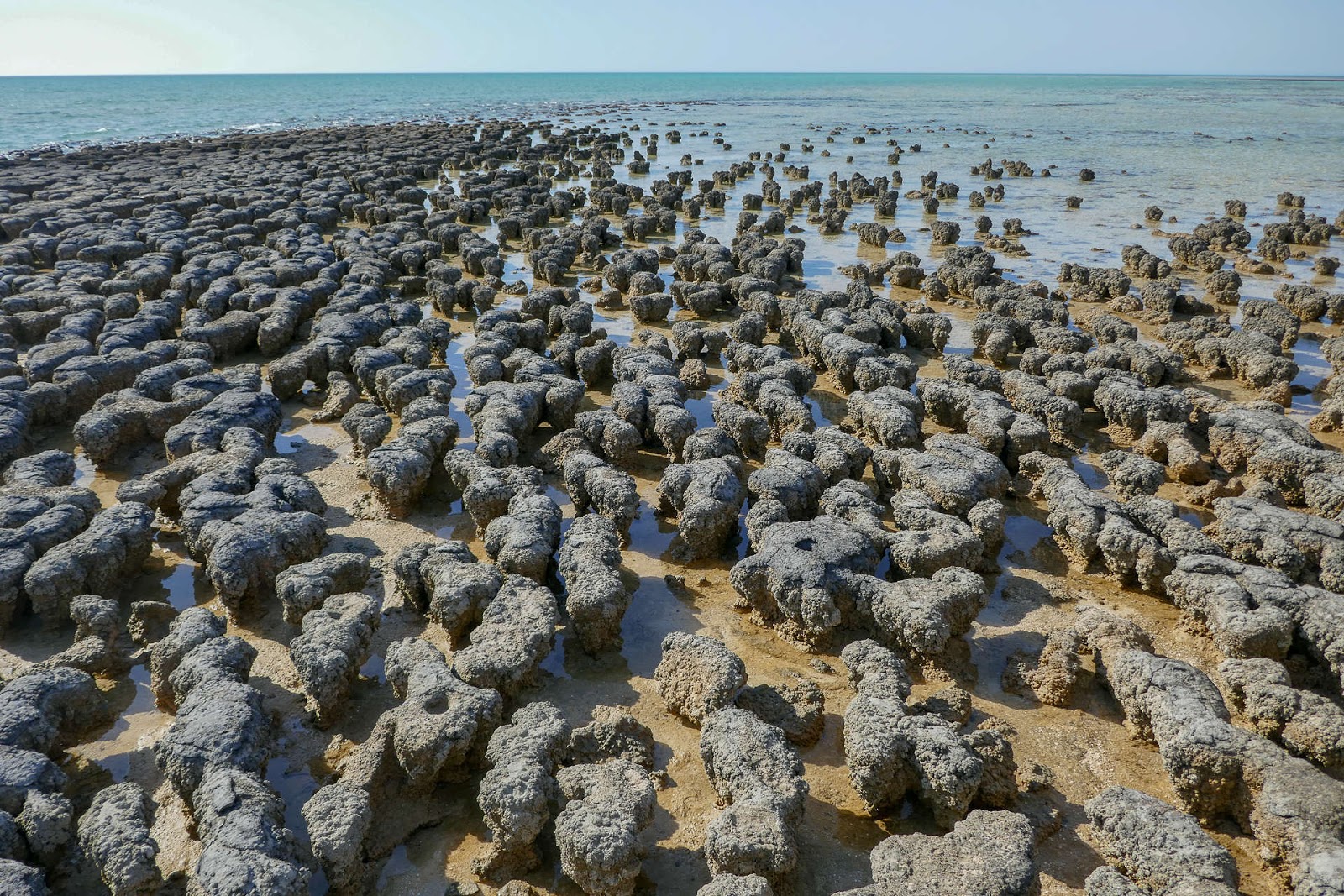
The last stop on our way to Denham was Hamlin Pool to see stromatolites. I had no idea what stromatolites were but they sure sounded interesting. We walked to a boardwalk built over the stromatolites which turned out to be microbial mats created by colonies of microbes called cyanobacteria (blue-green algae) which trap and bind sand and sediment grains. They didn’t look particularly attractive but they are remarkable for being found in the fossil record dating back 3.5 billion years and so are one of the earliest fossil evidence of life! What’s more, stromatolites are the reason life on this planet flourishes today. Before cyanobacteria, our atmosphere was only 1% oxygen. Then for the next 2 billion years, the photosynthesizing stromatolites pumped oxygen into the ocean. When the oceans’ waters were saturated, oxygen was released into the air. When the level reached 20% oxygen, life as we know it today, was able to exist and evolve!


Stromatolites

We continued our journey, arriving in Denham, the furthest north we’d venture on this trip, in the early evening. We’d have two days to find Dugong, the Australasian equivalent of the Manatee. Stay tuned to see if we are successful.
We hope all is well with everyone,
Peggy and Marc
Our route map:


Monday, February 18, 2019

Mission Honey Impossumable!

Greetings Everyone,
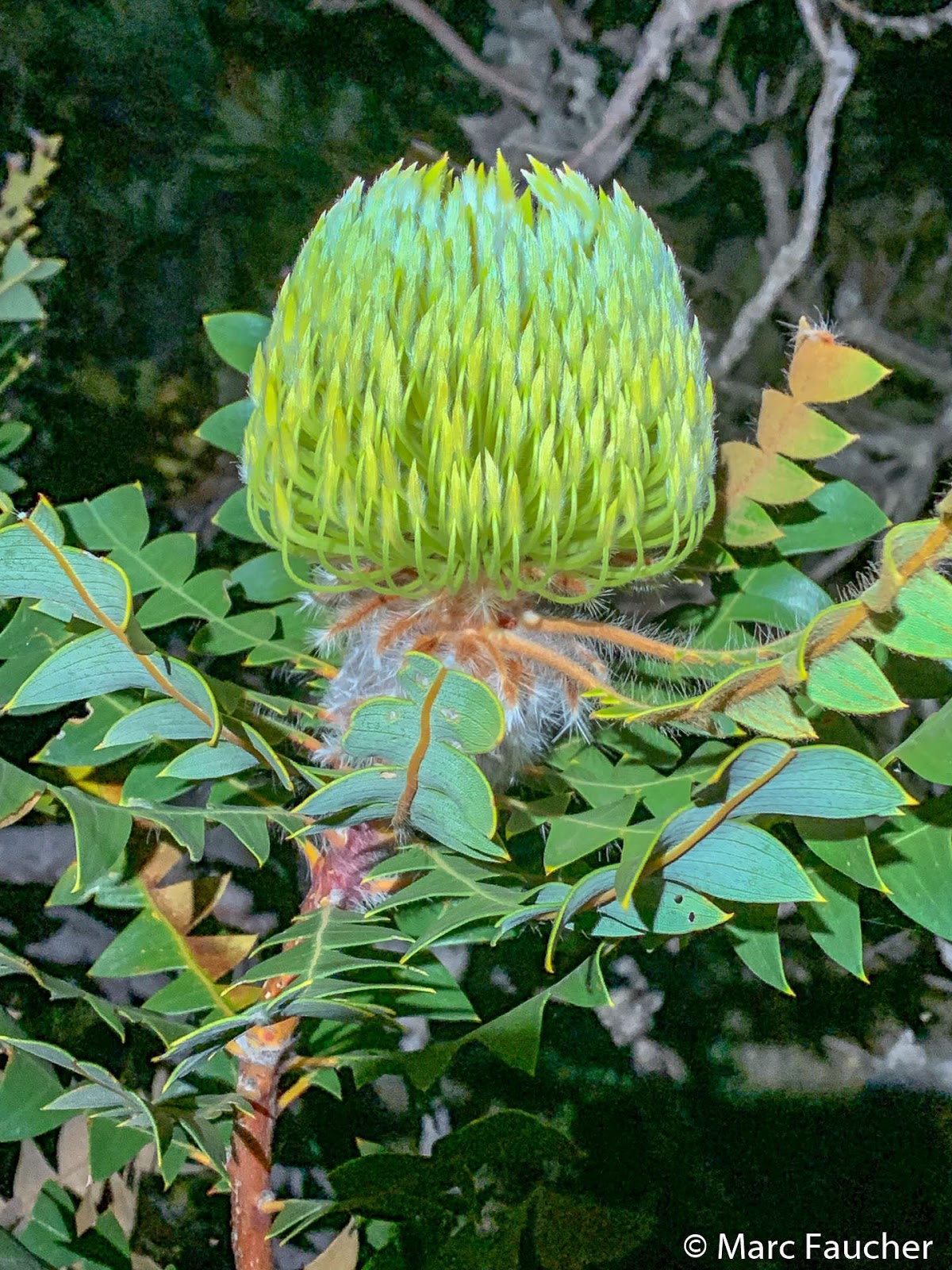
After our wildly exciting visit to Bremer Bay to see Orcas, we headed west along the southern coast of Western Australia. Our next stop was Cheynes Beach, a small coastal settlement surrounded by Waychinicup National Park. We had read that Cheynes Beach is a great place to search for Honey Possums. These tiny marsupials feed exclusively on nectar and require a year-round supply. At Cheynes Beach different species of Banksia boom at different times of the year providing a constant amount of nectar. This time of year, the Bird’s Nest Banksia were in bloom and we spent the day scouting likely places to look for Honey Possum tonight. 


Cheynes Beach

As dusk approached, the Western Grey Kangaroos emerged to graze on the lawns around our cabin. One female had a very large joey in her pouch. He didn’t look very comfortable, time to strike out on your own!


Western Grey Kangaroo and Joey

After dark, we donned our headlamps and went off to search for Honey Possums. We had found two large groves of Banksia that looked particularly promising, but we scanned each bloom to no avail.


Bird's Nest Banksia in Bloom

The next morning we were up early to do a bit of birding. Cheynes Beach is a good spot for the extremely rare Noisy Scrub-bird. We didn’t find the Noisy Scrub-bird, but we did see some Rock Parrots. 


Rock Parrot

Sadly we only had one night here and continued west toward Emu Point. We made a stop at Little Beach in Two Peoples Bay Nature Reserve, it was an idyllic spot with an isolated white sand beach. 


Little Beach

We arrived at Emu Cottage and settled in. Built around 60 years ago, it is one of the only original beach cottages in the area. 

That evening we drove back to Two Peoples Bay Nature Reserve to look for nocturnal animals. We had read that the picnic area near the visitors center was a good place to find Quenda and Quokka. We arrived before dusk to stake out the territory in our car. Sure enough around 7:15 a Quokka emerged from the bushes. But when we got out of our vehicle to get a closer view it bounded off. We’d have to rethink our stakeout strategy. We walked to the visitors center spotting a Western Ringtail Possum and Motorbike Frogs on the road. When we got back to the picnic area, we found not one but three Quokkas! They appeared to be a female with two joeys, but Quokka give birth to only one young at a time. The youngsters scurried back into the bush, but mom remained long enough for Marc to get a photo.

Quokka

We drove up to Little Beach. As we were entering the parking lot, Marc said there was a Quenda on his side of the car. I couldn’t see it but told Marc to get a photo. Unfortunately, the flash scared it off, and I never saw the animal. Not expecting to see an animal in the parking lot, Marc had the wrong setting on his camera, and the photo was overexposed. When we returned to Emu Cottage, Marc put the image on his laptop. We couldn’t make out what the animal was, but it wasn’t a Quenda. Two Peoples Bay is home to Australia's most threatened mammal and one of the rarest animals in the world, the Gilbert’s Potoroo (Potorous gilbertii). This potoroo was thought to be extinct until the population at Two Peoples Bay was discovered in 1994. It is estimated that there are fewer than 40 individuals left in the wild. Could this mystery animal be a Gilbert’s Potoroo?!! Marc tried several software techniques to improve the quality of the photo. We’re leaning toward Quokka. What do you think?

Gilbert's Potoroo?

The following evening we returned to Two Peoples Bay to look for the Quokkas again. This time we conducted the stakeout from a bench in the picnic area. The Quokkas appeared very close by but behind us so Marc couldn’t swing around for a photo without frightening them off. Foiled again. We went for a walk and when we returned the Quokkas had re-emerged, and Marc was able to get a great photo of mom with her joey.

Quokkas

As we were returning to our vehicle, Marc spotted two Western Ringtail Possums in a tree next to the carpark. These critically endangered marsupials posed in the open for a terrific photo.

Western Ringtail Possums

We drove back to Little Beach hoping to get another view of the mystery animal, but the parking lot was empty.

The next day we explored nearby Torndirrup National Park. The draw here is the coastal scenery and some unusual rock formations. First, we went to the Natural Bridge Viewpoint. The bridge was formed over millions of years by the penetration of groundwater into the joints of the gneiss. The joints widened to eventually form blocks which fell into the sea completing the formation of The Natural Bridge.

Natural Bridge

We moved on to The Gap. A viewing platform had been built 40m above the Gap. A grated floor allowed you to look at the pounding surf below which gradually eroded away the granite in this location.

The Gap

We drove to the end of the road to the site of Albany’s Historic Whaling Station. The Cheynes Beach Whaling Company was the last whaling company to cease operations in Australia, closing in 1978. It’s a morbid place with the whale chasing ship, the Cheynes IV complete with its harpoon mounted on the front and the big oil tanks and boilers. A staggering total of 1136 Humpback Whales and 14,695 Sperm Whales were caught from the station between 1952 and 1978! Sadly, a few countries still conduct this barbaric practice.

Whaling Ship

I was more interested in seeing the 22 m (72-foot) Pygmy Blue Whale skeleton on display. The whale presumably died of natural causes in Princess Royal Harbour in 1973. The station was still operating so the whale was towed to the whaling station, flensed and buried with the intention that it be displayed in the future. It’s the only way to get a feel for how massive Pygmy Blue Whales are!

Pygmy Blue Whale Skeleton

That evening we decided to drive the hour back to Cheynes Beach to give the Honey Possums one more go. Scanning Banksia blossoms at night with a headlamp looking for a mouse-sized animal that disappears at the slightest disturbance may seem like a fruitless task, but we were willing to give it one last try. We arrived near dusk and waited for it to get dark before embarking on mission impossible. We scanned every Banksia bloom in the vicinity for eyeshine or the slightest movement but sadly come up empty-handed. We had to admit defeat and continue our journey to the west tomorrow.

We hope all is well with everyone.
Peggy and Marc

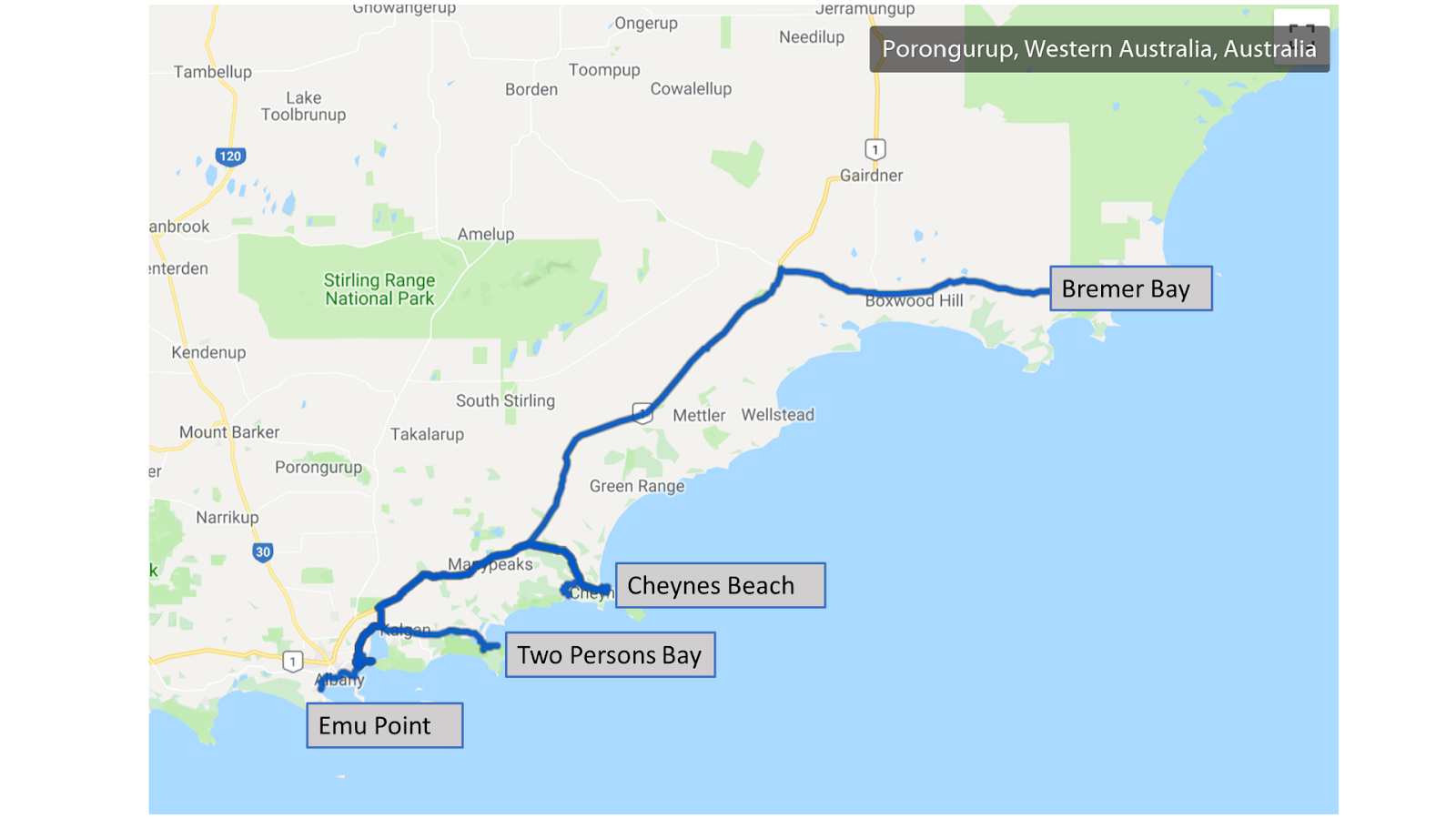
Our route map: