Showing posts with label Sri Lanka. Show all posts

Monday, March 03, 2014

The Largest Animal Ever to Have Existed!

Greetings All,
Our next hike took us through Sri Lanka's famous tea growing country.  Tea plantations were started by the British back in 1847 after their attempt to grow coffee failed due to a blight.  Today tea is still grown in the central highlands in terraced fields.

Tea Plantation

Sri Lanka is the world's fourth largest producer of tea and after Kenya it is the second largest exporter of tea.  The tea growing industry employs over a million people in Sri Lanka.  New green tea leaves are plucked by women who work in the fields 8 hours a day.  Our presence brought a welcome distraction to the monotony of picking tea and a smile to their faces when we stopped to photograph them.

Tea Picker

We stopped at our local guide's house for lunch.  He owns a small farm in the jungle and can grow just about anything.  In the garden around his house were cocoa trees, a few coffee bushes, pineapple, papaya, banana and palm trees.  He demonstrated how to climb a palm tree with just a rag tied around his feet.  He harvested a few coconuts before climbing back down.  He made it look easy but when Stewart tried it he only managed to get a few feet off the ground.  It takes a lot of strength and skill to climb a tree in this fashion.

Our Local Guide Climbing a Palm Tree

To husk the coconut he smashed it on a blade inserted into a wooden board that was stuck into the ground.  Once the outer husk is removed the brown circular coconut that we are all familiar with emerged.

Husking a Coconut


Our hike ended in the dry eastern lowlands where our van was waiting to take us to the beach.  We were all looking forward to some rest and relaxation.  When we arrived we found more of a fishing beach as opposed to a sun bathing and swimming beach.  This area was hit hard by the 2004 Tsunami.  Around 40,000 people in Sri Lanka were killed by this catastrophic event.  It was good to see that the area was recovering.

Beach at Argum Bay
 
The coastal wetlands and rice paddies are a haven for water birds.  We saw egrets, herons, spoonbills, cormorants, jacanas, ibis and stilts on our afternoon walk.


Black-headed Ibis
 
Near the start of our hike were the remnants of a building.  Asanga told us it was a government irrigation control center and that it had been destroyed by the Tamil Tigers during the civil war.  People in this area so feared the Tamil Tigers that they left their homes at night and hid in the forest. 

Government Building Destroyed during the Civil War

The Tamil Tigers were a separatist militant organization based in northern Sri Lanka.  Founded in May 1976 by madman Velupillai Prabhakaran, it waged a secessionist nationalist campaign to create an independent state in the north and east of Sri Lanka for the Tamil People.   This campaign evolved into the Sri Lankan Civil War which ran from 1983 until 2009, when Prabhakaran was killed by the Sri Lankan Military.  It was nice to see that peace and tranquility had returned to the area and that the locals no longer have to live in fear.

The next morning we started heading west back toward Colombo stopping near the town of Tissa  (Tissamaharama) for the night.  We got the opportunity to do one more game drive in Yala National Park. We divided into two jeeps and Marc, Asanga, John and I headed out in one.  This time we entered through the main south gate which was more crowded than the western gate we used 2 weeks earlier.  We were amazed at how much drier the park had become  The elephants were kicking the dry grass into balls and shaking out the dust before eating it.  I hope the animals can survive this drought.  We wondered if the rain we had in Arugam Bay would reach Yala.

Asian Elephant

We drove along the dusty roads with multiple jeeps behind and ahead of us.  At one point we broke away from the pack and came upon a single jeep watching a leopard sitting in a clearing about 200 feet from the road.  Our leopard luck had finally changed!  We were able to observe this beautiful female leopard for a few minutes before she got up and slinked back into the jungle.


Asian Leopard

Ironically, Arran, our guide from our first visit to Yala pulled up in another jeep just moments after the leopard had disappeared.  He was happy that we finally had a good sighting.  Timing is everything!

The next morning we visited the Katagarama Temple complex with Buddhist and Hindu temples and a mosque.  The devotees were preparing for the morning ceremony by bringing baskets of fruit and flowers to offer the deities.  All this uneaten fruit was attracting troops of gray langurs and even the odd cow or two.  At over 2200 years old, the giant white Kiri Vehera stupa was being decorated with a yellow, blue and orange ribbon symbolizing Buddhism while the devotees strolled around clockwise reciting prayers and leaving their offerings.

Kiri Vehera Stupa

We continued our journey toward Colombo stopping at a tiny restaurant for a drink.  A few days earlier Asanga had told us about watching for Blue Whales along Sri Lanka's southern coast.  I just couldn't get the thought of seeing a Blue Whale out of my head.  I asked Asanga where the best place to see Blue Whales was and he replied Mirissa Beach which we would arrive at around noon.  We told him to leave us there and we would delay our Sri Lanka departure for a day.  We were fortunate to get the last room at the hotel that offers whale watching tours and at lunch told the others in our group our plan.  They didn't blame us for wanting to stick around to see the whales.  We said our goodbyes and they headed off to Colombo to catch their flights home.

Early the next morning we headed out of Mirissa Harbor along with a dozen whale-watching boats.

Whale-Watching Boats in Mirissa Bay

We headed south away from the coast for around  9 km them headed east for another 6 km.  After about an hour and a half we still hadn't seen a whale and I began to worry that our change in plans was for naught.  Suddenly the whale-watching boats began to converge and we caught a glance of the spray from a whale before it submerged.  It looked too small to be a Blue Whale and turned out to be a Bryde's Whale, still a new species of whale for us.  We had one more sighting of a Bryde's Whale then headed out in search of the Blues.  Suddenly, our captain spotted the characteristic vertical single-column spout from a Blue Whale!

Blue Whale Spout

All the boats rushed to get a closer look.  You only have a few minutes to reach the whale before he dives again.

Watching a Blue Whale
 
You have to maintain a certain distance but we could see how massive a Blue Whale is.  At 98 feet in length and weighing up to 190 tons, a Blue Whale is the largest known animal ever to have existed!

The Small Dorsal Fin of a Blue Whale

Blue Whales dive up to 330 feet to feed on krill which they filter out of the water with their baleens.  They stay submerged for about 20 minutes then come to the surface to breathe.  When a Blue Whale raises his tail fluke you know he is diving and that the show is over.

Tail Fluke of a Blue Whale
What a grand ending to an amazing three weeks in Sri Lanka!

We hope all is well back home.
Peggy and Marc

Wednesday, February 26, 2014

Leech Zone, No Stopping!

Greetings All,
From Kandy we headed north to the Knuckles Range now part of a conservation area.  It had been dry prior to our arrival but the night before it rained.  Asanga our guide warned us the rain may have brought out leeches.  I hate leeches!  They crawl into your boots and inject an anesthetic before they bite so you don't know they're there.  They then inject an anticoagulant so that once bitten you continue to bleed for hours.  I wasn't too excited about the day's hike and sprayed my boots and socks with DEET to ward off the blood-sucking creatures.  After one last leech check we headed out.

Checking for Leeches

Most of the high mountain tops were obscured by clouds but we did get good views of the terraced rice paddies in the lower valleys.

Knuckles Mountain Range

At one point Asanga announces " We are entering a leech zone (a phrase I coined), do not stop.  If you stop to remove one leech, 3-4 more will attack you!".  I hightailed it through the leech zone and made it back to the village where our van was waiting.  When we arrived at camp we removed our boots and socks to assess the damage.  Marc had 5 bites on his ankle and one on his wrist (yes, they do climb up on your trek poles).

Marc Displays his Leech Bites

Stewart won the competition with 38 leech bites!  I tentatively removed my boots and socks.  Yippee, no bites!  Saturating my boots and socks with DEET worked.

The next morning we woke to clear skies and beautiful views of the Knuckles so named by the British as they resemble a clenched fist.

Knuckles Mountain Range

Everyone now sprayed their boots with DEET before our next hike.  Not long after heading out we encountered a troop of Purple-faced Leaf Monkeys in the treetops.  Endemic to Sri Lanka, these Old World Monkeys are wary of humans and it was difficult to get a good photo.  Marc managed to photograph a mother and baby when they paused in an opening in the forest canopy.


Purple-faced Leaf Monkeys

We also spotted Grizzled Giant Squirrels feeding in the canopy.  They appeared darker than their lowland cousins seen in Yala National Park.


Grizzed Giant Squirrel

We hiked down to the river which we crossed on a cement bridge and passed some village homes. The people living here are subsistence farmers growing rice, cardamon and other crops.  We stopped at a waterfall for lunch before returning to camp.  When we removed our boots and socks, we found no leech bites.  The others in our group sustained only a few bites.  DEET really works.

I'm sure some of you are wondering what does a leech look like and how big are they?  Asanga was brave enough to pick one up and hold it for me to photograph. 

Blood Sucking Creature

We left the Knuckles Range and drove to the village of Maskeliya at the base of Adam's Peak, our next hiking objective.  On the way we encountered more and more vans and buses along the narrow winding road.  At one point there was a standoff between us and a big red bus.  
 
Bus Standoff
 
The red bus won and we had to reverse to let it pass. "Where are all these people going", I asked Asanga. "To climb Adam's Peak" he replied.  I knew that the peak is held sacred by 4 religions and that many pilgrims make the climb but I wasn't prepared for this. From our hotel room we could see a mass of buses in the parking lot below.  
 
Bus Parking lot in Maskeliya
 
Asanga informed us that we would start our hike at 12:30 AM in order to beat the rush to the top for sunrise.  As we headed out we could see the trail and the temple on the top illuminated by lights.

Trail to the Summit of Adam's Peak

The route is lined by vendors selling everything from stuffed animals, silk flowers and food.

Vendor Stalls along the trail to Adam's Peak
 
We entered through a gate and continued up a series of steps.

Gate Leading to Adam's Peak

So far we managed to keep ahead of the crowd or so we thought.  As we climbed higher, we encountered more and more people.  Everyone was making the pilgrimage, old men and women, mothers and fathers carrying babies or leading toddlers by the hand, teenagers and of course us tourists.  About 300 vertical feet from the summit, we hit a wall of people.  It stretched as far as we could see into the darkness.

Throng on their way up Adam's Peak

The summit had reached capacity and now the trail had become backed up with thousands of pilgrims waiting to get to the top.  It had taken us one hour to climb 100 feet so we estimated that it would take us another 3 hours to reach the summit, well after sunrise.  We had no choice but to retreat as it would take hours to climb back down through the throng still on their way up.  We arrived back at our hotel at 6:00 AM.  We had to settle for a view of Adam's Peak at sunrise from our hotel room.

View of Adam's Peak at Sunrise

It was disappointing for us but more so for the locals that were also forced to turn back.  For us climbing Adam's Peak was a novelty but for the locals it is a true pilgrimage.  Buddhists believe that the footprint of Buddha is near the summit while the Hindus believe that it is the footprint of Shiva.  The Christians and Muslims believe that it is the footprint of Adam left when first setting foot on Earth after being cast out of the Garden of Eden, hence the name Adam's Peak.  Asanga estimated over 200,000 people attempted to climb the peak along with us.  

We left Maskeliya and drove to Nuwara Eliya, Sri Lanka's highest town where we spent the night.  The next morning we did a hike in Horton Plains National Park.  We stopped near the entrance to have our packed breakfasts.  There were a few Sambar stags hanging around waiting for a handout.  I refused to give over my breakfast and one of the stags stuck his tongue out at me.

Sambar Stag

Horton Plains National Park contains a mix of montaine grasslands and cloud forest.  The plateau is at an altitude of 6900 to 7500 feet and contains many species of endemic plants and animals.

Horton Plains National Park

As we entered the forest I could hear rustling in the trees.  A troop of endangered Purple-faced leaf Monkeys were feeding in the tree tops.  This is a different subspecies than the ones we saw in the Knuckles Range.  Here they are Trachypithecus vetulus monticola or Bear Monkey.  They have thicker coats and are missing the white patch on the rump of the lowland species. 

Bear Monkey

Our hike took us to two viewpoints along the edge of the plateau and to Bakers Falls.  As we were leaving the falls, a guide from another group pointed out a rare Rhino-horned lizard (Ceratophora stoddartii).  The males have a strange long, sharp horn composed of a single conical scale on the tip of their snouts.  Their horns are used to establish territory and in courtship.

Rhino-horned Lizard

We'll do a few more hikes in the highlands before heading to the beach for a little rest and relaxation.

We hope all is well back home.
Peggy and Marc

Monday, February 24, 2014

Temple of the Tooth

Greetings All,
We met our next trek group in Colombo on February 17 for a 2-week tour of the cultural and natural highlights of Sri Lanka.  We were joined by 5 folks from the UK and headed north to the town of Sigiriya.  Our first stop was the archeological site of Polonnaruwa, Sri Lanka's second capital city after the destruction of Anuradhapura in 993 CE.  Twenty-one kings reigned Sri Lanka from Polonnaruwa over the next 200 years.  The most famous king was Parakramabahu the Great who ruled from 1153-1186 CE.  He created a glorious garden-city with palaces, temples, monasteries, hospitals and dagobas (pagoda or stupa). The massive dagoba Rankoth Vehera is credited to King Nissanka Malla, a son-in-law or nephew of Parakramabahu the Great.

Rankoth Vehera

One of the more remarkable structures is the Vatadage, a circular stone shrine said to have been built by King Parakramabahu to enshrine the tooth relic of the Buddha.  There are four entrances to the second platform.  Stone steps with elaborately carved balustrades and statues lead to a stupa which once housed this most sacred relic.

Vatadage

The most impressive pieces of art from this period are the four gigantic Buddha images in the Gal Vihara.  They were carved right into the face of a large granite rock.  Here are two of the four images.

Gal Vihara

That afternoon we visited Sigiriya's most famous site, Lion Rock.  The story starts with King Dhatusena who had two sons and a beautiful daughter whom he loved very much.  To keep her in the family, he arranged a marriage with his sister's son, his nephew Migara.  One day his daughter came home with a blood-stained skirt.  She wouldn't admit it but the King knew she was being abused by her husband.  In retaliation, he had Migara's mother, his own sister, killed.  To get back at the King, Migara plotted to turn the King's younger son against him.  He convinced the younger son that if he wanted the throne, he'd have to kill his father and exile his older brother to India, both of which he accomplished.  The new King, Kashyapa, wasn't very popular for obvious reasons and needed a very secure place for his palace.  He chose Lion Rock for its strategic location and kicked out the monks who were living there. 

The Imposing Lion Rock

King Kashyapa ruled from this perch for the next 18 years (477- 495 AD).  His reign came to a fitting end when his brother returned from India with a massive army.  Kashyapa's army abandoned him during the battle and he committed suicide by falling on his sword.  Today you can climb stairs to the top of the rock. Along the way are some impressive murals of some very well-endowed ladies.

Mural, Lion Rock

Most have been destroyed or covered with painted floral designs by the monks who found them too distracting.  Near the top is the impressive Lion Gate.  All that remain are the beast's two front paws on either side of the entrance.

Lion Gate

Our last stop in the area was the Dambulla Cave Temple also known as the Golden Temple of Dambulla.  At the entrance a gold Buddha image towered over the temple.

Entrance to Dambulla Cave Temple

We climbed to five caves under a vast overhanging rock in the temple complex.  The first cave, the Cave of the Divine King, dates back to the 1st century.  The cave is dominated by a 14-meter reclining Buddha hewn out of the rock.

Buddha in the Cave of the Divine Kings

In the second and largest cave (which also dates back to the 1st century) are more than 50 Buddha images.  This is the Cave of the Great Kings.

Buddha Images in the Cave of the Great Kings

We left Dambulla and drove 72 km south to the city of Kandy.  In the evening we visited one of the most sacred Buddhist temples in the world, the Temple of the Tooth.  It is here that one of the Lord Buddha's canine teeth is enshrined. 

Monks outside the Temple of the Tooth

Monks conduct rituals three times a day: at dawn, at noon and in the evenings.  We had come to witness the evening ceremony.  It started with the beating of drums and the blowing of a horn.  We gathered around an inner shrine where I thought the ceremony would take place but most of the arriving pilgrims and tourists were headed up a set of stairs.

The Evening Ceremony Begins with the Beating of Drums

It turns out that the relic of the tooth of the Buddha was in a shrine on the upper level.  A long queue had formed to see the golden casket containing the tooth.  The door is opened and closed according to an astrologer.  We bypassed the queue and joined a mass of people trying to photograph the inner sanctum from a distance.  We were able to get a decent photo of the golden casket housing this most sacred relic.  We didn't get to see the actual tooth.  It is displayed to the public once every 5 to 10 years.  It was last shown in 2012 and 8 million devotees from around the world showed up to see it.  Some waited in the queue for weeks for their chance to see the tooth of the Buddha.

Golden casket Containing the Tooth Relic 

I still wanted to get a closer look so we worked our way into the queue and were able to pass briefly by the shrine.  I was caught up in the spiritual fever of being so close to relic that it brought me to tears.  I can't claim to be a Buddhist but the legend surrounding the relic is fascinating and the excitement of the devotees infectious.  When the Lord Buddha died in 543 BC, his body was cremated and four of his teeth removed.  One remained in India for 800 years but was smuggled to Sri Lanka for safe keeping as there were kings in India bent on destroying it.  It was hidden in the hair ornament of a princess and along with her husband they secretly brought it to Sri Lanka disguised as commoners.

What a fantastic start to our visit to Sri Lanka!  All the sites that we have visited are now UNESCO World Heritage Sites.  Tomorrow we head to the mountains for a bit of trekking to explore some of Sri Lanka's natural treasures.

We hope all is well back home.
Peggy and Marc     

Monday, February 17, 2014

Where Have all the Leopards Gone?

Greetings All,
After leaving Myanmar we flew to Colombo, Sri Lanka via Kuala Lumpur, Malaysia.  We had a few days before meeting up with our next trek group so we visited Yala National Park in southern Sri Lanka.  Yala is Sri Lanka's second largest national park and is said to have the largest leopard density in the world.  We set out to explore the park with our guide, Arran, hoping to find a lot of leopards to photograph.

There are plenty of other animals and birds in the park to enjoy.   Yala harbors 44 species of mammals and 215 species of birds including 6 endemics.  One of the first birds we encountered was this Malabar Pied Hornbill.

Malabar Pied Hornbill

We rudely interrupted two land monitor lizards in the process of mating.  They reared up on their hind legs and embraced lovingly or so I thought.


Land Monitor Lizards

There was a lot of hissing going on and when the male started getting rough, the female had enough and made a hasty retreat.  Yala is also home to herds of wild water buffalo.  Around the periphery of the park most of the water buffalo contain genes from domestic stock.


Wild Water Buffalo

The Little Green Bee-eaters were especially prolific.  They flitted back and forth across the road alighting on branches nearby which made for a great photo.


Little Green Bee-eater

There are four species of deer in the park.  By far the most common are the Spotted Deer.  This handsome buck posed nicely for us.


Male Spotted Deer

There are more than 90 species of waterfowl that inhabit Yala's wetlands.  We observed Cattle, Little, Intermediate and Great Egrets, Red and Yellow-wattled Lapwings, Gray heron, Black-headed Ibis, Indian Pond Heron, White-breasted Water Hen, Lesser Whistling ducks and this beautiful Painted Stork.


Painted Stork

The Asian Elephant herds of Yala number from 300 to 350 individuals.  Most of the males are tuskless owing to the British shooting out all the large males with tusks in colonial times.  We did spot Nalaka, one of the few males with tusks.

Nalaka, male Elephant w/Tusks

The breeding herds containing the females with calves were more difficult to spot.  They tended to stay hidden in the jungle.  One small herd of about 7 individuals came out of hiding for a mud bath.  The adults sprayed muddy water on their back to cool down.  A tiny calf tried to emulate mom without much success.  He had not yet mastered the numerous muscles in his tiny trunk.  When the herd left the waterhole we got a good photo.

Asian Elephants

Almost everywhere you look in Yala you see Peafowl.  One Peacock was doing his best to impress a Peahen.  His tail feathers were extended in a brilliantly colored fan which he shakes violently to attract her attention.  At first she seemed interested but soon turned away and strolled off.

Peacock Displaying

There are two species of monkey in Yala.  The Toque Macaque is endemic to Sri Lanka.  They hang around the rest stops looking for an opportunity to steal food.  We managed to hang onto our breakfasts.

Toque Macque

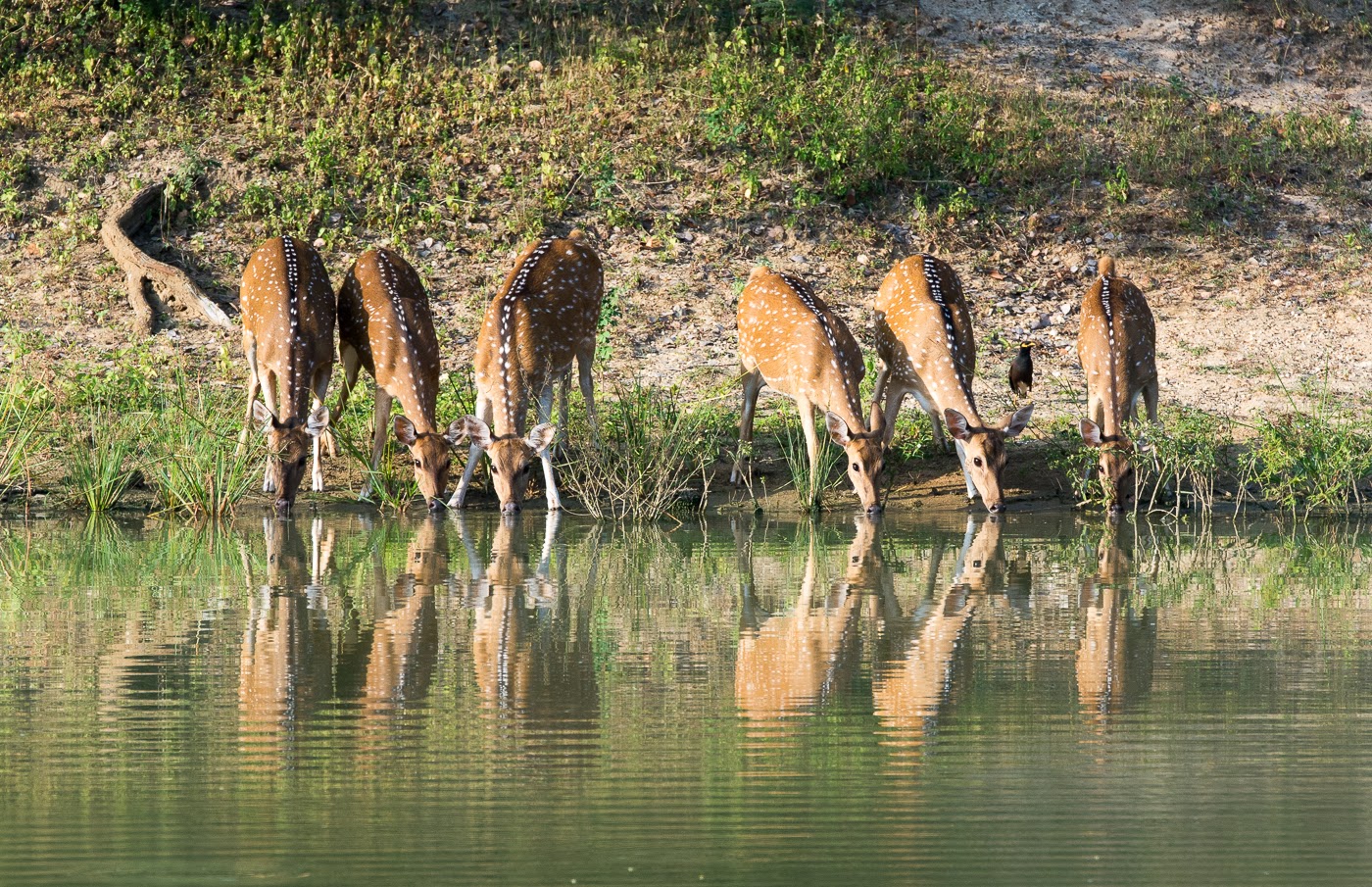
Not wanting to miss anything we spent two full days in the park.  It gets really hot around noon and the animals tend to be less active.  Most people take a break around midday and return to their lodgings to rest.  We found that you can still spot animals when they come to one of the park's many waterholes to drink.

Spotted Deer Drinking at a Waterhole

One of my favorite smaller animals was the Grizzled Giant Squirrel.  They are found only in Sri Lanka and India.  They are near-threatened due to hunting and habitat loss.

Grizzled Giant Squirrel

Another small mammal spotted at dawn and dusk is the common Black-naped Hare.

Black-naped Hare

We were nearing the end of our second full day in the park and had yet to see a leopard.  We were getting desperate.  Others staying at our camp were getting good sightings but we always seemed to arrive minutes too late.  We decided to bend the rules and stay in the park past sunset in the hopes of getting a sighting of one of the cats that had been eluding us the past couple of days.  One of the top guys in the wildlife department, Chandre, was with us so weren't too concerned about staying late.  He wanted to see a leopard as badly as we did.  Finally, success!  A beautiful female leopard slinked out of the jungle to get a drink at a nearly waterhole.  Despite being some distance away and the growing darkness Marc was able to get a descent shot.

Female Asian Leopard

Time to head out of the park before it got much darker!  Thank you Arran, Chandre and our driver Koshala for being so patient and willing to remain in the park for 13 hours two days in a row for us to get good sightings and photos of Yala's elusive inhabitants.

We hope all is well back home,
Peggy and Marc