Greetings Everyone,
From Ranthambore we were to take the night train to Katni and drive to Panna National Park, the third and final destination on our inaugural Vana Safaris Tour. However, our plans were to take an unexpected twist. We had found that our dear friend Saeedeh from Iran was coming to India on Nov. 1st. We had not seen her in 16 years! It didn't look like our paths would cross but Saeedeh would be arriving in Jaipur tonight, a mere 3-hour drive away. I told Avi that it was too bad that we wouldn't get to see Saeedeh. He said "Why not"? We discussed various options and came up with a plan to drive back to Jaipur to meet her, spend the night there, drive to Agra the following morning, take the direct flight to Khajuraho and drive to Panna. It meant a lot of changes and Avi set about to make it happen. I had already sent Saeedeh a message that we wouldn't be able to meet her. We sent multiple messages that our plans had changed and we were heading to Jaipur. Now all that was needed was for Saeedeh to get our message!
We arrived in Jaipur and still had not heard back from Saeedeh. Would she get our message in time? Finally, around 6:00 we got a response from Saeedeh. She would take a taxi to our hotel and join us for dinner. Yippee! While waiting for Saeedeh to arrive we watched a puppet show, sadly a dying art form in India.
 |
| Puppet Show in Jaipur |
Then there she was... Even after 16 years I recognized her immediately! We embraced for a long time and cried tears of joy. Even though we only spent a mere 10 days together back in 2000 it created a bond that has lasted all these years. We chatted for a bit and I showed Saeedeh photos from our 2000 trip. They brought back many happy memories. We had a traditional Rajistani meal and all too quickly Saeedeh had to return to her hotel. Oh what a magical evening it was!
 |
| Peggy, Saeedeh and Marc |
The following morning we drove to Agra where we caught a direct flight to the new airport in Khajuraho. It was a short drive to Panna National Park and we didn't waste any time before going on our first game drive. The Park is much like Gir with teak forest and tall grass and undergrowth - it was difficult to see animals here. We did see Spotted Deer, Sambar, Blue Blue, Wild Boar and Southern Plains Gray Langur but no new mammals. We had to be out of the park by 5:45 and went to nearby sanctuary called Jhinna. We were able to do a night safari in the sanctuary and saw Asiatic Jackals, Blue Bull, Indian Gazelle, Small Indian Civet, Common Palm Civet and Wild Boar.
 |
| Asiatic Jackal |
We were up early the next morning for our full-day safari inside the park. We saw a lanky Jungle Cat in the road but it disappeared in the grass before Marc could get a photo. We didn't see much except for the usual cast of characters: Blue Bull, Sambar, a large herd of Spotted Deer, Southern Plains Gray Langur and Peafowl, so we returned to the lodge around noon for a little break.
 |
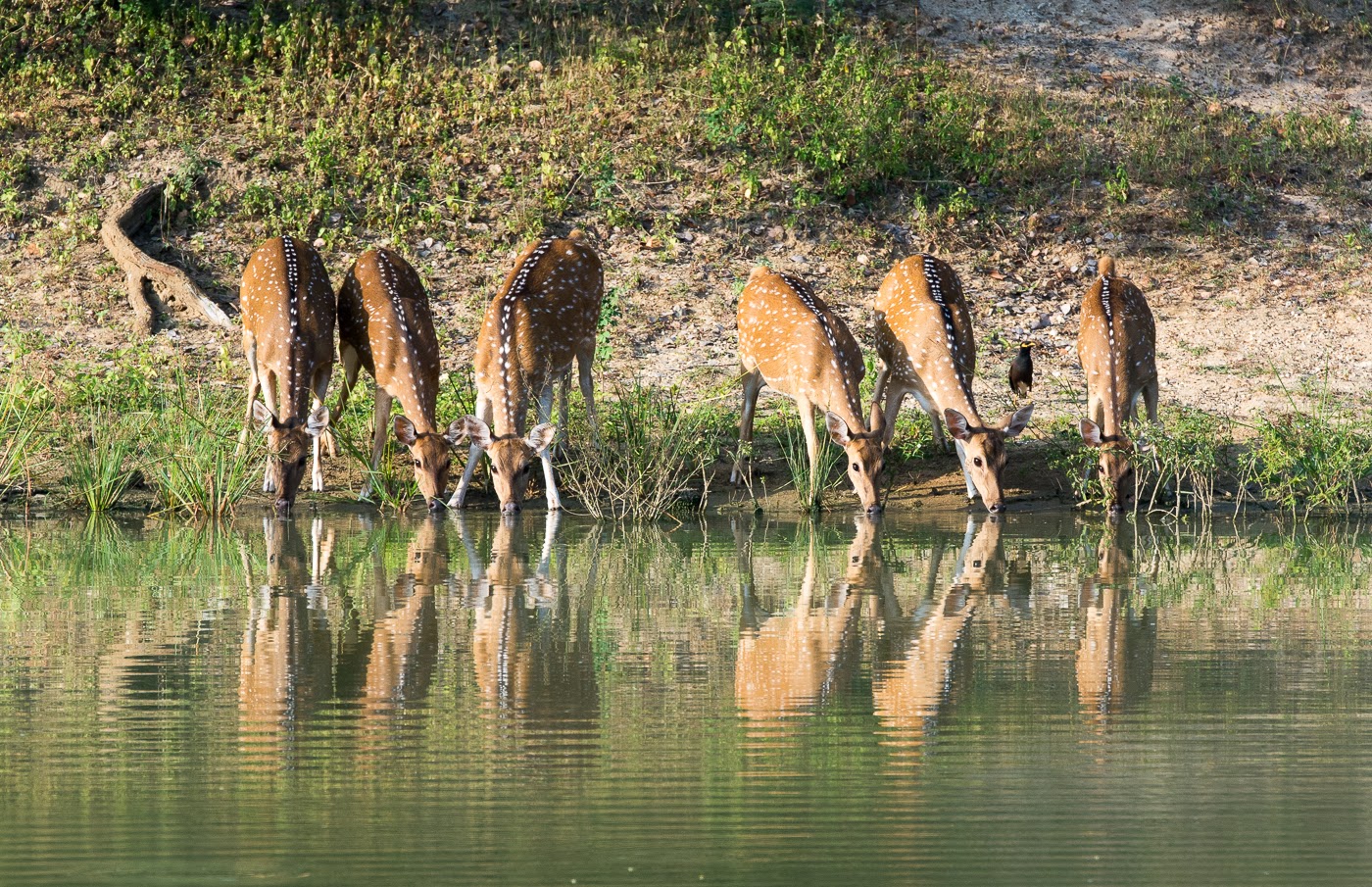
| Herd of Spotted Deer |
We returned to the park around 2:30 and I spotted a Common Cobra crossing the road. We learned that a jeep had seen a leopard kill a sambar in the morning and drag it up a steep bank but there was no sign of the leopard now.
The following morning we returned to the Park and got a call that a tigress designated as P142 or Rani had been sighted on top of the plateau. We raced off to see her. When we arrived there were about 8 jeeps already there. She was lying in the road and the jeeps were far from her.
We drove to the head of the line but I wanted to go closer. The other jeeps seemed afraid that she would charge. We did go closer and she got up and scent-marked a tree. We got to within 100 feet of her but she did not charge, instead she moved off into the tall grass.
 |
| Rani in the Road |
We drove to the head of the line but I wanted to go closer. The other jeeps seemed afraid that she would charge. We did go closer and she got up and scent-marked a tree. We got to within 100 feet of her but she did not charge, instead she moved off into the tall grass.
 |
| Rani Scent-marking a Tree |
Just 7 years ago there were no tigers in Panna National Park. They had all been poached out! In March of 2009, a tigress designated T1 was brought from Kanha National Park. Since then T1 has given birth to 5 litters of cubs! Rani is one of T1's daughters from her 4th litter. She is 26 months old and her designation P142 means:
P - born in Panna
1 - to T1
4 - in T1's 4th litter
2 - 2nd cub
Her father is T112, her half brother from T1's first litter. There are now 35 tigers in Panna so in 7 years, Panna went from 0 to 35 tigers! To read more about this incredible success story go to:
We left Rani and went off in search of more wildlife. Our forest guard spotted a leopard crossing the road. I completely missed it until he was in the tall grass on the side of the road. Marc got some photos.
 |
| Leopard in the Grass |
We returned to the lodge for brunch and one of the staff showed us some Lesser Short-nosed Fruit Bats roosting in a nearby clump of bamboo. Very cute!
 |
| Lesser Short-nosed Fruit Bats |
The park was closed on Wednesday afternoon so we left at 4:00 for Jhinna Sanctuary to spend the night. On the drive we saw 5-striped Palm Squirrels, Southern Plains Gray Langurs, Blue Bull, Indian Gazelle and a Sloth Bear sow with a cub! They were in the forest so we didn't get a clear view. We stopped at the camp for a nice dinner.
 |
| Camp Dinner |
After dinner we went on a night drive and saw Common Palm Civet, Asiatic Jackal and Indian Fox.
 |
| Common Palm Civet |
We were up early the following morning in order to leave at 4:30. As we were getting into the jeep we heard Blue Bull alarm calls close by. Not far from camp I spotted a leopard on the side of the road. He crouched, startled by the spotlight, but slinked off into the forest before Marc could get a photo. As we were looking for him we spotted another smaller leopard not far away. This must be a female, the mate of the male we had surprised. We were amazed at how close they were to camp, less than a quarter-mile away!
We left the Sanctuary and drove to Panna National Park for the morning safari. We saw all the usual characters: Wild Boar, Sambar, Blue Bull, Spotted Deer, Southern Plains Gray Langur and a magnificent Crested Hawk Eagle.
 |
| Crested Hawk Eagle |
At the junction of two roads we paused to check out a Sati Stone carved in the 10th Century. Sati is when a widow throws herself on the funeral pyre of her deceased husband, a tradition that thankfully is no longer practiced.
 |
| Sati Stone |
We returned to the lodge for brunch and a bit of rest before the afternoon safari. We had great views of Plum-headed Parakeets on the drive back to the Park.
 |
| Plum-headed Parakeets |
We spotted our 36th species of mammal on this safari, a Four-horned Antelope, and some of the usual: Southern Plains Gray Langur, Spotted Deer, Blue Bull plus one of our favorites, a Yellow-footed Green Pigeon.
 |
| Yellow-footed Green Pigeon |
We stopped in the vicinity of the tracker following Rani and the few jeeps that had gathered hoping for a view. While we were waiting we heard what sounded like a pig squeal. Had Rani just killed a spotted deer? Frustratingly we could see nothing in the tall grass.
We did our final safari in Panna the following morning. We didn't see any tigers or leopards just the regulars: Spotted Deer, Sambar and Southern Plains Gray Langur. A beautiful Indian Roller posed nicely in a nearby tree.
 |
| Indian Roller |
We were driven to the airport for the flight to Delhi where we spent our final night in India. The next morning we said a teary-eyed goodbye to Avi. We were so happy to be the first clients of Vana Safaris, the inaugural tour was a big success. We saw 36 species of mammal including 16 species that were new to us! We learned about some of the challenges of protecting wildlife and their habitat in a country with a burgeoning human population and met some conservation heroes. We were able to meet up with our Iranian friend Saeedeh after not seeing her for 16 years. Thank-you Avi and Monika for making all this happen. We wish you much success with Vana Safaris in the future. We look forward to our next adventure with you!
 |
| Peggy, Avi and Marc on Safari |
We hope all is well with everyone.
Peggy and Marc
Mammal List for Inaugural Vana Safaris Tour: Oct. 22 - Nov. 12, 2016
| No. | Species | Scientific Name | Notes |
| 1 | Gray Mongoose | Herpestes edwardsii | Gir, Rann of Kutch & Ranthambore |
| 2 | Southern Plains Gray Langur | Semnopithecus dussumieri | Gir, Ranthambore & Panna |
| 3 | Spotted Deer (Chital) | Axis axis | Gir, Ranthambore & Panna |
| 4 | Sambar | Rusa unicolor | Gir, Ranthambore & Panna |
| 5 | Blue Bull (Nilgai) | Boselaphus tragocamelus | Gir, Rann of Kutch, LRK, Ranthambore & Panna |
| 6 | Indian Leopard | Panthera pardus fusca | Gir, Ranthambore & Panna |
| 7 | Wild Boar | Sus scrofa | Gir, LRK, Blackbuck, Ranthambore & Panna |
| 8 | Five-striped Palm Squirrel | Funambulus pennantii | At Gir, Rann of Kutch, LRK, Ranthambore & Panna |
| 9 | Indian Hare (Black-naped) | Lepus nigricollis | At Gir, Rann of Kutch, LRK, Ranthambore & Panna |
| 10 | Greater Indian Fruit Bat | Pteropus giganteus | At Gir, Rann of Kutch, LRK & Ranthambore |
| 11 | Asiatic Jackal | Canis aureus | Gir, Rann of Kutch, Ranthambore & Panna |
| 12 | Indian Desert Jird | Meriones hurrianae | Rann of Kutch |
| 13 | Jungle Cat | Felis chaus | Rann of Kutch, Ranthambore & Panna |
| 14 | Little Indian Field Mouse | Mus booduga | Rann of Kutch |
| 15 | Grey (Asian) Musk Shrew | Suncus murinus | Rann of Kutch |
| 16 | Bengal (Indian) Fox | Vulpes bengalensis | Rann of Kutch, LRK, Ranthambore & Panna |
| 17 | Indian Desert Cat | Felis silvestris ornata | Rann of Kutch & Ranthambore |
| 18 | Pale Hedgehog | Hemiechinis micropus | Rann of Kutch |
| 19 | Greater Mouse-tailed Bat | Rhinopoma microphyllum | Rann of Kutch and Little Rann of Kutch |
| 20 | House Mouse | Mus musculus | Rann of Kutch |
| 21 | Rat ? | Rann of Kutch | |
| 22 | Indian Wild Ass | Equus hemionus khur | Little Rann of Kutch |
| 23 | Desert (White-footed) Fox | Vulpes vulpes pusilla | Little Rann of Kutch |
| 24 | Small Indian Mongoose | Herpestes auropunctatus | Little Rann of Kutch |
| 25 | Blackbuck | Antilope cervicapra | Blackbuck/Velavadar |
| 26 | Indian Grey Wolf | Canis lupus pallipes | Blackbuck/Velavadar |
| 27 | Ruddy Mongoose | Herpestes smithii | Ranthambore |
| 28 | Bengal Tiger | Panthera tigris tigris | Ranthambore & Panna |
| 29 | Chinkara (Indian Gazelle) | Gazella bennettii | Ranthambore & Panna |
| 30 | Common Palm Civet | Paradoxurus hermaphroditus | Ranthambore & Panna |
| 31 | Striped Hyena | Hyaena hyaena | Ranthambore |
| 32 | Rhesus Macaque | Macaca mulatta | Ranthambore |
| 33 | Small Indian Civet | Viverricula indica | Ranthambore & Panna |
| 34 | Sloth Bear | Melursus ursinus | Ranthambore & Panna |
| 35 | Lesser Short-nosed Fruit Bat | Cynopterus brachyotis | Ken River Lodge |
| 36 | Four-horned Antelope | Tetracerus quadricornis | Panna |
Key:
LRK - Little Rann of Kutch
Our route map:

Our route map: