Thursday, November 24, 2016

Tiger! Tiger!

Greetings All,
We're on the second third of our safari with Avijit Sarkhel of Vana Safaris.  Our travels have taken us from the state of Gujarat to the neighboring state of Rajasthan by way of Jaipur.  A 3-hour drive brought us to the city of  Sawai Madhopur on the edge of Ranthambore National Park.  We had visited this Park back in 2004 and I must admit I was a little wary about returning.  We did see tigers on our first visit but only after booking a jeep safari.  We didn't realize that the standard safari involved riding in a canter, an open-top bus that sits 20 typically noisy passengers!  At that time, a canter had to stick to a prescribed route and complete it in a certain amount of time.  This meant no stopping to photograph birds or other animals.  This time around Avi had booked two full-day safaris in a private jeep for us.  The full-day safari option was new starting this year so we were Avi's first clients to try it out.  We were allowed to go into the park at 6:30, a half-hour earlier than the canters and other jeeps on the morning safari.  Atule, our forest guard who accompanied us, got a radio call around 7:00 that a tiger had been spotted.  We rushed off to the location where several other jeeps were parked and saw our first tiger lying in the tall grass!


Pacman - Our 1st Tiger Sighting!

His name is Pacman and he's about 3 years old.   Pacman disappeared in the long grass so we went off in search of more wildlife.  There were plenty of Spotted Deer, Sambar, Blue Bull, Wild Boar, Peafowl and even a few Indian Gazelle or Chinkara and a Ruddy Mongoose.


Wild Boar

We got another call around 9:00 that a second tiger had been spotted at the edge of a small pond.  This time it was a female, T41, called Laila.  There were several jeeps vying for a view as she walked down a dry river bed, crossed the road calling to her cubs and went out of view about 30 minutes later.  


Laila Crossing the Road


Being on a full day safari meant we got to stay in the park when most other vehicles had to leave.  At 10:42 we found Laila sitting in a pool with her huge paws resting on a rock.  


Laila Resting in a Pool

This time we had her all to ourselves.  She got up and walked along the road and turned off onto a path through the forest scent-marking along the way.  


Laila Scent-Marking

We followed her until the path petered out.  We were hoping to find her two cubs, about a month and a half old, but did not not see them.  She left us an hour and 15 minutes later.  What a great sighting!
  
Around 1:00 we encountered Pacman on the road coming toward us.  We had to back up when he got too close.  He left the road about 10 minutes later.  Again, we had a private viewing!  It was only early afternoon and we already had 4 sightings, 2 of which were private with 2 different tigers!  


Pacman Coming Toward Us


Other vehicles started to return to the park around 2:30.  At 5:15 we had a call that Pacman had been spotted again.  When we arrived, jeeps were already jockeying for position.  He crossed the road and we all got good views but had to leave in order to be out of the park by 5:30.  What a great first day, 5 sightings of 2 different tigers!!

Pacman

Wildlife viewing didn't end once the sun went down.  After dinner we went off in search of nocturnal animals.  We drove down the main road and spotted a Common Palm Civet and her 2 cubs sitting on the border wall of the Park.


Common Palm Civet and Cubs

We visited the town dump where a Striped Hyena was known to hang out, maybe not the most pristine place but we did get a great view of this normally shy nocturnal creature.


Striped Hyena


We left the lodge at 6:00 the following morning for our second full day safari and we were first into the park at 6:30.  The morning started off with our first tiger sighting at 7:13.  It was T83 or Lightning, Pacman's sister.  We followed her for 20 minutes and amazingly had her all to ourselves.   


Lightning

We also saw all the regulars: Spotted Deer, Sambar, Langurs, Blue Bull, Chinkara and some Painted Spurfowl.  


Sambar Stag


Around 9:50 we heard a Spotted Deer alarm call and drove off toward the source of the sound.  I spotted the tiger first.  It was a new female called Krishna, the current queen tigress of Ranthambore.  She eventually came out to the road.  We were joined by 2 other jeeps who were also able to get good views.  The other jeeps had to leave because they were on a morning safari and we had her all to ourselves.  She came onto the road and we followed her to the same path that Laila had taken yesterday.  This caused some confusion on our part.  Could this be the same tiger, Laila, we saw yesterday?  Or was the tiger we saw yesterday really Krishna?  Avi insisted they were the same tiger since she was scent marking the same exact route. We followed her to the same point we had left Laila the day before.  Our encounter lasted 45 minutes! 


Krishna

At 1:45 we had our 8th tiger sighting.  It was Lightning again.  She was lying next to a stream just off the main road.  We parked and watched her for about an hour on our own. 


Lightning

We got a call late in the afternoon that Pacman had been sighted by the lake.  When we arrived there were already many vehicles so Marc took a few photos of Pacman from a distance and we left.  This was our 9th sighting.


Pacman in the Lake

When we returned to the lodge we were able to review side-by-side photos which revealed that the female tiger we saw today was indeed Krishna, the mother of Pacman and Lightning.


Laila                                         Krishna

This is highly unusual behavior for two unrelated female tigers to be scent marking the same exact territory especially when one is thought to have cubs.  A closer look at photos of Laila revealed that she has an injury on her right foreleg and some recent facial wounds.


Laila with Right Foreleg Injury


Could Laila and Krishna have already engaged in a few skirmishes?  Was Laila challenging Krishna's reign as queen tigersess of Ranthambore?  Who would be the victor and where would the loser end up?  Only time would tell.

The following morning we explored the buffer area to the northwest of the Park.  We met our local guide, Hanuman, who volunteers for Tiger Watch, an NGO whose mission is to "promote sustainable coexistence between people and tigers by combining community participation and science".  In 2013 Tiger Watch started the Village Wildlife Volunteers (VWV) program where villages supplied information such as cattle kills, human-wildlife conflict and the movement of straying big cats as well as illegal activities such as poaching, logging and mining.  The VWV's were also trained in the use of camera traps and smartphones to identify and track animals.  The data provided by the VWV's was extremely helpful in protecting wildlife and their habitat as well as combating poaching.  To learn more about Tiger Watch and the Village Wildlife Volunteers Program go to:


To reach the Kainaderi Sanctuary where Hanuman does most of his work, we had to pass through several villages where few westerners venture.


Cattle Herder

We arrived at the plateau overlooking the edge of the Sanctury late in the afternoon and could not venture further as we had a long drive back to our lodge.  After dark I glimpsed an animal crossing the road.  A closer look revealed a Jungle Cat in a villager's plowed field.

Jungle Cat


We also saw Small Palm Civet, Common Palm Civet, Asiatic Jackal, Indian Hare and possibly a Desert Cat.  The following morning we were able to add a third full-day safari in the Park.  We were first in and spotted a Sloth Bear lumbering away into the forest.  


Sloth Bear


We also saw Wild Boar, Spotted Deer, Sambar, Langur, 5-stripped Palm Squirrels, an Indian Scops Owl, Blue Bull, Wooly-necked Stork and a Black Stork eating fish.  
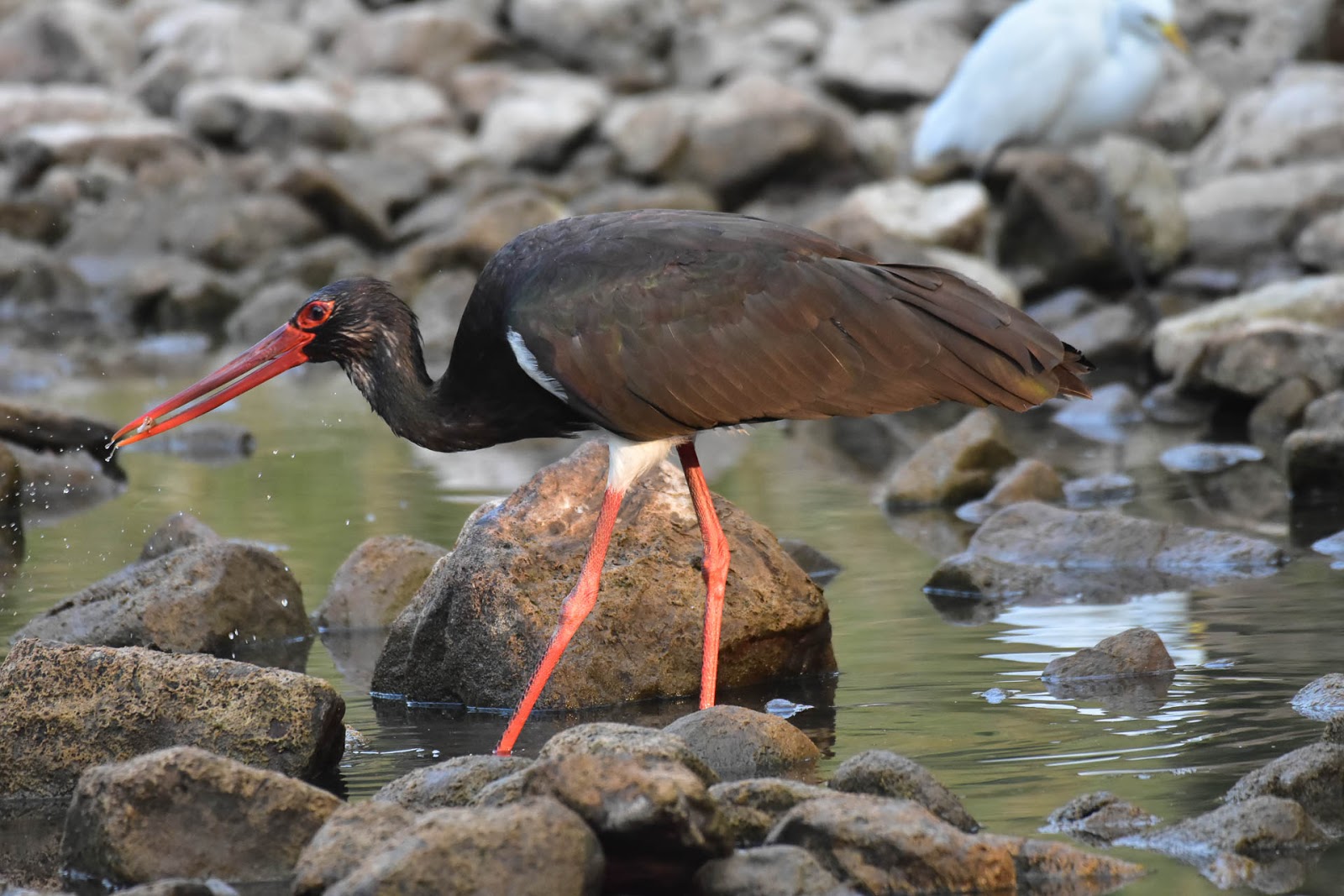

Black Stork Eating a Small Fish

Around noon I spotted a tiger lying next to the road.  It was Laila and our 10th sighting.  We watched her for awhile before she got up, drank and went to sit in the tall grass.  We left her 45 minutes later. 


Laila Drinking from a Pool

At 3:25 Avi and I spotted another tiger in a rocky wash.  We drove around to intercept the tiger and found it was Laila again.  She came out on the road and followed us before heading off into the forest 45 minutes later.  This was our 11th and final tiger sighting in Ranthambore National Park.


Laila Checking a Scent Mark 

The Park wasn't always a safe haven for tigers and other wildlife.  In 1973, very concerned about the dwindling number of tigers due to hunting, Project Tiger (PT) was started at the insistence of Indira Gandhi.  Nine reserves were created under PT with Ranthambore being one of them.  At that time the area looked very different.  There were 16 villages dotting the area and the Park's largest lake, Padam Talao, had been drained for agriculture.  All the vegetation had been eaten by domestic cattle and wild animals were rarely seen. 

In comes Fateh Singh Rathore, the assistant field director at that time.  With a high amount of tact and patience he convinced the villagers to move out of the park.  It wasnt always easy.  At one point he was beatened by angry villagers and left for dead.  He recovered and continued his important conservation work.  Largely because of Mr. Rathore, "Ranthambhore became the place which brought the tiger to the consciousness of people the world over."

On our last morning in Ranthambore we explored a different area, Zone 6.  There were quite a few other vehicles traveling the same route.  We waited for them to leave before proceeding.   Suddenly the line of jeeps and cantors was heading back in our direction.  They were pursuing something.  Marc and Avi spotted a leopard as it ran away.  I missed it.  

Our time in Ranthambore had come to an end.  What an amazing privledge to spend so much private time in the company of wild tigers!  Never in my wildest imagination did I expect such intimate and lengthy encounters or to witness such unusual behavior of these magnificent cats.  Thank you Avi for making this possible!

Little did we know that another unexpected surprise awaited us that evening.  Stay tuned to find out what it was and how we fare in our next destination, Panna National Park.

We hope all is well with everyone.
Peggy and Marc

Our route map:


Ranthambore Map:


Postscript:

We later learned that Lightning had ventured outside of the park after our departure and fell into a 45-foot well in Khandoj Village.   A team of forest guards rescued her without injury and released her back into the forest.  Tiger Watch provided all the equipment necessary for the rescue.   There is a video on the Facebook page of Tiger Watch.


Sunday, November 13, 2016

Gujarat Trick or Treat!

Greetings All,
After our epic trek in Nepal we shifted gears to wildlife watching.  We booked a 3-week safari with our good friend, Avijit Sarkhel, and were able to do the inaugural tour of Vana Safaris, a new company he started with his wife, Monika.  We flew into New Delhi on October 22 and were warmly greeted by Avi.  We were invited to his home where we met his wife Monika and his sister who prepared us a delicious Bengali meal.  

The following morning we flew to Rajkot by way of Mumbai in the Indian State of Gujarat.  A 3-hour drive brought us to our first destination, Gir National Park.  The draw here is the Asiatic Lion and Gir is the only place in the world they live.  The park is dominated by teak forest and grassland.  Due to an unusually heavy monsoon, the vegetation was dense and the grass tall.  It would be difficult spotting wildlife.


Dense Vegetation at Gir


We arrived just in time for the afternoon safari.  We encountered some of the Park's herbivores such as Spotted Deer, Nilgai and Sambar but the lions remained elusive.  We'd try again the next day.  Around 8:30 the following morning we came upon a few jeeps of Indian tourists.  They had just seen a leopard but it had disappeared into the forest. We drove off disappointed but I heard someone shout.  When I turned back one of the jeeps flashed its lights.  We went back and the leopard had been spotted again.  Most of the other jeeps had given up the search and moved off but we waited and were rewarded with a beautiful sighting of a female leopard! 


Female Leopard!


She vanished into the tall grass and I looked back to see a second leopard cross the road behind us!  It turned out to be a male.  We followed both cats for about 40 minutes.

For our afternoon safari we were assigned Routes 4 and 7.  We missed the lions again!  They were on Route 6 in the morning.  The next day we were determined to find the lions.  We requested Route 6 but it was closed for road work.  Bummer!  We were hoping that the lions would cross onto Route 5 but they didn't.  As dusk was falling I heard the characteristic "sawing" of a leopard.  Leopards make a call like someone sawing wood to allow territorial neighbors to keep out of each other's way and also allows males and females to find each other.  We found the leopard, a magnificent male, not far away and we rewarded with a great view.  


Male Leopard!

Sadly our 5 safaris in Gir did not yield any lions and it was time to move on to our next destination, the Great Rann of Kutch.  It was a long 9-hour drive but we were humbled when we passed a group of pastoral nomads on their way to Rajasthan. Here we were in our comfortable air-conditioned vehicle while the nomads were on foot at noon leading their camels carrying all their worldly belongings.  


Desert Nomads on the Move


The Great Rann of Kutch is a seasonal salt marsh located in the Thar Desert near the border with Pakistan. It is reputed to be one of the largest salt deserts in the world and its so big it can be seen from space!

Rann of Kutch, photo from NASA Earth Observatory

We were the guests of Jugal Tiwari, the founder of the Centre for Desert and Ocean (CEDO).  He has worked tirelessly in the region since 2005 to protect the area's unique wildlife and we were privileged to spend a few days with him.  To learn more about CEDO and how you can help go to:


We searched day and night for wildlife but sightings were few and brief.  There are many pressures adversely affecting this fragile ecosystem including habitat loss for agriculture, livestock grazing and commercial wind farms.  The use of agricultural pesticides, roadkill, hunting and predation by domestic pets are also threatening the wildlife.

Shepherds on the Road

We did encounter several colonies of Indian Desert Jird.  Jirds are closely related to gerbils but lack the long hind feet and the characteristic erect posture of a gerbil.  In addition, the Indian Desert Jird is diurnal, in comparison to the three common gerbil species found in India which are nocturnal.


Indian Desert Jird

We also sighted Asiatic Wild Cat also known as Desert Cat, Jungle Cat, Asiatic Jackal, Indian or Bengal Fox and this adorable Pale Hedgehog.  When threatened the hedgehog curls inside into a ball exposing only its spines, staying like this for hours.

Pale Hedgehog

The Great Rann of Kutch is also an important area for migrating birds.  The diverse habitats including wetlands, grasslands, tropical thorn forest and the coast all provide staging, feeding and roosting grounds for 375 species.  We saw many specialities such as White-naped Tit which is vulnerable and endemic, Painted Sandgrouse, Desert Warbler and MacQueen's Bustard.  This species is listed as vulnerable because of a population decrease by 20 to 50% from 1984 to 2004 due mainly to hunting and land-use changes.   In January, 2014, Saudi prince Fahd bin Sultan bin Abdulaziz Al Saud shot 2,100 MacQueen's bustards during a 21-day hunting safari in Pakistan, shocking in this day and age!


MacQueen's Bustard

From the Great Rann of Kutch we drove to the Little Rann of Kutch stopping at the 10th century Pereshwar Temple dedicated to Shiva.  While Marc and Avi were photographing the roosting Greater Mouse-tailed Bats, I watched a Pundit perform a puja ceremony.  


Pundit Performing a Puja Ceremony

The guys were allowed to go into the inner sanctum but I was not.  When I asked Avi "why not?", he replied that "women were too much of a distraction for the gods".  Me, a distraction?  Yeah, right!  Besides, gods and pundits should be above temptation.  

A sanctuary has been created at the Little Rann of Kutch as the World's last refuge of the Indian Wild Ass.  Spread over 4954 km², it is the largest wildlife sanctuary in India.  The sanctuary is one of the last places on earth where the endangered wild ass sub-species, Indian Wild Ass (Equus hemionus khur), can be spotted.   The main threat faced by the sanctuary is the illegal salt mining activity in the area from which 25% of India's salt supply comes.  It didn't take long to locate a scattered herd of about 25 Indian Wild Ass.  We could actually approach quite close on foot for photos.


Indian Wild Ass

Other mammals such as the Desert and Indian Fox, Nilgai or Blue Bull, Wild Boar and Indian Hare live here.  The following morning we found a sleepy Desert Fox curled under a thorn bush.  He grew tired of us watching him sleep and trotted off across the salt pan.


Desert Fox

That evening a group of local women treated us to a song and dance performance in celebration of Diwali, the Hindu Festival of Lights.  It spiritually signifies the victory of light over darkness, good over evil, knowledge over ignorance and hope over despair.


Diwali Song and Dance Performance

We were up very early to leave at 3:30 for Blackbuck National Park at Velavadar, our last stop in Gujarat.  We wanted to get there for the morning safari.  Today was Halloween.  Would we be tricked or treated to something special?  Upon entering the Park we immediately spotted Blackbuck, Wild Boar and Nilgai.  Ramjan, our local guide, saw something on the road ahead.  We could see White Storks but there was something else.  Could it really be a pack of Indian Grey Wolves?  Yes!  We tried to get closer but they ran off into the tall grass.  We drove around and Ramjan told us to get out of the car and get ready to photograph them as they crossed the road.  Sure enough they did and Marc got great photos!  


Indian Grey Wolves

There were 7-8 wolves in the pack.  I was so excited I forgot to count.  Ramjan said he had not seen a pack this large in 12 years!  We watched them far out in the grassland but could only see their heads.  


Blackbuck and Wolf

We left the park and went to the main road where Ramjan said they would cross after a few motorcycles went by.  He was right again!  They crossed and Marc got more great shots, including one of a wolf crossing behind a motorcycle!  It amazes me how predators and people in India tolerate each other.


Indian Grey Wolf Crossing a Highway

We returned to the Park and turned our attention to the Blackbuck.  This antelope is native to India and is found mainly in this area.  There are approximately 3500 Blackbuck in the Park congregating in herds as large as 500 individuals or in smaller bachelor herds creating a sea of spiraling horns.


Blackbuck Herd


It was fun watching them pronk like the Springbok of Southern Africa.  They leapt into the air with an arched back and stiff legs, typically as they crossed a road.  


Pronking Blackbuck

There were also numerous Montague's and Marsh Harriers, Common Crane, White Stork and Greater Flamingo.  The Harrier roost found at the park is one of the largest in the world.


Sparring Harriers

After lunch we returned to the Park where we encountered two massive Blue Bulls engaged in a fierce battle.  They locked horns, dropped to their knees and pushed each other with tremendous force.  This went on for about 20 minutes before the victor chased off the loser.


Dueling Blue Bulls


That evening as we were leaving the park we spotted one last wolf crossing the road.  Seeing the Indian Grey Wolves was the best Halloween treat ever!


Indian Grey Wolf

Our last safari in Gujarat the following morning yielded no wolves so we realized how special yesterday's sightings were.  We drove to the city of Ahmadabad where we would fly to Jaipur in Rajasthan State for the second half of our safari.  Stay tuned to see what surprises Avi has in store for us!  
We hope all is well back home.
Peggy and Marc

Our route so far:

Places visited in Gujurat


Friday, October 21, 2016

In Peter Matthiessen's Footsteps

Greetings All,
After spending 3 nights in Shey it was time to leave and continue our trek in the Dolpa District of Nepal.  A frenetic Montain Weasel visited our camp dashing from one empty marmot burrow to another and bouncing off our toilet tent.  The Mountain Weasel is listed as near-threatened by the ICUN because it is in significant decline due to habitat and resource loss.


Mountain Weasel

We trekked pass Shey Gompa one last time and headed up a side valley toward our next objective, the Saldang La.  Along the way were tiny settlements where people were grazing yaks, sheep and goats.  The trail climbed gradually toward the pass and we stopped for lunch at its base.  We resumed our climb and Chet paused to listen to a noise overhead.  Large flocks of birds were flying high above us.  At first we thought they were geese as they were flying in a V formation but they sounded more like cranes.  Several flocks coalesced into one massive flock heading south toward India. 


Migrating Cranes

We soon reached the Saldang La, our third pass at 16,500 feet!  To the north lay the dry mountains of Mustang and the Tibetan Plateau beyond.  


Us on the Saldang La

A descent through barren valleys brought us to the tiny village of Namduna Gaon.  Several yak trains were heading up the Saldang La.  There is a brisk trade between Saldang and Ringmo.  In ancient times salt from Tibet was the main trade commodity but today lumber from the forests around Ringmo seems to be in high demand.


Yak train near Namduna Gaon


We camped above the village and the Namdung Monastery which we would visit in the morning.  When we showed up early the following day, the Gompa was locked and there was no one around to open it up.  Chet kept yelling for someone and finally a woman arrived from the fields to let us in.  As with most gompas we've visited so far this one was vacant as the head lama was in Kathmandu.  It seems the gompas are only functional during ceremonies. 


Inside Namdung Monastery


After our visit we continued down toward the village of Saldang.  In about 2 hours we could see the village below.  To my horror a massive trek group of 30 plus their staff and 50 or so mules were camped there.  Thankfully, we camped above and could not see them from our tent.  It turns out they were a group of 28 doctors from the US traveling to remote villages in the area to provide basic medical care, very admirable but difficult work under such primitive conditions.


Doctors' Camp at Saldang


In the afternoon we visited the home of an Alchi or Tibetian medicine man who was also a monk.  He invited us into his home to see his private Gompa. We climbed up a crude ladder to the shrine.  He had many things including ancient texts written by his great grandfather on yak leather.  


Ancient Text on Yak Leather

We went into his little shop where he showed us a picture book called "Caravans of the Himalaya" written in 1995 by Eric Valli in which he was featured.  Some of the photos showed primitive medical procedures which I can't imagine enduring.  The Alchi had some medical instruments hanging from his belt.  When I asked him what they were he pulled out what looked like a crude scalpel.  I cringed.


"Caravans of the Himalaya"


The following day we awoke to more rain so we decided not to visit Karang, a smaller village to the north.  The group of doctors was packing up camp.  The bad weather had forced them to change their plans as well.  They would cross the Saldang La and head to Shey instead of visiting a village further north.  The rain stopped in the afternoon and we visited the Samyeecholing Monastery.  As usual, we had to find someone with a key to let us in.  A young monk showed up, unlocked the door and we entered the main chamber.  The monk opened a few windows and lit a few butter lamps so we could see the interior better.  Freshly painted (about 2 years ago) murals adorned the walls and again all the typical Buddhist artifacts were present.  I gave the monk a kata or scarf given to us by our friend Galden Sherpa when we were back in Kathmandu and he draped it over the middle statue.


Inside Samyeecholing Monastery


This Gompa was unique in that it had both Hindu and Buddhist deities represented.  The original monastery was built here 600 years ago but the present day one is only about 20 years old.  The young monk took us upstairs to a tiny chamber with old statues about 300 years old.


The Old Gompa Room


We returned to camp for tea around 4:00.  I looked out of the mess tent to see a herd of dzos (yak/cow hybrids) coming down the pass carrying long timbers.  We went out to photograph them and ended up taking this video as they headed straight toward our toilet tent!  Would it survive?


Whew, that was a close one!  The next morning we left Saldang and headed down the valley past the villages of Namdo and Rapa.  This time of year everyone is busy harvesting barley.  The plants are either pulled out of the ground or cut with a sickle and are stacked neatly once the heads with the grain is removed.  The livestock gets to eat the stalks during the long cold winter.


Stacks of Barley

We left the main trail and headed for our next campsite near the hamlet of Rakka.  When we arrived we found that the campsite had been obliterated during the last monsoon and that a small lake was now in its place.  We headed further upriver to a suitable campsite.  While we were setting up our tents, I noticed a herd of 35 or so Blue Sheep across the river coming down for a drink.  A male with massive horns paused mid-drink for Marc to take his photo.


Blue Sheep Ram Drinking at the River


It was a cold walk up the river valley the next day until the sun finally reached us.  The remaining bushes gave the desolate valley some autumn color.  What looked like tamarisk had turned a deep purple and other bushes a brilliant red.  


Fall Colors


We had lunch at the confluence of the Dachen and Nagon Kholas before heading up the broad gravel bed of the Nagon Khola toward the Langmuse La, our fourth pass crossing.  It started to sleet around 2:00 and I wondered if it would make tomorrow's pass crossing difficult.  We have microspikes but the rest of the crew and the mules did not.  The skies had cleared up the following morning and we climbed steeply, encountering snow sometimes as deep as a foot but mostly only 2-3 inches.  The slopes we had to traverse above looked steep and with the newly fallen snow, slick.  I kept telling myself if Putchay and the mules could do it so could I.  We put on our microspikes which gave me more confidence.  It wasn't so bad.


Approaching Langmuse La


We reached the top around 9:45 where we could see Dhaulighari looming to the east.

Us on Langmuse La

We took a few photos and headed down the south side which fortunately was snow-free.  Another large flock of cranes flew high above us.  We reached the valley floor where the remnants of many camps were strewn about.  Locals come here in the spring to graze their sheep and goats and have left behind old shoes, aluminum cans and worst of all broken glass.  It was sad to see in this remote and beautiful valley.


High Meadow Camp


We set up camp on the far side and as we were preparing for tea Marc spotted a Wooly Hare but I missed it.  It would have been a new mammal for me.  After tea we climbed the ridges above camp in search of the hare.  It was a long shot but we had to try.  Lo and behold we startled it and it sprang along a ravine coming to a stop long enough for Marc to get a photo.


Woolly Hare


It was near this remote valley that George Schaller, a biologist accompanying Matthiessen on his travels in 1973, spotted two Snow Leopards.  We'd have to be content with the Wooly Hare.  The next morning we headed out toward the Bagala, our 5th and final pass crossing.  As we got closer we could see that there was a lot of snow on the pass.


First Look at the Bagala


Could we make it over?  Chet said they'd have to do a reconnaissance trip after lunch to assess the situation.  I wasn't so sure.  I was already thinking about a "Plan B."  When we arrived at the junction of 2 routes, one toward the Bagala and one toward the Numala, I hesitated.  Chet asked us which pass we wanted to take.  The Bagala meant a much shorter route back to Juphal but we were uncertain if we could cross it.  The Numala was a sure thing but meant 5 long days of trekking to get back to Juphal.  After careful consideration, we chose the Numula and set up camp at the junction.

A trekking group from Singapore was coming down the Numala and reported that it was snow-free.  They also reported that an American trek group had camped at the base of the Bagala but decided to turn back.  We felt that we had made the right decision to climb the Numala the next day.

The next morning we awoke to clear skies and made the straightforward 3000-foot climb to the top of the Numala Pass.  We were rewarded with stunning views of Dhaulighari and Annapurna to the east.


Us on the Numala

A long descent brought us to the Tarap Valley and the village of Tokyu.  I was shocked to see motorbikes in the village.  How did they get here?  There is no road to this remote village.  I found it ironic that the yaks were hanging out by the motorcycles.  Could this mean the end of the yak trains?


Motorcycle and Yaks in Tokyu


We stopped to visit the local Chaiba Gompa before continuing on.  Once again we had to find someone to unlock the door.  It was an old Gompa, maybe 300 years.  There were some large Buddhist statues inside and a pile of mani scrolls.


Inside Chaiba Gompa


We continued to the village of Dho Tarap where we spent the night.  The next day the Tarap Valley narrowed into a deep canyon.  It took us two days to negotiate the long canyon, sometimes climbing high above to avoid sheer walls while other times approaching to within 5 feet of the raging torrent of the Tarap Khola.


Deep Canyon of Tarap Khola


The canyon ended at a confluence just below the village of Khani Gaon.  Chet took us to see our final Gompa.  We crossed the raging river on a wooden plank bridge and climbed up to Chhedhui Gompa past old chortens.  


Chortens Below Khani Gaon


When we arrived it appeared deserted but we could see an old man spinning a prayer wheel.  Chet called to him but he didn't seem to have the key.  An old woman showed up with a couple of girls and opened the door which wasn't locked.  It was an old Gompa maybe 600-700 years old.  At first the woman said no photos but she gave in.  There were statues, masks, horns and butter lamps.  


Inside Chhedui Gompa Below Khani Gaon


We were then taken into the back chamber which had even bigger and older statues.  


Old Statue Inside Chhedhui Gompa 


The following day was our last long hike and brought us to the town of Dunai.  We camped at a new lodge just outside of town.  Dibi, the owner, has a daughter in Canada and a son in the US and was happy to talk to us.  Our 22nd and final day of the trek was a short one.  It didn't take long to reach Sulighat which closed the loop on our long circuit hike.  Now it was just a mere 1400-foot climb from the Thuli Bheri Khola to Juphal, the end of our trek!  We celebrated the completion of our journey in the footsteps of Peter Matthiessen with a raffle of items we brought from home and a tip ceremony for our amazing trek crew.


Raffle in Juphal


During my speech I broke broke down into tears.  I wanted to convey to them just how special Nepal was and how much we appreciated all their hard work.  This trip would not have been possible without their guidance and support.


Chet, Pemba, Chahndan, Shree Dahn, Jamar and Birendra


We later learned that George Schaller at the age of 84 and Alex, Peter Matthiessen's son, had just completed a 30-day trek in the area!  Like us they were seeking to experience the spirituality and adventure that Peter and George had 43 years ago!  I think both parties were successful!

We hope all is well back home.
Peggy and Marc

Our route map:


More detail:

Covered over 190 miles and climbed over 40,000 ft