Monday, February 17, 2014

Where Have all the Leopards Gone?

Greetings All,
After leaving Myanmar we flew to Colombo, Sri Lanka via Kuala Lumpur, Malaysia.  We had a few days before meeting up with our next trek group so we visited Yala National Park in southern Sri Lanka.  Yala is Sri Lanka's second largest national park and is said to have the largest leopard density in the world.  We set out to explore the park with our guide, Arran, hoping to find a lot of leopards to photograph.

There are plenty of other animals and birds in the park to enjoy.   Yala harbors 44 species of mammals and 215 species of birds including 6 endemics.  One of the first birds we encountered was this Malabar Pied Hornbill.

Malabar Pied Hornbill

We rudely interrupted two land monitor lizards in the process of mating.  They reared up on their hind legs and embraced lovingly or so I thought.


Land Monitor Lizards

There was a lot of hissing going on and when the male started getting rough, the female had enough and made a hasty retreat.  Yala is also home to herds of wild water buffalo.  Around the periphery of the park most of the water buffalo contain genes from domestic stock.


Wild Water Buffalo

The Little Green Bee-eaters were especially prolific.  They flitted back and forth across the road alighting on branches nearby which made for a great photo.


Little Green Bee-eater

There are four species of deer in the park.  By far the most common are the Spotted Deer.  This handsome buck posed nicely for us.


Male Spotted Deer

There are more than 90 species of waterfowl that inhabit Yala's wetlands.  We observed Cattle, Little, Intermediate and Great Egrets, Red and Yellow-wattled Lapwings, Gray heron, Black-headed Ibis, Indian Pond Heron, White-breasted Water Hen, Lesser Whistling ducks and this beautiful Painted Stork.


Painted Stork

The Asian Elephant herds of Yala number from 300 to 350 individuals.  Most of the males are tuskless owing to the British shooting out all the large males with tusks in colonial times.  We did spot Nalaka, one of the few males with tusks.

Nalaka, male Elephant w/Tusks

The breeding herds containing the females with calves were more difficult to spot.  They tended to stay hidden in the jungle.  One small herd of about 7 individuals came out of hiding for a mud bath.  The adults sprayed muddy water on their back to cool down.  A tiny calf tried to emulate mom without much success.  He had not yet mastered the numerous muscles in his tiny trunk.  When the herd left the waterhole we got a good photo.

Asian Elephants

Almost everywhere you look in Yala you see Peafowl.  One Peacock was doing his best to impress a Peahen.  His tail feathers were extended in a brilliantly colored fan which he shakes violently to attract her attention.  At first she seemed interested but soon turned away and strolled off.

Peacock Displaying

There are two species of monkey in Yala.  The Toque Macaque is endemic to Sri Lanka.  They hang around the rest stops looking for an opportunity to steal food.  We managed to hang onto our breakfasts.

Toque Macque

Not wanting to miss anything we spent two full days in the park.  It gets really hot around noon and the animals tend to be less active.  Most people take a break around midday and return to their lodgings to rest.  We found that you can still spot animals when they come to one of the park's many waterholes to drink.
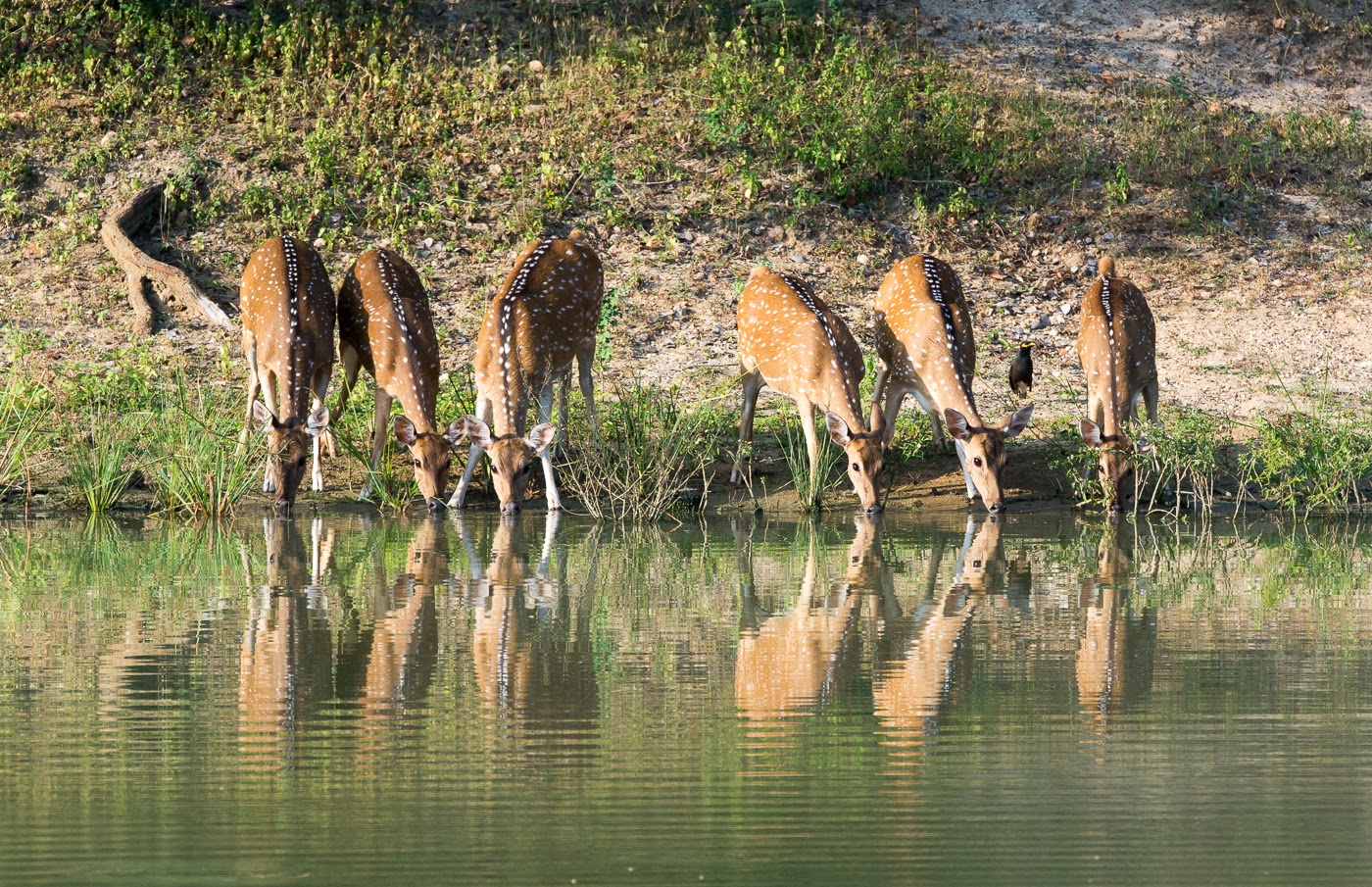
Spotted Deer Drinking at a Waterhole

One of my favorite smaller animals was the Grizzled Giant Squirrel.  They are found only in Sri Lanka and India.  They are near-threatened due to hunting and habitat loss.

Grizzled Giant Squirrel

Another small mammal spotted at dawn and dusk is the common Black-naped Hare.

Black-naped Hare

We were nearing the end of our second full day in the park and had yet to see a leopard.  We were getting desperate.  Others staying at our camp were getting good sightings but we always seemed to arrive minutes too late.  We decided to bend the rules and stay in the park past sunset in the hopes of getting a sighting of one of the cats that had been eluding us the past couple of days.  One of the top guys in the wildlife department, Chandre, was with us so weren't too concerned about staying late.  He wanted to see a leopard as badly as we did.  Finally, success!  A beautiful female leopard slinked out of the jungle to get a drink at a nearly waterhole.  Despite being some distance away and the growing darkness Marc was able to get a descent shot.

Female Asian Leopard

Time to head out of the park before it got much darker!  Thank you Arran, Chandre and our driver Koshala for being so patient and willing to remain in the park for 13 hours two days in a row for us to get good sightings and photos of Yala's elusive inhabitants.

We hope all is well back home,
Peggy and Marc     

Sunday, February 16, 2014

Electric Buddhas

Greetings All,
We saved the best for last, the majestic Shwedagon Pagoda in Yangon.  We arrived in the late afternoon and entered via the east gate.  We climbed steps past shops selling trinkets for tourists and offerings for the Buddhist pilgrims.  It's difficult to capture the grandeur of the Pagoda.  It rises 326 feet into the sky and is covered with dazzling gold plates and gold leaf.

Shwedagn Pagoda

The original temple is believed to be more than 2600 years old making it the oldest Buddhist temple in the world!  Legend has it that two merchants met the Lord Buddha after he had gained enlightenment and offered him food and alms.  In return Lord Buddha gave them 8 of his hairs as a blessing.  When the merchants returned home they gave the hairs to the king who built the Shwedagon Pagoda to enshrine the strands.

We walked about the stupa then sat for an hour and a half to wait for the sunset.  Groups of tourists, pilgrims, monks and nuns strolled around the middle terrace stopping to recite prayers, make an offering or to take a photo.

Pilgrims Praying

Volunteers swept the floor then rolled out a red carpet.  "For whom?" we wondered.

Volunteers Sweeping the Floor

Just after sunset a large group surrounded by police linking arms to prevent people from approaching too closely made their way around the pagoda.  It turned out to be the President of Germany.  Can you pick him out in the crowd?

Germany's President Visits Shwedagon

The upper tower of the pagoda glinted with the last rays of sunshine.   At the very top is the diamond orb containing 4351 diamonds including a 76 carat apex diamond!  Below the diamond orb is the pennant-shaped vane and the umbrella.  The umbrella alone is 43 feet high and is adorned with close to 84,000 gems including 5,448 diamonds and 2,317 rubies!  From this distance it's difficult to get a feel for the size and grandeur of the umbrella.  It weighs a staggering 5 tons including half a ton of gold!     


Upper tower of Shwedagon

A few monks ascended the lower terraces to collect gold leaf that had blown off from the walls.  Only monks and men for that matter are allowed on the terraces.


Monks Collecting Gold Leaf

After dark the pagoda comes alive with throngs of Buddhist devotees.  They stop at their planetary post to pray for prosperity, a good husband or to have a son.  They light candles, pour water over the Buddha image or make offerings of flowers, incense, or money.


Devotees Worshipping at Sunday (my) Corner

Myanmar Buddhism is unique in that it incorporates an astrological aspect of Hinduism.  Myanmar Buddhists not only believe that karma (the doing of good or bad deeds) affects their fate but also believe that it is also determined by the day of the week you were born.  There are eight planetary posts or "corners" around the Pagoda representing the eight days of the week (Wednesday is split into two posts, an a.m. and a p.m.).  Each Planetary Corner has a Buddha image and an animal representation underneath:  garuda (large mythical bird)  for Sunday, tiger for Monday, lion for Tuesday, tusked elephant for Wednesday morning, tuskless elephant for Wednesday evening, mouse for Thursday, guinea pig for Friday and naga (mythical dragon/serpent) for Saturday.  Do you know the day of the week you were born and what your animal sign is?   

Devotees Worshipping at Tuesday Corner

Around the main stupa are many tiny shrines with "electric Buddhas" lit up with halos of colored lights.  The pilgrims and monks alike prayed to the Buddha Images.

Buddhist Pilgrims Praying inside a Shrine

Monks Praying inside a Shrine

After 3 and a half hours of trying to absorb the majesty and spiritual intensity of Shwedagon Pagoda, it was time to leave.  It was a fitting end to our visit to Myanmar with it's rich historical, cultural and religious history.  We wish the people of Myanmar prosperity and peace on their way to developing the world's next democracy.  We hope they can maintain their unique traditions in a world that is becoming more homogenous by the day.

We hope all is well back home,
Peggy and Marc

Wednesday, February 12, 2014

Leg Rowing on Inle Lake

Greetings All,
We spent two days touring the fascinating sites around Inle Lake.  Our first stop was Pindaya Cave.  On the way we passed by colorful villagers on their way to market in some strange-looking contraptions.

Pa-Oh Women on the way to the Market

We stopped to visit some Danu women who were harvesting wheat by hand!  They cut the wheat with a hand sickle and tie it into small bunches to be collected later for threshing.

Danu Women Harvesting Wheat 

They work 7 hours a day with a 1-hour lunch break and make $1.30 per day.  It will take them 3 days to harvest the wheat in this field and another 2 days to thresh the wheat.

At the entrance to Pindaya Cave is a statue of a giant spider and of a man shooting an arrow at it.


Killing the Giant Spider

According to legend, 7 sisters flew (they were humans with wings) to bathe at Lake Botoloke.  A giant spider captured them and trapped them in the cave.  A handsome prince rescued them and fell in love with the youngest sister.

Inside Pindaya Cave are 8078 and counting Buddha images!  They are made from bronze, wood, marble and jade.  They date from around 1134 to the present. 

Buddha Images in Pindaya Cave

The next morning we took a boat ride on Inle Lake where the fishermen practice a unique rowing method.  They row their boats with their legs keeping their hands free to fish with nets or wicker traps.

Leg Rowing on Inle Lake


We arrived at the Nam Hu Village where the 5-day rotating market was taking place.  The market rotates through the major villages around the lake every 5 days.  The Intha in their conical bamboo hats and the Pa-Oh Ladies with their colorful headscarf's were busy selling vegetables, fruit, flowers, spices, rice, household goods, secondhand clothes and fish.


Pa-Oh Ladies Selling Beans

Many of the vegetables sold here are actually grown on the lake on floating gardens.  The locals use water hyacinth to create a floating mat onto which they pile aquatic weeds from the lake and soil to create a garden.  The garden is held into place with bamboo poles.

Floating Garden

The next day we were to visit the Shwe Inn Dain Pagoda.  On the way we stopped at some shops to meet some Padaung Ladies.  They are known for wearing brass coils around their necks which gives them the appearance of having very long necks.


Padaung Lady

They start wearing the coils around the age of 5 and as they get older the coil is replaced by a longer one and more turns are added.  The woman above is 63 years old and she is wearing 24 coils.  The neck isn't actually being stretched but the weight of the coils pushes down on the collar bone and compresses the rib cage.  We were told that this practice started to protect the women living in the forest from tigers.  Now, the young women do not want to wear the brass coils (understandably so).  They consider them ugly and fear if they wear them they will not get a husband.  The practice is being kept alive to some extent by tourism.  This Paduang lady actually lives in another village 2 days away.  She was hired by the local shop as a tourist draw.

We continued on to Indein Village which had the 5-day rotating market for that day.  Two Pa-Oh ladies were wearing their traditional dress.


Pa-Oh Ladies

We climbed a hill to the Shwe Inn Tain Pagoda.  Recently restored stupas were glistening in the morning sunshine.


Shwe Inn Tain  Pagoda

The next day it was time to head back to Yangon.  On the way to the Heho Airport we stopped at the Shwe Yan Pyay Monastery made of teak wood and with unusual oval windows.  The novice monks were learning their Buddhist teachings.  We didn't help by distracting them by taking loads of photos.

Monks at Shwe Yan Pyay Monastery

Inle Lake is a fascinating place with leg rowing fisherman, colorful markets, floating gardens and friendly ethnic people.  Once again we thank Myo Win Tun for sharing this magical place with us.

We hope all is well back home.
Peggy and Marc

Plains of Pagodas

Greetings All,
The next stop on our cultural tour was the ancient city of Bagan in central Myanmar.  From the 9th to the 13th centuries the city was the capital of the Kingdom of Pagan.  During the height of the Kingdom, over 10,000 temples, pagodas and monasteries were built on the plains surrounding Bagan,  Only a mere 2200 remain today of which we visited around 20 to give us a feel for what the city was like in it's heyday.  Inside the Manuha Temple were colossal statues of Bhuddha confined in tiny shrines.  The expression on the Buddha's face was one of sorrow.  This temple was built by the captive Mon King Manuha in 1067.   He was trying to convey what it felt like to be under house arrest.


Buddha in Manuha Temple

Abeyadana Temple was built in 1102-1103 by King Kyansitta for his beloved wife Abeyadana.  Legend has it that this temple was built at the place where Abeyadana  waitied for her husband while he was hiding from the wrath of King Suwlu.  Inside are some of the finest frescos in Bagan.

Mural inside Abeyadana Temple
 
Said to be the most beautiful temple in Bagan, Ananda was also built by King Kyansittha in 1105. 


Ananda Temple

Inside the temple are 4 standing Buddha statues one each at the N, S, E and W end of the temple.

Buddha Statue in Ananda Temples

All are 31 feet high and the further you stand from the Buddha the more he appears to be smiling.  We climbed the Shwe San Daw to get a view of the temples at sunset.

Temples of Bagan at Sunset

This temple has become very popular with tourists for watching the sunset.  You have to arrive early to secure a space on the narrow terrace.  The climb down was quite steep.  Fortunately there were handrails to grab onto.

Climbing down Shwe San Daw Temple

The next morning we took a break from "temple-hopping" and visited Mt. Popa.  On the drive we stopped at a village to learn about some of the local industries.  A man was extracting oil from peanuts using an ox-powered grinding wheel.  Marc asked about making peanut butter from remnants but it has not caught on yet and is fed to livestock instead.

Extracting Oil from Peanuts

Another man was climbing a Toddy Palm on a bamboo ladder to collect juice from the cut fruit stem.

Collecting Toddy Juice
The juice is boiled until only a paste remains.  The paste is rolled into balls to make a candy called Jaggery.  It tastes amazing like maple sugar candy!


Packaging Jaggery

As we approached Mt. Popa we could see the volcanic plug of Taung Kalat with a Buddhist Monastery perched on top.

Monastery on Kaung Kalat

At the base of Kaung Kalat is a Nat Shrine.  Nats aren't insects but spirits which the local people pay respect to by making offerings of food, flowers or money.  If you don't respect the Nats bad luck will come your way.  There are 37 great Nats and each was represented at the shrine.

Some of the 37 Great Nats

The "Queen Nat" is Popa Medaw.  She was born an ogress, the kind that eats flowers not human flesh.  She fell in love with Byatta whose duty was to gather flowers for the King.  The King disapproved of the liason and killed Byatta and took their two sons to the palace.  Popa Medaw died of a broken heart and became a Nat.  You can see her worshipping the Buddha (lower left) in this shrine on the summit of Mt. Popa.

Nats Worshipping Buddha
    
We returned to Bagan to visit it's most massive temple, Dhammayangyi, built in 1167-1170 by the evil King Narathu who killed his father to gain the throne.  Feeling some remorse he had a grand temple built to honor his father.

Dhammayangyi Temple

It's the only temple of it's kind in Bagan owing to the fact that the evil King had the hands of it's builders chopped off which I effectively demonstrate.  Without hands, they could not build another temple.

Getting my Hand Chopped Off

We visited the Sulamani Temple next.  Built in 1183, the interior contains some beautiful murals painted in the 18th century.

Mural in Sulamani Temple

 We watched another glorious sunset over the temples of Bagan.

Sunset over Bagan's Temples 

We like to thank our guide Myo Win Tun for sharing the wonders of Bagan and beyond with us. 

We hope all is well back home,
Peggy and Marc