Greetings All,
I am a little hydrophobic and I'm sure many of you were surprised that we signed up to do a raft trip in Alaska. It's not your classic whitewater adventure like rafting through the Grand Canyon but more of a float trip. There are no roads in the Arctic National Wildlife Refuge (ANWR) and so the only way to get around is by foot or by one of the several rivers that flow through the refuge to the Beaufort Sea. We were to raft a section of the Kongakut River from Whale Mountain to the Arctic Coast. The orange hook at the top right of the map shows our proposed route:
 |
| Our Raft Route (shown in orange) |
On June 19, our group of 9 (7 clients and 2 guides) flew north from Fairbanks. We split into 3 planes and Marc, Virginia and I loaded into a tiny 4-seater Helio Courier for the 3-hour flight. Once we cleared the sprawling metropolis of Fairbanks and the Fort Knox Gold Mine, the boreal forest and patches of tundra interlaced with winding rivers stretched as far as the eye could see.
 |
| Flying over the Arctic Tundra |
We stopped in the tiny outpost of Fort Yukon before continuing north. We had to cross the jagged peaks of the Brooks Range before reaching the Kongakut River and flying along it. "Where on Earth were we going to land in these rugged mountains and narrow river valleys?" I wondered. Steve our pilot, flew low over the river and I could make out a scratch of an air strip below on a gravel bar along the river. Emilie, one of our guides, was waiting with most of our gear. She had flown separately in a 2nd Helio that had already arrived and was on the ground waiting to take off.
 |
| "Landing Strip" at Whale Mountain |
We landed safely, unloaded our plane and watched as Steve took off on the short runway to pick up more of our group waiting at Arctic Village.
 |
| Steve taking off from Whale Mountain |
Emilie gave us each a can of bear spray and advised us to make a lot of noise to alert Grizzlies to our presence. We set up our tent at the edge of the willows and set off to explore the immediate area.
 |
| Our Cozy Home for the Next 10 Nights |
The others arrived 4 hours later and set up their tents. We had a hearty dinner of chicken curry with vegetables and rice. As we were preparing for bed, Emilie spotted a grizzly bear on the ridge above camp. The bear traversed the ridge forging for ground squirrels totally oblivious to our presence.
 |
| Grizzly Bear at Whale Mountain Camp |
We watched until he disappeared from view. I waited a little longer to make sure that he didn't double back. I didn't sleep too soundly that night, dreaming of grizzly bears sitting on our tent.
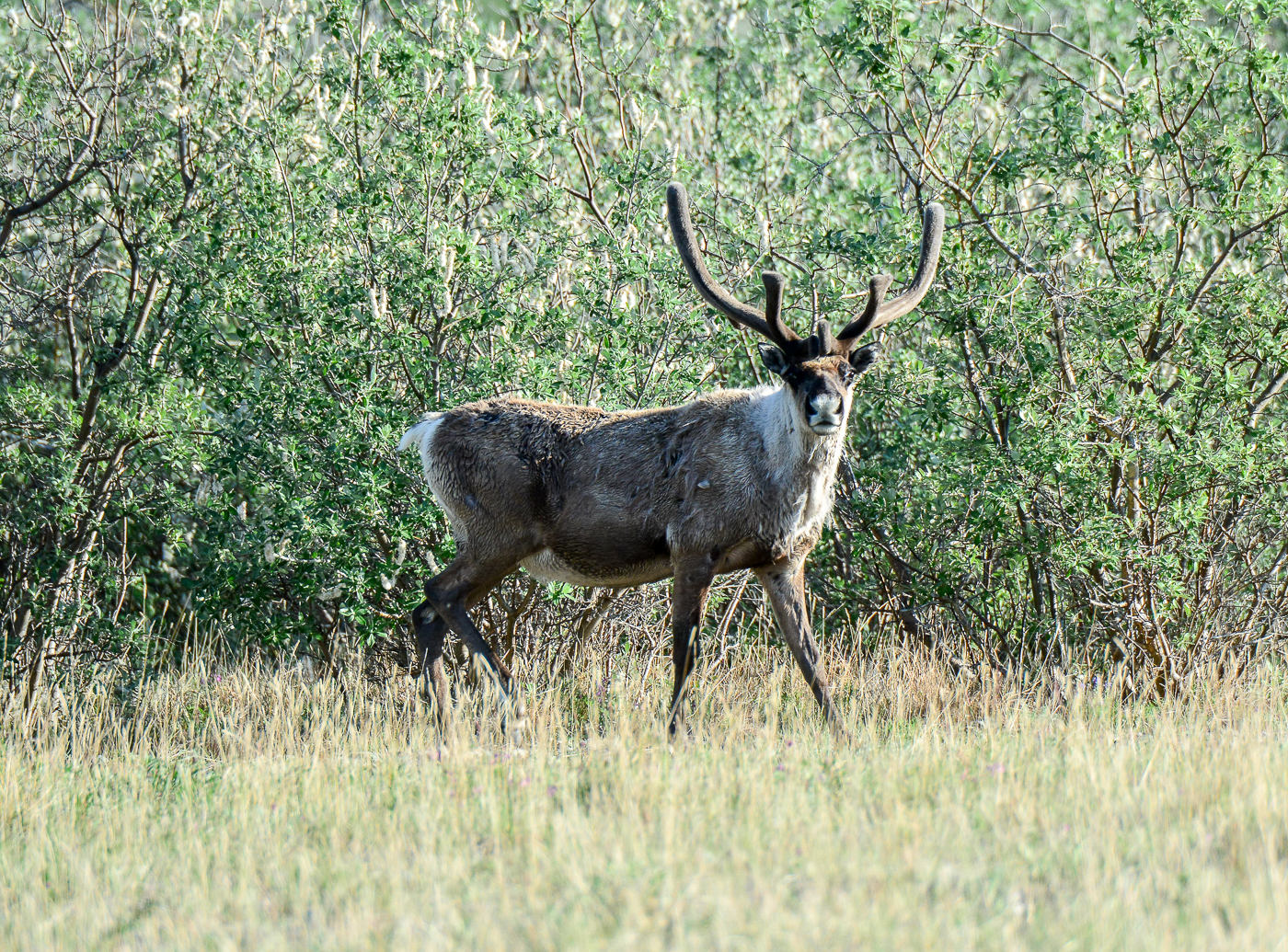
The next morning we awoke to sunny skies and warm temperatures. I spotted a lone male caribou wandering into camp. He noticed us and made a wide detour around camp. I hope he is the first of many caribou we encounter on this trip.
 |
| Lone Male Caribou |
Today was a layover day in camp and we opted to climb to the top of the ridge just above. We forded an icy stream and climbed steeply to the first viewpoint, about where we saw the grizzly bear the night before. There was no sign of him now and we continued climbing to the next knob and onto the next. When we reached the highest knob on the ridge we stopped to admire the mountain views.
 |
| Peggy Above the Kongakut |
We could just make out the white sea ice about 25 miles to the north. The spring wildflowers were spectacular and splashed the green tundra with blue, yellow, pink and white.
 |
| Siberian Flox |
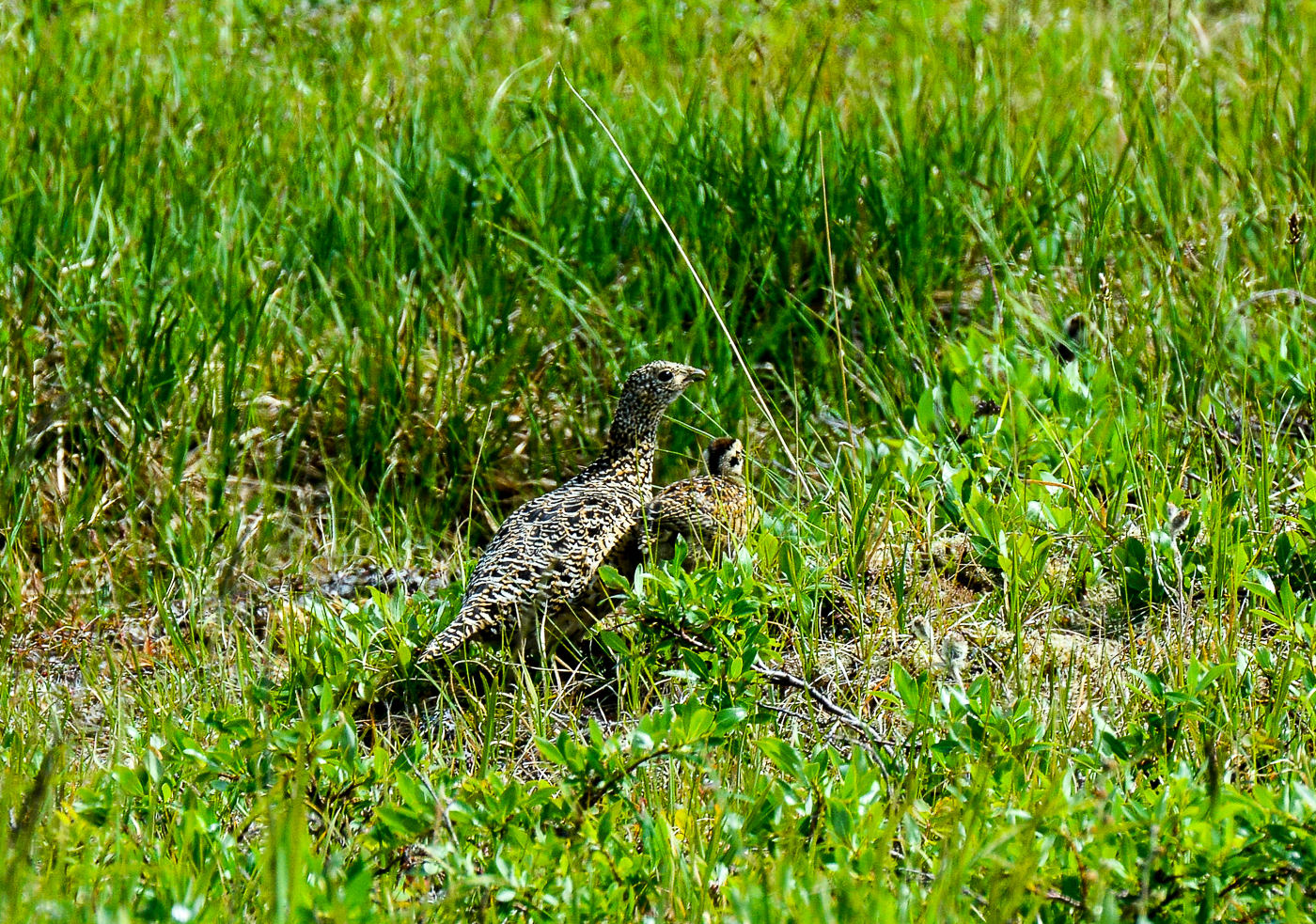
We startled a Rock Ptarmigan on the way down and he froze hoping to blend in with the surrounding rocks.
 |
| Rock Ptarmigan |
I slept better that night in preparation for our first rafting the next day. It's quite a production to pack up camp and load the rafts. Everything (cook tent, tables, chairs, food, stove, propane, personal river bags and water filter) must fit into the rafts. The center of each raft was piled high with gear. Two people sat in the front and two in the rear. The 9th person got to paddle an inflatable kayak.
 |
| Preparing for our First Raft Trip |
Finally we were underway and headed downriver toward our next destination, Caribou Pass. The river flowed swiftly but the rapids we encountered were never more than Class II. Darren, our second guide, steered from the back and would shout "forward" when he wanted us to paddle and "drift" when he wanted us to stop padding. We could see a flock of Dall Sheep on a ridge above the river. We had spotted them from our hike yesterday and we were happy to see them in the same location so we could get a closer look. About 30-35 sheep, mostly ewes with lambs, were grazing in the high meadow.
 |
| Dall Sheep |
It took us about 5 hours to paddle the 15.5 river miles to Caribou Pass. We unloaded the rafts and set up camp, making sure to put our tents far from the cook tent. If a grizzly bear did wander into camp, he'd usually head to the cook tent. We also had to take care not to eat in our tents and to leave all our smelly stuff (toothpaste, deodorant, soap, etc.) in the cook tent each night.
 |
| Cook Tent at Caribou Pass Camp |
The next day was another layover day and we headed out to explore a long ridge behind camp. We were treated to sunny weather, spectacular views and colorful wildflowers. We could see clear to the coast and make out Demarcation Bay and an old ship wreck through our binoculars.
 |
| View of the Arctic Coast |
We had to make a hasty retreat from the ridge as a thunderstorm was brewing and we reached camp just as it started to rain. Thunderstorms are not common in the Arctic but all this warm weather was fueling the buildup of clouds. The next morning, 2 members of our group were not feeling well and had to be evacuated. Fortunately, there was an "airstrip" about a mile downriver and Emilie was able to arrange for a plane to pick them up. Our group of now 7 continued 15 miles downriver to our third camp without a name. We tried to come up with a name but the best we could do was "Bumps on My Butt Camp" due to the mosquitoes attacking when you were most vulnerable.
We were getting the morning routine down, packing up sleeping bags and pads, having breakfast, packing personal gear, carrying group gear to the river bank and loading the rafts. The whole process took about an hour and a half. The mountains began to dwindle as the Kongakut flowed toward the coast. We stopped in a meadow full of Arctic Lupine and spotted a Savannah Sparrow. We had volunteered on a project studying these birds back home and were amazed to find them so far north.
 |
| Savannah Sparrow |
We set up camp on a tundra bench about 11.5 miles downriver from our previous camp. This time of year the sun never sets and we had ample time after dinner to explore the tundra. Here we encountered a new bird, the colorful Lapland Longspur, that breeds in the far north.
 |
| Lapland Longspur (breeding male) |
Emilie and Darren were very skilled at picking the correct river channel to follow. Arctic rivers have many braids and if you pick the wrong one, you end up stranded on a gravel bar. We did hit a few shallow spots and we'd have to get out to push or pull the rafts into a deeper channel. On one of these occasions I looked up to see a black figure silhouetted on the horizon. "Animal!" I shout. At first I thought it was a moose but when I looked through my binoculars I could make out a lone black wolf! He watched us, disappeared, then reappeared to make sure we weren't in pursuit. He was too far away for a photo. Soon after we entered the aufeis (German for "ice on top"). This ice forms when the Kongakut overflowed and froze. After the river recedes, this ice is left along the sides of the river. Over years it can build to 15 feet high.
 |
| Paddling Along the Aufeis |
We stopped for lunch and climbed to the top of the aufeis for an amazing view.
 |
| Us on Top of the Aufeis |
A Snow Bunting was singing on top of the aufeis on the opposite bank.
 |
| Snow Bunting |
We returned to the rafts and floated through the aufeis to the Beaufort Sea! It was an exhilarating experience to reach the Arctic Ocean by raft. We climbed to the top of a gravel bar called Icy Reef for a better view of the ocean and sea ice beyond. Over 200 seals were lounging on the ice!
 |
| Ringed Seals off Icy Reef |
We couldn't quite make them out but guessed they were Ringed Seals, the favorite food of polar bears. We set up our tents, closer together this time, on Icy Reef and set out for a bit of exploration. A lot of driftwood had collected along the shore. "Where did all this wood come from?" I wondered. I didn't sleep too well tonight. Grizzly bears were one thing but polar bears were a whole different ball game. I figured if the seals felt safe here, we'd be safe as well.
 |
| Our Camp on Icy Reef |
Since we had made good time to Icy Reef we had a few extra days to explore the coast. We decided to try and get to Turner River to the southeast. We no longer had a river current to push us along but a favorable tailwind made for easy paddling. We headed for a spit of land with a mound, called a pingo . There was a log cabin with a sod roof sliding into the bay.
 |
| Old Man Store's Cabin |
Old Man Store built the cabin and sold it to Joe Arey, son of a whaler. Mickey Gorden bought the cabin in 1929 and lived there until 1933. There was the remnants of another cabin and an old cemetery with wooden grave markers dating back to 1918. We headed for the pingo and climbed to the top. Some animal had made deep burrows in the mound. I looked up to see an Arctic Fox disappear down one of the holes.
We returned to the rafts and paddled another hour or so along the coast to look for a campsite. The first spot we checked out had nesting geese so we moved on. The next site appeared to be free of geese so we camped here in the tundra. As Darren and Emilie set up the kitchen tent they disturbed 4 goslings. We got some good photos before 3 of them returned to the water and headed down the coast.
 |
| Mama, Where Are You? |
The 4th was nowhere to be found but showed up later in the water heading in the opposite direction. We hoped that the goslings would reunite and somehow find their parents before the foxes found them. We never knew their fate. Before dinner we took a walk on the tundra and found some Dowitchers, Lapland Longspurs and Sandpipers.
 |
| Long-billed Dowitcher |
The next day the wind was still favorable and we reached the Turner River. We set up our last camp next to the river on grassy tundra. On the opposite bank was a flat gravel spit, perfect for the planes to land on. There was a lot of evidence that a caribou herd had been here, lots of tracks, poo and shed fur. Unfortunately they were long gone and the tundra appeared empty. However, we found many nesting birds and wild flowers carpeting the gravel river banks. American Golden Plovers were nesting in tiny ponds behind camp and a Least Plover was nesting right in camp. We had to be careful where we walked, we didn't want to step on a nest!
 |
| Don't Step on the Nest! |
Long-tailed Ducks were hanging out on a gravel spit. You couldn't get too close or they would fly.
 |
| Long-tailed Ducks |
We awoke to rain, the first bad weather we had on the trip. It was a layover day so we hung out in our tents reading and snoozing. We hoped the weather would clear by the following morning for the flight back to Fairbanks.
The next morning was a very foggy. Would the planes be able to land? Emilie called at 7:30 and gave a weather report. It was good enough for the planes to come and get us at 11:00. We packed up for the last time, loaded the rafts and paddled across the river to the "landing strip". As we unloaded the rafts I spotted a brown shape trotting toward us. It was a curious wolverine coming to check us out! "Wolverine!" I exclaimed. Marc had his camera ready so was able to get a photo!
 |
| Wolverine! |
We could hear a plane in the fog. Emilie got on the radio and contacted Daniel, the pilot. He couldn't see us but we told him we could hear him fly over. We lined the airstrip with river bags and he made another pass. This time he was low enough to see us and the airstrip. He made a third pass and landed on the strip. At first he headed straight for us and we had to run to get out of the way. The plovers and terns were going crazy as they were nesting on the strip. Daniel landed safely and took Martin, Jane, Darren and a lot of the gear back to Arctic Village. Not long after they left, the fog cleared and we were left on the rockbar in beautiful sunshine.
We pumped all the air out of the rafts and helped Emilie pack them into bags. We adjusted the river bags along the landing strip per Daniel's instructions and the terns dive bombed me. Marc and I stalked a pair of Pacific Loons and Marc got some great shots.
 |
| Pacific Loons |
We could hear a second plane and Matt, the second pilot, had no trouble finding us and landing. Marc, Virginia and I climbed in along with most of the remaining gear. Emilie was left alone to wait for Daniel to return to take her to Whale Mountain to drop off the blue raft for the next Kongakut trip. The flight over the Brooks Range was spectacular and a little scary. We threaded our way through the mountains, skirting rugged ridges just below the clouds.
 |
| Flying Through the Brooks Range |
We made it to Arctic Village where we met up with the others. We waited for about an hour for the Caravan to arrive to take us back to Fairbanks. The locals were anxiously waiting for the Caravan to deliver loved ones and much needed supplies.
 |
| Waiting for the Caravan |
Before we knew it it was back to the hustle and bustle of civilization. We had an amazing journey along the Kongakut River to the Arctic Ocean. The weather smiled upon us and the river gods treated us well. The spectacular scenery, elusive wildlife, colorful wildflowers we encountered and good company made for an incredible journey. Thanks to Emilie and Darren for guiding us safely down the river, preparing delicious meals and for their wealth of Arctic knowledge.
We hope all is well back home,
Peggy and Marc