Greetings Everyone,
Our wanderlust has brought us to the colorful South American country of Colombia. After 60 years of civil war, peace is finally returning and tourists are beginning to discover this gem of a country. A 6-hour flight from Newark brought us directly to the capital city of
Bogotá, a sprawling metropolis of 8 million people. We arrived ahead of the rest of our group and had ample time to prepare for our upcoming trek in Los Nevados National Park. Due to severe T-storms and tornado warnings on the East Coast of the US most of our group arrived late the previous night or in the morning just before we were to leave
Bogotá. We boarded a 1-hour flight to the city of Pereira where we met our trek crew. Our group was now complete: Sergio our trip leader, local guides Mateo, Diego and Manuel and 7 clients: Marc and I, Sergey and Alla from RI, Jennifer and Dave from NJ and Julie, Jennifer's twin sister also from NJ. We piled into two Toyota Land Cruisers along with all our gear stowed on the roofs for the 4-hour drive to El Bosque farm near the park border.
 |
| Loading the Land Cruisers |
We stopped in the town of Santa Rosa de Cabal for lunch. Ten years ago there was not much here but today the town is burgeoning with restaurants and shops catering to the local and foreign tourists on their way to the park.
 |
| Shop in Santa Rosa de Cabal |
We left the tarmac road behind and bumped along a dirt road flanked by forest fragmented by cattle pastures and potato fields. Late in the afternoon we arrived at Finca (farm) El Bosque and set up camp in a soccer field next to an abandoned school.
 |
| Our Camp at El Bosque |
Dinner was served in the main farmhouse on a ridge above camp. Here Diana and her two daughters, Loraina and Siomara, had prepared us a delicious meal of chicken, rice and fried plantains, staples for the farmers who live in this region of Colombia. At an elevation of nearly 12,000 feet it was nice to have a warm place to eat and get out of the wind and rain. We turned in early as most in our group hadn't slept in hours.
 |
| Diana Preparing Dinner |
We woke to a cloudy morning and prepared for an acclimatization hike to La Asomadera Ridge, about 2500 feet above us. We climbed gradually along a dirt road to the park headquarters at Potosi where we had to check in before entering the park. We learned that this is a long holiday weekend in Colombia and that their would be many Colombian tourists in the park over the next few days. A four mile walk from the park entrance brought us to our destination, the ridge overlooking Laguna
Del Otún, the largest lake in the Park.
 |
| Laguna Del Otún |
Three Andean Condors soared overhead. Condors had become extinct here but between 1997 and 2001, 16 captive bred condors from the US were reintroduced. In 2010 a juvenile was spotted indicating that the released condors had started to breed in the wild. Good news! One soared overhead to check us out and Marc was able to get his photo even though he didn't have his long lens.
 |
| Andean Condor |
We ate our packed lunches and headed back to camp as a light rain began to fall. We left the road and climbed steeply down through pasture land. We had an early dinner in order to prepare for our first climb tomorrow. Mateo handed out crampons, harnesses and helmets for the climb up 16,289-foot Nevada Santa Isabel. We were driven early the next morning to La Conjera area where the climb started. We were now in the páramo, a neotropical high mountain biome above the tree line where grasses and shrubs prevail.
 |
| Start of our Climb up Nevada Santa Isabel |
Once on the ridgeline we were hit with a strong wind and the clouds had descended obscuring all views. The climb was pretty straightforward until we reached a glacier at around 15,600 feet. We were informed that the park officials had prohibited anyone to go onto the glacier due to the deteriorating weather. We had no choice but to return the way we had come. Many locals were on their way up sporting only sneakers and sweatshirts while some of the more fashionable ladies were wearing fur coats. Colombians flock here to see and touch snow for the first time.
 |
| Glacier on Nevada Santa Isabel |
The weather had not improved by the next morning and we had to pack up camp in the rain for our move to Berlin Farm about 12 miles away. We were driven to Potosi for the start of our hike. We retraced the route we had taken 2 days earlier to the viewpoint over Otún Lake. This time we continued down but veered off from the road before we reached the lake. We entered the magical El Bosque (forest) were giant frailejón (Espeletia hartwegiana) plants abound. These plants are endemic to the páramo regions of Colombia, Venezuela and Ecuador. The frailejón plant is endangered due to the destruction of the páramo for cattle grazing and potato farming.
 |
| Us in the Frailejón Forest |
This time of year the plants were blooming and their flowers resembled tiny sunflowers, not surprising since Espeletia is a genus in the sunflower family.
 |
| Frailejón Flowers |
We continued our trek past a wetland and had to cross a few small ridges before spotting some farms in the distance. We thought that one must be our destination, Berlin Mountain Farm, but they were not. As we passed by Mateo spotted a few Andean Lapwings (Vanellus resplendens) foraging in a pasture.
 |
| Andean Lapwing |
We had to climb 1200 feet to the top of a ridge where we encountered a Colombian Cowboy called an Arriero and his two dogs.
 |
| Arriero |
The sun broke through the clouds as we descended into the valley where Berlin Mountain Farm lay nestled in complete isolation.
 |
| Berlin Mountain Farm Valley |
We were welcomed by Maria and her son Little Diego and ushered into a tiny but warm kitchen.
 |
| Maria and Little Diego |
We thought it odd that benches had been built along the wall above the wood stove but they did provide additional seating in a cramped space.
 |
| Warm and Cozy in Maria's Kitchen |
Diego, Maria's husband, arrived just before dark. He had made the round trip from Berlin to Potosi to pick up our bags and delivered them on his horses to Berlin. We set up our tents in a pasture while Little Diego chased the pigs and managed to ride one! We turned in after dinner as the rain began to fall again. When we awoke it was still raining so we hung out in Maria and Diego's kitchen where Mateo told us a sad story. Diego's father had been murdered by cattle rustlers and Berlin Farm was abandoned. Diego moved to the city where he met Maria but they couldn't make a go of it. They returned to the Berlin Valley where they rebuilt the farmhouse. They seem quite content in their isolated valley sometimes not receiving visitors for up to 3 months at a time. They don't mind hosting a few tourists but I got the impression that large numbers would not be very manageable.
By 9:30 it had stopped raining so we bid Maria farewell and waved a goodbye to Diego and Little Diego as they were milking the cows. We climbed through another frailejón forest where cattle had caused a lot of destruction to a pass where we got a view of our second climbing objective, Parmillo Del Quindío.
 |
| Parmillo Del Quindio. |
We headed down into a large wetland, the headwaters of the mighty Quindío River. We stopped before we reached the bottom and had lunch around the frailejón plants. We continued to the wetland where we had to decide whether or not to climb Parmillo Del Quindío. By this time it was 1:45 and way too late to climb 2500 feet to the summit so we had to abandon our attempt. Instead we crossed the wetland by hopping from one plant to the next. The Colchon de Pobre (Plantago rigida) form firm cushions which dam and filter water.
 |
| Colchon de Pobre Hopping |
We climbed out of the wetland to a series of ridges which we had to traverse through long tussock grass. The footing here was tricky and we had to take care not to sprain an ankle. Despite our caution, Jennifer fell slightly twisting her ankle. As we descended the fog rolled in and we could not see more than 30 feet in front of us. It was difficult for Mateo and Diego to find the route to La Playa Farm, our next destination.
 |
| Hiking Through the Fog and Mud |
Finally we could hear dogs barking and we knew we were getting close. We arrived safely just before dark, cold, wet and with mud caked boots. We sought warmth and food in the now familiar kitchen with its high benches next to a wood stove.
 |
| Kitchen at La Playa |
The horses hadn't yet arrived with our gear so we opted to sleep in one of the bunkrooms. As we were finishing dinner Diego arrived with the horses carrying our gear, whew! A few minutes later Sergio announced that a horse was missing with my bag and his. I was more concerned about my iPad than the safety of the horse and the guys who went back out in the dark to look for it. Shame on me! About 30 minutes later Mateo, Diego and a cowboy returned wet and covered in mud with the missing horse. Thank you guys!
The next day we were to climb to the high camp of Tolima known as Arenales in preparation for our final climbing attempt up Tolima Volcano. Given the poor weather conditions and the muddy state of the trails we instead opted to spend the day at La Playa. At this point we weren't sure how we were going to get down from the páramo as we were getting reports that some of the routes were impassible due to the thick mud. After our rest day the guides decided the safest route down was via another farm called La Argentina. The weather had finally cleared just in time for our retreat the following day. We got our first views of Tolima Volcano as we were leaving La Playa.
 |
| Tolima Volcano Looms Over La Playa |
We climbed to the top of a ridge where the views of 17,129-foot Tolima got even better. Mateo commented that he hadn't seen the volcano in the clear for 25 years!
 |
| Tolima Volcano |
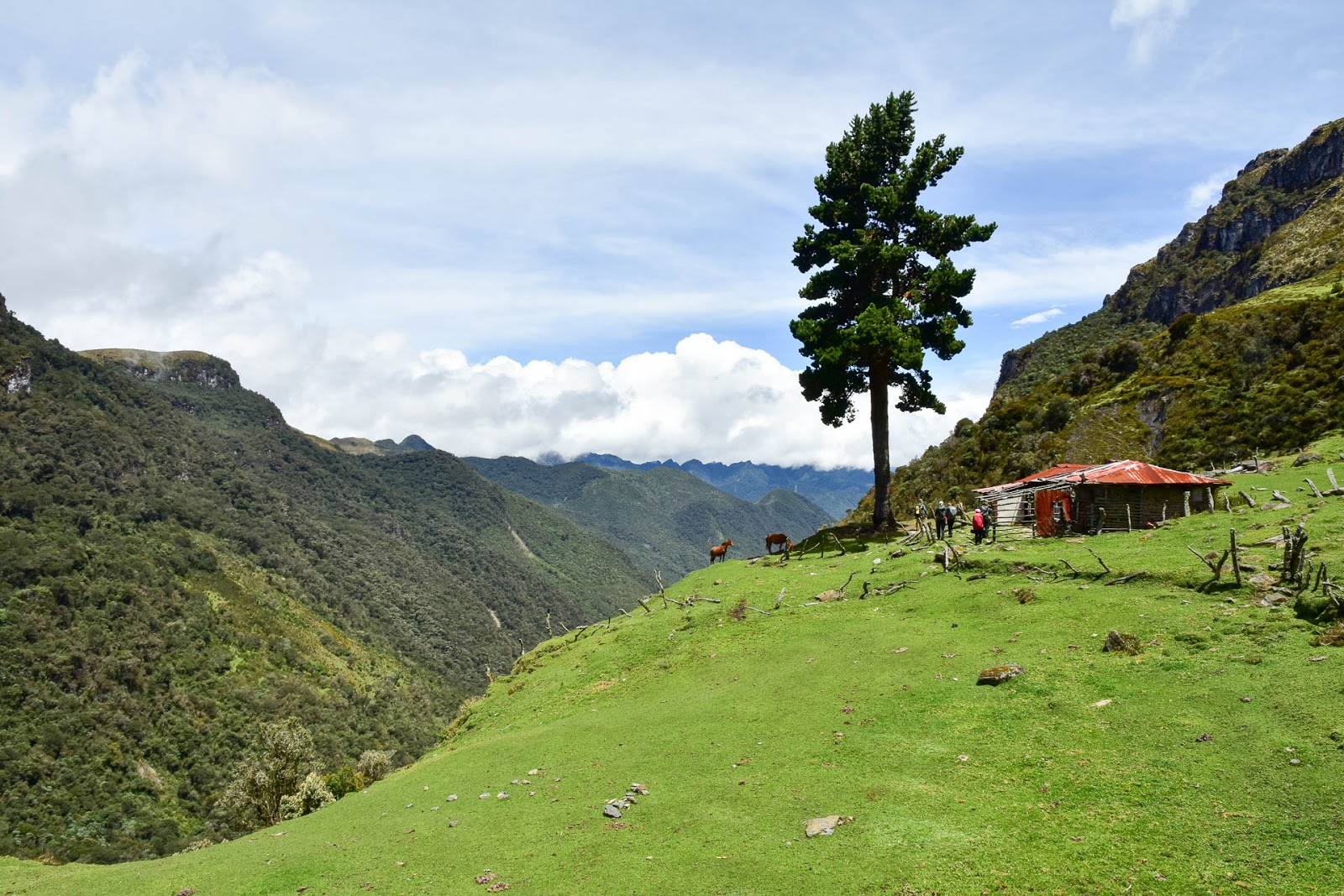
We bade farewell to the páramo and its iconic frailejón plants and entered the Cocora Valley. The forest returned and we were told that this area was one of the last hideouts for the FARC (the Revolutionary Armed Forces of Colombia) guerillas during the civil war. We passed by the abandoned farm of Buenos Aires where Don Javier, the owner of La Argentina, spent his childhood. An immense pine tree planted by Don Javier's grandfather 150 years ago towered over the farm.
 |
| Buenos Aires Farm |
We arrived at La Argentina Farm just in time for lunch. Gloria, Don Javier's wife, had prepared a big pot of potato soup for us. We spent the entire afternoon in the kitchen watching Gloria preform her daily chores. She was constantly busy preparing meals, serving people, putting wood into the stove and making cheese.
 |
| Gloria Making Cheese |
Cows are hand-milked daily to supply the key ingredient for making cheese.
 |
| Milking a Cow |
We spent a very windy night in one of La Argentina's bunkrooms before finishing our trek the next day. We continued our descent into the Cocora Valley to the town of Salento. Tall Wax Palms (Ceroxylon quindiuense), the national tree of Colombia, grew on the ridges above town. They can grow up to 150 feet in height and are the tallest monocots in the world.
 |
| Wax Palms Near Salento |
Our trek through Los Nevados National Park had come to an end. Although we had encountered a lot of wet weather and muddy trails, the warm hearts of the local farmers who welcomed us into their homes more than made up for it. May the park and resident farmers continue to coexist in a way that protects the páramo and its unique plants. Perhaps tourism can provide the farmers with an alternative form of income so they can abandon some of their more harmful agricultural practices. A heartfelt thanks to our amazing local guides Mateo, Diego and Manuel for taking such good care of us during the trek!!
We hope all is well back home,
Peggy and Marc
Los Nevados National Park location in Colombia:
Our route in Los Nevados National Park:
 |
| Orange: vehicle track, blue: trek route |