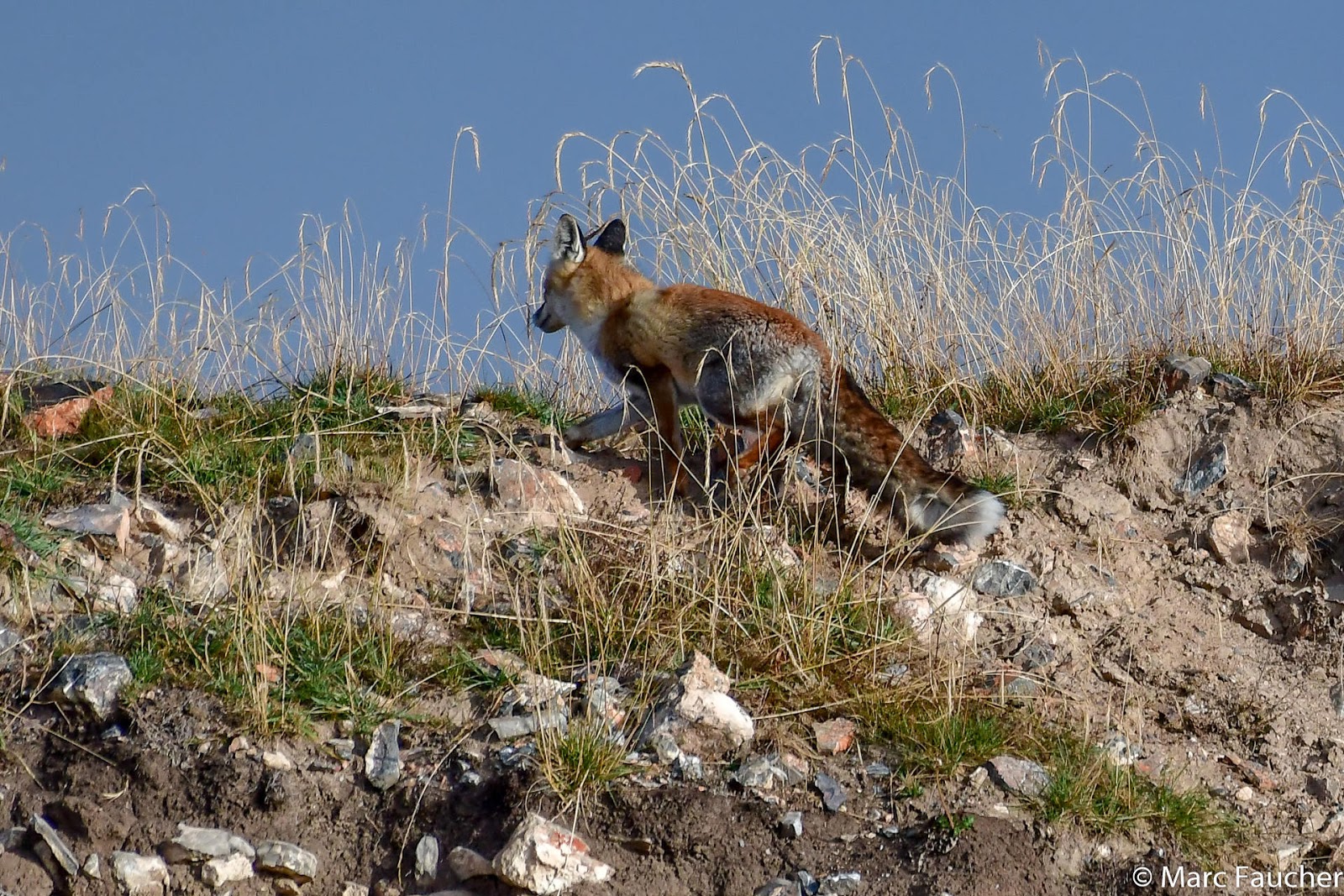
Showing posts with label Tibetan Wolf. Show all posts

Saturday, December 29, 2018

Life on the Roof of the World, Part II

Greetings Everyone,
We’ve been exploring the Tibetan Plateau for animals and birds along with our Greentours group. We’re in Nangqian, the southernmost point on our circuit and about halfway through our journey. On the morning of October 11, we were off to visit nearby Baixha Forest Reserve. We drove down into a canyon stopping where Jesper had spotted a flock of Blue Sheep nimbly negotiating the rocky cliff above the river. The youngsters were encouraged to follow in the footsteps of their elders.
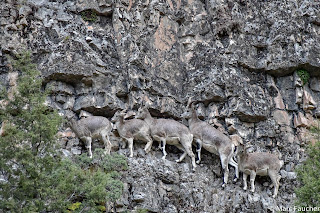
Blue Sheep

While waiting for breakfast, Jesper noticed a very obliging Glover’s Pika sitting on a log to warm up in the morning sun.

Glover’s Pika

The following day we continued our exploration of the southern end of our route in the beautiful Kanda Shan Mountains.

Kanda Shan Mountains

We were on the lookout for White-lipped Deer, a vulnerable cervid that makes these forested ridges home. We located a herd grazing on the open slopes above the road. At this time of year males and females come together for the annual rut. Males jealously guard their harem of females against competitors. 

White-lipped Deer

On October 13, we returned to the main circuit and continued toward the western reaches of our route. We stopped along the way to search for Blyth’s Voles that so far had eluded us. We found a colony but no one appeared to be home. Our patience paid off when Erling spotted a brave fellow who dared to venture above ground.

Blyth’s Vole

We stopped for lunch in the bustling town of Zhiduo where many of the locals still wear traditional dress among a backdrop of modern automobiles. Change is coming fast to the Tibetan Plateau.

Zhiduo

Just outside of town a herd of Argali, the largest wild sheep, was grazing close to the road. They were all females who are much smaller than the males with sport massive corkscrew-shaped horns. We did see a few males a long distance off. They tend to avoid humans as they are hunted for trophies leading in part to their endangered or threatened status.

Argali

One more surprise awaited us before arriving in Qumalai for the night. We were in the lead vehicle and spotted a lone Tibetan Wolf standing next to the road. He saw us and tore off at breakneck speed. Why was he so terrified? When we examined our photos later, Cathy noticed that half of his left rear leg was missing! Although hunting is banned, no doubt he was the victim of a snare set by humans. Wolves are persecuted because they kill livestock. No wonder he fled at our approach. We were happy to see that he could get around just fine on three legs.

Tibetan Wolf 

The next day it felt as if we had finally reached the “Roof of the World” and our day was full of iconic Tibetan Plateau wildlife! Early in the morning, a Tibetan Fox paused to give us a wide-eyed stare. 

Tibetan Fox

Tibetan Gazelle were plentiful and this male gave us a stunning view.

Tibetan Gazelle 

The scenery was spectacular with the Chang Tang mountains looming over the vast Tibetan Plateau.

Tibetan Plateau

Finally, Chiru or Tibetan Antelope, one of the animals I most wanted to see appeared in the grasslands along the highway! There are only 150,000 Chiru left in the world and they reside exclusively on the Tibetan Plateau. Chiru have long been hunted for their soft and warm underfur called shahtoosh. Traditionally this fine wool had been transported to Srinagar in Kashmir, where it was woven into fabric used to make shawls. It takes 3-5 hides to make a single shawl, and since the wool cannot be sheared or combed, the animals have to be killed to collect their fur. Fortunately, hunting is now controlled and the trade in India has been banned. The numbers of Chiru are slowly increasing. We set off on foot to get a closer look. As expected the antelope were wary and moved off. We noticed two males lying down and unaware of our presence. We were able to approach closely to get a great view of their impressive spiral horns and beautiful black faces.


Male Chiru

We arrived at Budongquon, a bustling truck stop at the junction with the main route from Beijing to Lhasa. We weren’t expecting to see much wildlife here but surprisingly there were many animals nearby. When we stopped for lunch, Marc and I set off on foot to check out a small herd of female Chiru a short distance away.


Female Chiru

After lunch, we went off in search of more mammals. Just outside of town a herd of Kiang was lounging right next to the road.


Herd of Kiang

Amazingly a large herd of Wild Yaks was grazing under a power line quite close to the main highway, another species that I most wanted to see! I was thrilled by our close encounter. Much larger than their domestic cousins, Wild Yaks have long shaggy black coats and in males especially, the undercoat may form a long "skirt" that can reach the ground. Horns on the males are much longer than those of domestic yaks. They are considered vulnerable by the IUCN with less than 10,000 individuals left in the wild.


Wild Yaks

What an amazing day of wildlife viewing! Jesper tallied 647 Tibetan Gazelle, 31 Tibetan Fox, 224 Kiang, 325 Tibetan Antelope, and 149 Wild Yak! 

The next day we went off to explore “Wild Yak Valley” and Jesper warned us that the gravel road may be a bit bumpy. I joked that it may very well be paved since it had been two years since Jesper had been in the valley. To our surprise, the road had been paved! More change had come to the Tibetan Plateau. While eating breakfast we heard Tibetan Wolves howling. Erling was the first to spot them on a ridge a great distance away. A pack of 7 wolves reunited with a lot of tail wagging and muzzle licking. We wanted to get a closer view but an icy river blocked our path.

Blocked by an Icy River

We opted to take a walk to look for voles instead. We found one but amazingly it was in the jaws of an Altai or Mountain Weasel!

Mountain Weasel with a Vole

There were many Woolly Hares scampering among the bushes and we finally got good views and photos.

Woolly Hare

We stopped to check out a small herd of Tibetan Gazelle. Phil and I were watching one end of the herd and completely missed the two sparring females that Marc was able to capture in an amazing photo!

Tibetan Gazelle Sparring 

The next day’s drive from Golmud to Dulan wasn’t very eventful as far as mammal viewing was concerned. We did manage to pick up a new species, Black-tailed or Goitered Gazelle. We had seen them earlier on our trip in Mongolia but these were the first spotted in China.

Black-tailed or Goitered Gazelle

On October 17 we set off on foot to explore the Dulan Mountains. We struck out on the Chinese Red Pika but Marc spotted a lone Tibetan Wolf high on a ridge. It was the rutting Kansu Wapiti that stole the show. The same species as our North American Elk (Cervus canadensis), Kansu Wapiti stags sporting massive antlers were bugling across the valley to attract potential mates. At one point 3 stags had come together ready to rumble but a serious confrontation never took place.

Kansu Wapiti Stag

During our last drive from Chaka to Xining on the Tibetan Plateau we didn’t encounter many mammals but by now we had seen so many amazing species that we were thoroughly satisfied. We were happy to see so much wildlife coexisting alongside humans and their livestock but we also realized that big changes are coming to the Tibetan Plateau. We were surprised to pass through many large cities connected by newly constructed 4-lane motorways. A high-speed rail now cuts across the plateau and there are many more herders grazing yaks, sheep, and goats on the grasslands. All this will pose new challenges to the wildlife who now have to compete with livestock for dwindling resources. Highways and rail lines cut off traditional migration routes and more people mean increased hunting or poaching. 

The Chinese Government is starting to acknowledge these threats to wildlife and hopefully will put in more controls to mitigate their harmful effects. The Tibetan Plateau is truly a magical place with animals found nowhere else on the planet. May humans find ways to coexist with these magnificent creatures!

Our sincere thanks go to our Greentours trip leaders Jesper Hornskov and Phil Benstead and to our intrepid drivers who worked hard under tough conditions to get us to all our destinations.

Our Drivers

We hope all is well with everyone.
Peggy and Marc

Our route map:

Saturday, November 10, 2018

Splendors in the Ruoergai Grasslands

Greetings Everyone,
On September 25 we flew from Ulaanbaatar, Mongolia to Chengdu, China via Beijing for the next leg of our journey. We had arranged a private trip to the Ruoergai Grasslands in Sichuan Province with local guide Sid Francis. Sid picked us up early the following morning for the long drive to Ruoergai on the eastern edge of the Tibetan Plateau. Along the way, we were amused by the many camps set up to house the throngs of Chinese tourists that would be visiting the plateau during Golden Week, the 7-day national holiday celebrated the first week of October. City folks could get the feel of sleeping in a tent, riding a horse or petting a yak!

Tourist Camp

We arrived in the town of Ruoergai and settled into our comfortable hotel for a 5-day stay. Even after the long drive, we were keen to go off in search of mammals so we drove another 45 minutes north of town to the site of an old rock quarry to look for wild cats. None were around so we headed further north and turned off onto a cement track that led through grasslands to a pass. Amazingly we picked up the eyeshine of many animals: Tibetan Fox, a Pallas’s Cat, a Chinese Mountain Cat, and even a lone Tibetan Wolf! The predators were here but the distance and darkness made viewing and photographing them difficult. We’d have to return in the morning light.

We returned the following morning but fog and drizzle now hampered our ability to spot animals. We did see hundreds of Plateau or Black-lipped Pikas scurrying around their burrows and even a few Himalayan Marmots that had not yet hibernated for the winter. With all this potential prey, no wonder there were so many predators out last night.

Black-lipped Pika

Himalayan Marmot

We returned to Ruoergai for lunch and headed out in the evening to spotlight along a road to the west of town. Unusually high traffic made it tricky but Sid spotted the eyeshine of a feline in the grass. We got out to investigate and after climbing over a few fences we were able to approach the cat to within 10 meters. We could clearly see that it was a Chinese Mountain Cat, a feline endemic to China! Larger than a domestic cat and with tufted ears, the Chinese Mountain Cat inhabits the grasslands and deserts on the northeastern edge of the Tibetan Plateau. Until 2007, the Chinese Mountain Cat was known only from six individuals, all living in Chinese zoos, and a few skins in museums. What a treat to get so close to this mysterious cat!

Chinese Mountain Cat

Early the next morning we returned to the rock quarries to look for more cats. We didn’t find any but we flushed three Red Foxes from their hiding spots in a second, more distant quarry.

Red Fox

We continued to the one-lane cement track which I had dubbed “Canyon Road” since from the pass it leads down into a narrow canyon. The weather had greatly improved and today we got great views of the surrounding mountains from the top of the pass. Sid spotted some Blue Sheep on a distant ridge.

View from the Pass

We headed down into the canyon not seeing many mammals but enjoying the many birds flitting about in the trees. The canyon narrowed to high rock walls adorned with Buddhist prayer flags and paintings. 

Buddhist Painting

We reached a tiny village where elderly Tibetans sat spinning their prayer wheels in the morning sun. It was nice to see that they were allowed to practice their religion which at one time was discouraged in China.

Tibetans in Village

In fact, we were surprised to see that many new chortens and temples had been built in the valley. On the way back we stopped to visit a Buddhist monastery that had recently been constructed. A lone monk invited us inside. Although the building was new many artifacts inside appeared ancient.


Tibetan Buddhist Monastery

By this time it had gotten quite late and we decided to visit a third rock quarry before returning to Ruoergai. As dusk began to fall, 11 female Tibetan Gazelle appeared from the ridges above and approached quite closely. They were followed by a lone male, possibly staking out females in preparation for the upcoming rut.

Tibetan Gazelle

A very early start the following morning didn’t yield much mammal-wise so we returned to Ruoergai for some much-needed downtime. We headed out in the afternoon but our ability to drive north was hampered by road construction. After a 5-hour delay, we were finally on our way. It had started to rain and I wanted to return to Ruoergai. There was so much oncoming traffic that we had no choice but to continue north. Finally, we reached the turnoff for “Canyon Road” and by this time it had stopped raining. Things were looking up. Soon after we picked up the eyeshine of a mammal. It was our first Asian Badger! But, it wasn’t alone. It was being harassed by two Tibetan Foxes. Sid thought that the foxes follow the badger waiting for it to dig up a tasty pika and then steal its meal. What crafty foxes! We tried to get closer on foot for a better view but the trio moved off after this photo:

Tibetan Fox (left) and Asian Badger (right)

A bit further down the road, Sid picked up the eyeshine of an animal sitting on the top of a ridge. It was a Pallas’s Cat, possibly the same one we had seen on our first night. We climbed to the top of the ridge to investigate, reaching the hollow where the cat had been sitting but it had left. Continuing down the road we detected the eyeshine of three more animals. A look through Sid’s spotting scope revealed a mother Pallas’s Cat and her two nearly grown kittens! They were hanging out on a rock about halfway up the ridge. 

Pallas's Cat Family

We proceeded carefully on foot to get a closer look. The kittens were very curious but mom had slinked off. We were able to get to within 10 meters for some wonderful views and photos. We didn’t go any closer not wanting to disturb the cats further. Wow, four Pallas’s Cats in one night! 


Pallas's Cat Kittens

We continued up the road and down into the canyon. We were on the search for nocturnal squirrels that inhabit the forest. On the way, we encountered two Siberian Roe does and further along this impressive Sika stag grazing next to the road.


Sika Stag

Our search for the squirrels paid off as we spotted three Chinese Giant Flying Squirrels high up in the conifers. Marc was able to get a photo of one.


Chinese Giant Flying Squirrel

On the drive back we spotted what we thought was a pack of Tibetan wolves but it turned out to be another Asian Badger being harassed by three Tibetan Foxes. Maybe this was the same group we had seen on the drive in but these were on the other side of the road so we speculated that they were different. Again we tried to get closer on foot but failed. 

We slept in the following morning as we didn’t return to the hotel until 2:00 am from our “lamping” session the night before. Around noon we headed north back to “Canyon Road”. We drove past the rock where we had seen the Pallas’s Cat family but it was surrounded by domestic yaks. The fact that so many predators coexist with domestic animals including dogs and their herders was a surprise to me.


Domestic Yaks around "Pallas's Cat Rock"

We decided to head even further north to a massive Plateau Pika colony. On the way, we were sad to see thousands of skinned Chinese Zokor hanging to dry. Apparently, the Chinese government thinks it’s a good idea to trap and kill these burrowing rodents, believing they destroy the grasslands. The weather had deteriorated and by the time we reached the pika colony, it had begun to snow. We didn’t see much except for a few Black-necked Cranes braving the storm.


Chinese Zokor Carcasses

The next morning we left the Tibetan Plateau making one last stop at Baixi. On the drive in I spotted an animal on the grasslands about a kilometer off the road. It was one of a pack of five Tibetan Wolves that had just killed a Tolai Hare!


Tibetan Wolves


We also spotted a Chinese Serow grazing on a ridge above and some great birds like this beautiful Gray-headed Bullfinch.


Gray-headed Bullfinch

We returned to the main road for the long drive to Dujiangyan. We followed the Minjiang River hoping that the detour we had encountered on the way in had been cleared. Not seeing any road closure signs we proceeded on the main road, unfortunately, hitting the roadblock once again. We were forced to backtrack and follow the detour high above the river.


Roadblock

We arrived in Wenchuan after dark and stopped for dinner. This city had been destroyed in the 2008 Sichuan earthquake during which 69,000 people lost their lives. The city has been rebuilt in Las Vegas-style with a lot of gaudy lights.

We arrived in Dujiangyan in time for bed. On our last day with Sid, we decided to visit the nearby Panda Center. Although I’d prefer to see Giant Pandas in the wild, this is now difficult since the Chinese government has closed the Wolong Panda Reserve to foreigners. At least we were able to see Giant Panda in their native country and hope that one day these bears will be released into the wild.


Giant Panda

A big thanks to our wonderful guide Sid for showing us the splendors of the Ruoergai Grasslands! In a fast-changing world, we hope that the unique mammals that make the Tibetan Plateau home will continue to coexist with their human neighbors.
We hope all is well with everyone,
Peggy and Marc

Our route map: