Greetings Everyone,
We’re in China searching for rare and elusive mammals. You may think that a country with 1.5 billion people wouldn’t have much wildlife but there are still remote areas where animals find refuge. We’re in Chengdu, the capital of Sichuan Province in central China, to start our quest. It’s October 3 and the rest of our Greentours group is due to arrive at the airport for our flight to Xining. Xining is the capital of Qinghai Province and the largest city on the Tibetan Plateau at an elevation of nearly 7500 feet. After reaching Xining and checking into our hotel it was off to dinner and bed for an early start in the morning.
The next morning, we drove to Huzhu Beishan National Forest Park, about an hour and a half to the northeast of Xining, arriving in time to watch the sun rise over the mountains.
 |
| Huzhu Sunrise |
The target was Siberian Roe Deer which were quickly spotted but a lone Alpine Musk Deer spotted by Erling on the top of the ridge stole the show. With a head shaped more like that of a kangaroo’s, the Alpine Musk Deer is easily identifiable. Sadly this primitive deer species and other members of its genus are endangered due to overexploitation for its musk, a brown waxy substance that the deer use to scent mark. Musk is highly prized for its cosmetic and alleged pharmaceutical properties and can fetch $45,000 per kilogram on the international market.
 |
| Alpine Musk Deer |
We took a short walk in the forest to look for two pika species, Chinese Red and Tsing-ling Pikas, that are endemic to central China. Many people think that these small mammals are rodents but they are more closely related to rabbits and hares. We came up empty for the Chinese Red species but I spotted a very obliging Tsing-ling Pika sitting under a rock.
 |
| Tsing-ling Pika |
The next morning we hit the road on a 2-week journey of exploration on the Tibetan Plateau. We divided our Greentours group of 9 led by Jesper Hornskov and Phil Benstead into three very comfortable 4x4’s, perfect for a long road trip.
 |
| 4x4 Caravan |
Our first destination was Qinghai Lake also known as Lake Koko Nor, the largest lake in China! We were on the search for Przewalski’s Gazelle, one of the rarest large mammals in the world. Jesper was quick to spot a herd about 2 kilometers from the road. We approached very carefully on foot but the gazelle were very wary and did not allow us to get within 1 kilometer. Their behavior is understandable since they have been hunted to near extinction. Fortunately, they are now protected under Chinese law and their population has grown to as many as 1600 individuals. As a result, they were reclassified from critically endangered to endangered in 2008. They still face habitat loss and competition with domestic livestock. We counted 41 individuals in two herds grazing on the dry grasslands.
 |
| Przewalski’s Gazelle |
An early start from Gong He brought us to a site known for Pallas’s Cats. As the sun rose we scanned the nearby rocks hoping that the cats had come out of their hiding places to warm up but the rocks were empty. Suddenly Jennie spotted an animal moving on a ridge across the river. It was a long way off but through a spotting scope, we could see that it was a Pallas’s Cat! But wait, it wasn’t alone... The cat was being harassed by a Red Fox. Did the fox actually consider the cat a potential meal or was it just trying to get rid of a competitor? I suspected the latter. We watched as the cat fended the pesky fox off with an arched back and a few swipes of its paw. Finally, the fox got the message and sauntered off. The Pallas’s Cat hung out on a rock before heading up the ridge and out of view.
 |
| A Red Fox (left) and Pallas's Cat (right) |
That afternoon brought us to the Er La Pass, at nearly 15,000 feet, our highest point so far. We climbed on foot high above the pass on the lookout for more cats but a lone Tibetan Fox and Snow Leopard tracks in a small patch of snow would have to suffice. The glorious views from the top were ample reward for our efforts.
 |
| Above the Er La Pass |
We successfully stalked a small herd of Tibetan Gazelle or Goa grazing close to the road below the pass. They looked very similar to the Przewalski’s Gazelle we saw yesterday and at one time the Przewalski’s Gazelle was considered a subspecies of Tibetan Gazelle but today they are considered distinct species. Goa too are threatened by habitat loss and competition with domestic stock. The increase in fenced pasture restricts the movement of the gazelle and access to forage.
 |
| Tibetan Gazelle |
We arrived at our cozy truck stop accommodation in Wenquan for the next two nights. It allowed us to spend more time in the area so that we could resume our search for cats in the morning.
 |
| Our Cozy Room |
We drove to the top of the Wenquan Pass arriving at first light. It was here that a Greentours group got exceptional views of three Pallas’s Cat kittens two years ago and we were hoping to repeat the experience. We scanned the nearby ridges to no avail so we headed out on foot to search the upper valleys.
 |
| Hiking Above Wenquan Pass |
We reached a viewpoint and stopped to scan nearby rock outcrops but there were no Pallas’s Cats to be seen. The sun made a brief appearance drawing a Tibetan Dwarf Hamster out of its rocky lair. Although not the Pallas’s Cat that we were seeking, we were happy to get close views of this seriously cute rodent, another China endemic.
 |
| Tibetan Dwarf Hamster |
The next morning we left Wenquan for Huashixia, an area of dunes covered in willow scrub. We were on the search for Gansu Pika that inhabit the thick undergrowth. After searching for nearly 4 hours we had all but given up hope of spotting these elusive creatures when one appeared out of nowhere. It was so close that we were caught off guard and Marc was unable to take a photo before it slipped back down its burrow. We waited for it to reappear but it remained underground. All was not lost as we did see our first Kiang, the largest of the wild asses, and a bit further down the road we got even better views.
 |
| Kiang |
The day ended with our closest view yet of Black-necked Cranes, the world’s only alpine crane species. These birds breed on the Tibetan Plateau and in late October head south, flying over the Himalaya at incredibly high altitudes.
 |
| Black-necked Cranes |
It was a very cold (-14 degrees C) start to the day on the top of Bayankala Pass at 4824 meters, nearly 16,000 feet! Buddhist prayer flags whipped in the stiff wind.
 |
| Bayankala Pass |
It was too snowy underfoot to explore from the pass so we walked down the highway at a brisk pace to meet the rising sun.
 |
| Walking down from Bayankala Pass |
We rejoined our vehicles and stopped to scan for animals below the pass where Jesper spotted a lone Tibetan Wolf hunting for pika. He seemed unconcerned by our presence so we tried to get closer on foot. However, an icy river blocked our path so we had to settle for a distant view.
 |
| Tibetan Wolf |
After lunch, we crossed a second pass called Xiewu at 4458 meters. From here we took a short walk encountering more domestic than wild animals. The bushes were covered in a thick white fiber to protect them from the harsh conditions.
 |
| Xiewu Pass |
Further down we explored a side valley where a Tibetan family was preparing for the long winter ahead by piling fodder for livestock on the roof of their stone house.
 |
| Tibetan Family |
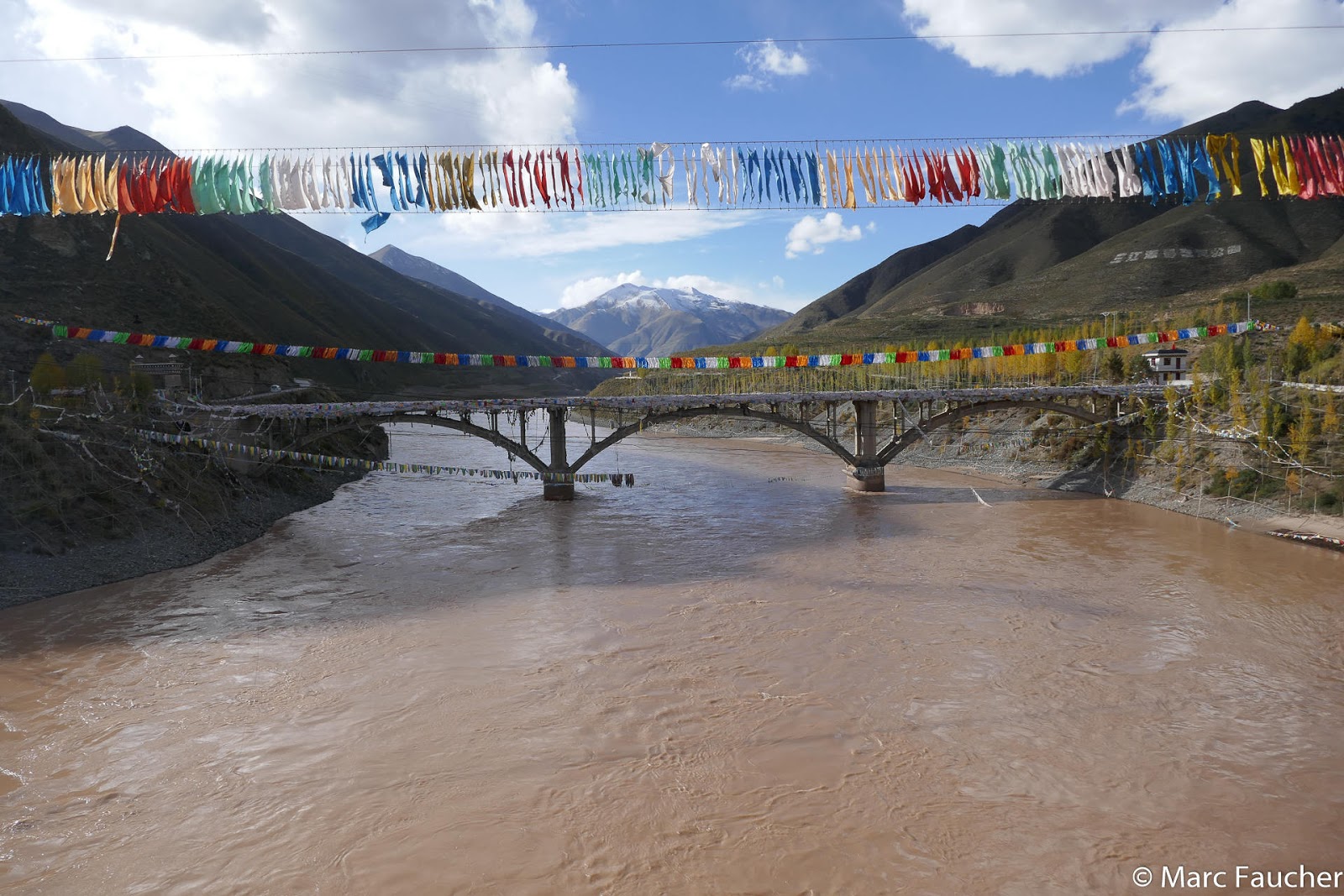
Just before Yushe, we crossed the mighty Yangtze River whose source is on the Tibetan Plateau. At 6380 km it is the longest river in China and the third longest river in the world!
 |
| Crossing the Yangtze River |
A final surprise awaited us as we entered the town, a pair of Ibisbill, a bird so distinct it has its own family, Ibidorhynchidae!
 |
| Ibisbill |
Another day, another pass. This morning we crossed over the Galaga Pass at 4493 meters (just below 15,000 feet) and headed down to a secret valley dubbed “Greentours Valley”.
 |
| Galaga Pass |
We stopped before a bridge too narrow for our vehicles and had breakfast. Cathy spotted a Tibetan Fox, our closest encounter yet and we all got great views and photos.
 |
| Tibetan Fox |
We crossed the bridge on foot and headed into the valley on the lookout for Glover’s Pika that hang out on the rocks. I missed the first sighting but luckily there was another more obliging individual.
 |
| Glover’s Pika |
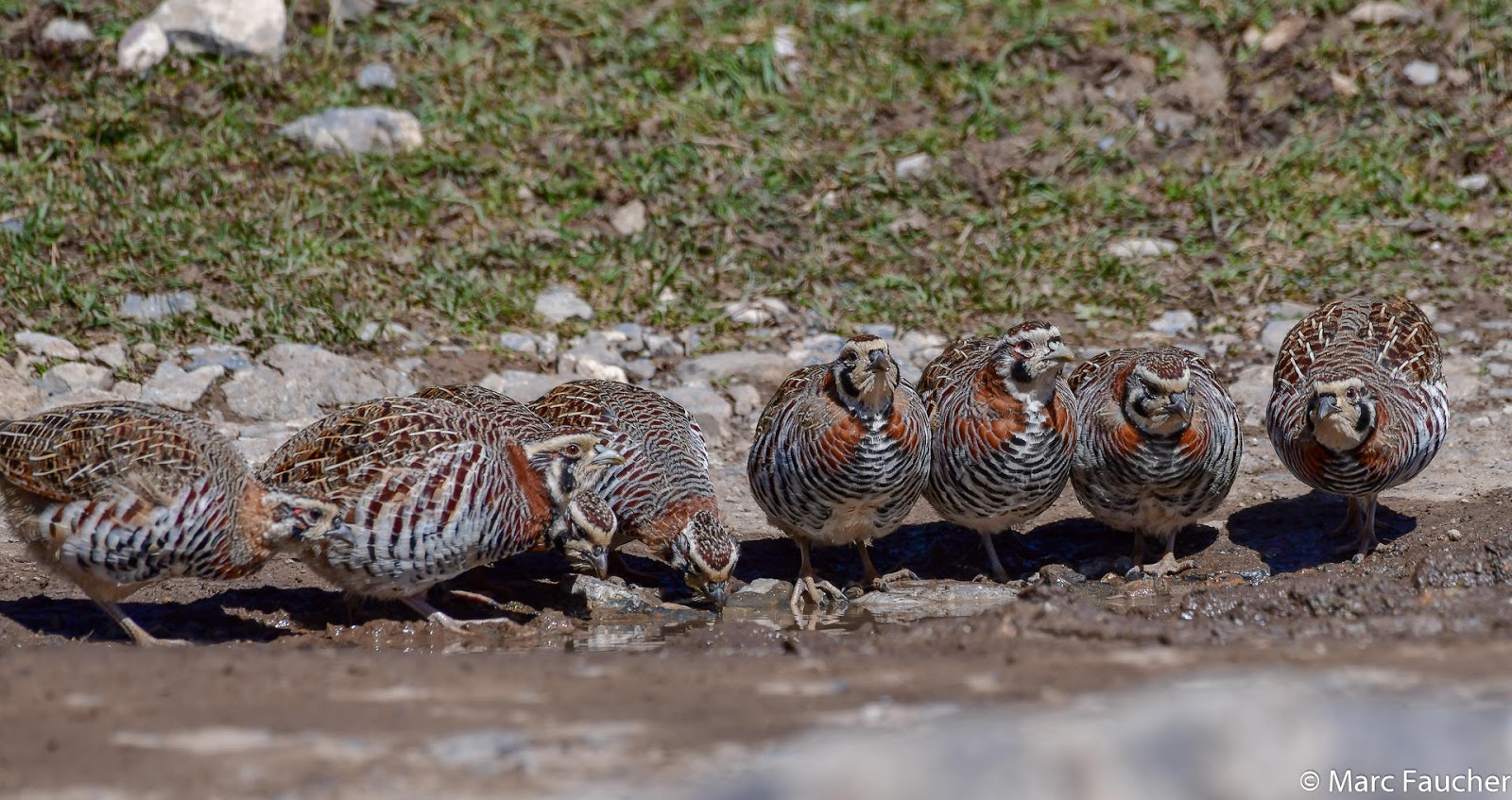
There were many Himalayan Marmots that had come out of their burrows to bask in the warm sunshine and a large family of Tibetan Partridge stopped right next to the road for a drink giving us fantastic views and photographic opportunities.
 |
| Tibetan Partridge |
Past a small village, the canyon narrowed and Buddhist deities had been carved into the stone wall and painted with bright colors.
 |
| Buddhist Carvings |
Further up the valley, an Altai Weasel ran across the road in front of Jesper. We feared that we had missed it but the weasel reappeared and we followed it down the road as it ran along the rocks.
 |
| Altai Weasel |
Further up the valley, I spotted a large flock of White Eared-Pheasants. They
get their name because of their white coloration and their prominent ear tufts, not because they have white ears! We got great views as they scrambled up the rocky slopes and finally out of view.
 |
| White Eared-Pheasants |
It was getting late and time to head back to our vehicles. We still had a 2-hour drive to Nangqian. Our exploration of the Tibetan Plateau was now half over. We had seen so many amazing creatures that eke out a living on this high and dry plateau often referred to as the “Roof of the World”. What surprises await us during the second half of our journey? Stay tuned!
We hope all is well with everyone.
Peggy and Marc
Our route map: