Greetings Everyone,
Our journeys have brought us back to Ecuador to explore the country’s many diverse habitats in search of animals and birds. Our first destination was Cuyabeno Reserve which straddles the equator in the northeast. From Quito a 35-minute flight takes you to the “oil town” of Puerto Agrio. Here we were met by staff from Cuyabeno Lodge and boarded a bus for the hour and a half drive. We drove along a narrow, winding road with little traffic through a couple of small towns. We stopped at the small town of Tarapoa and picked up Fabricio, our guide for Cuyabeno. He told us a bit about the area during the last part of our drive. Basically the area was all rainforest prior to the 1930’s when oil was discovered. Extraction started in the 50’s and Ecuadorians from other parts of the country flooded in for jobs in the oil industry displacing the indigenous tribes. The Cuyabeno Reserve was created July 26, 1979 mainly for the remaining indigenous people. At 603,380 hectares (1,490,000 acres), it the second largest reserve of the 45 national parks and protected areas in Ecuador. There are eight major ecosystems in Cuyabeno consisting of swamps, flooded forests called varzea, rivers, lakes and well drained forests called terra firma.
 |
| Map of Cuyabeno Reserve (courtesy of Cuyabeno Lodge) |
We stopped for lunch at the Choza Marle Cafe next to the Cuyabeno River. While waiting for the food to be served Marc photographed the colorful Green-banded Uranias, a day-flying moth.
 |
| Green-banded Uranias |
After lunch we boarded a boat piloted by Hector for the two and a half hour cruise down the Cuyabeno River. We saw some birds including a nocturnal Great Potoo which awoke at our approach.
 |
| Great Potoo |
Fabricio spotted three Monk Sakis, a type of monkey, high up in a tree but they were too far away to get a good view. A bit further downriver he spotted a Two-toed Linne’s Sloth and two Pink River Dolphins, our mammal viewing was improving! The sun was setting as we entered Laguna Grande where the lodge was located. Greater Bulldog Bats were plying the water looking for small fish near the surface.
 |
| Greater Bulldog Bats |
Our explorations began early the next morning. As we left the lodge, prehistoric-looking Hoatzins were roosting just past the dock.
 |
| Hoatzin Pair |
We crossed Laguna Grande and entered the Cuyabeno River where a family of Proboscis Bats were roosting on a log. Fabricio told us that they were the only bats that are truly blind.
 |
| Proboscis Bats |
We continued upriver seeing many birds and encountered a large troop of Common Squirrel Monkeys and two Monk Sakis much closer than the ones we saw yesterday. We passed back through the lagoon seeing two Pink River Dolphins before returning to the lodge for breakfast.
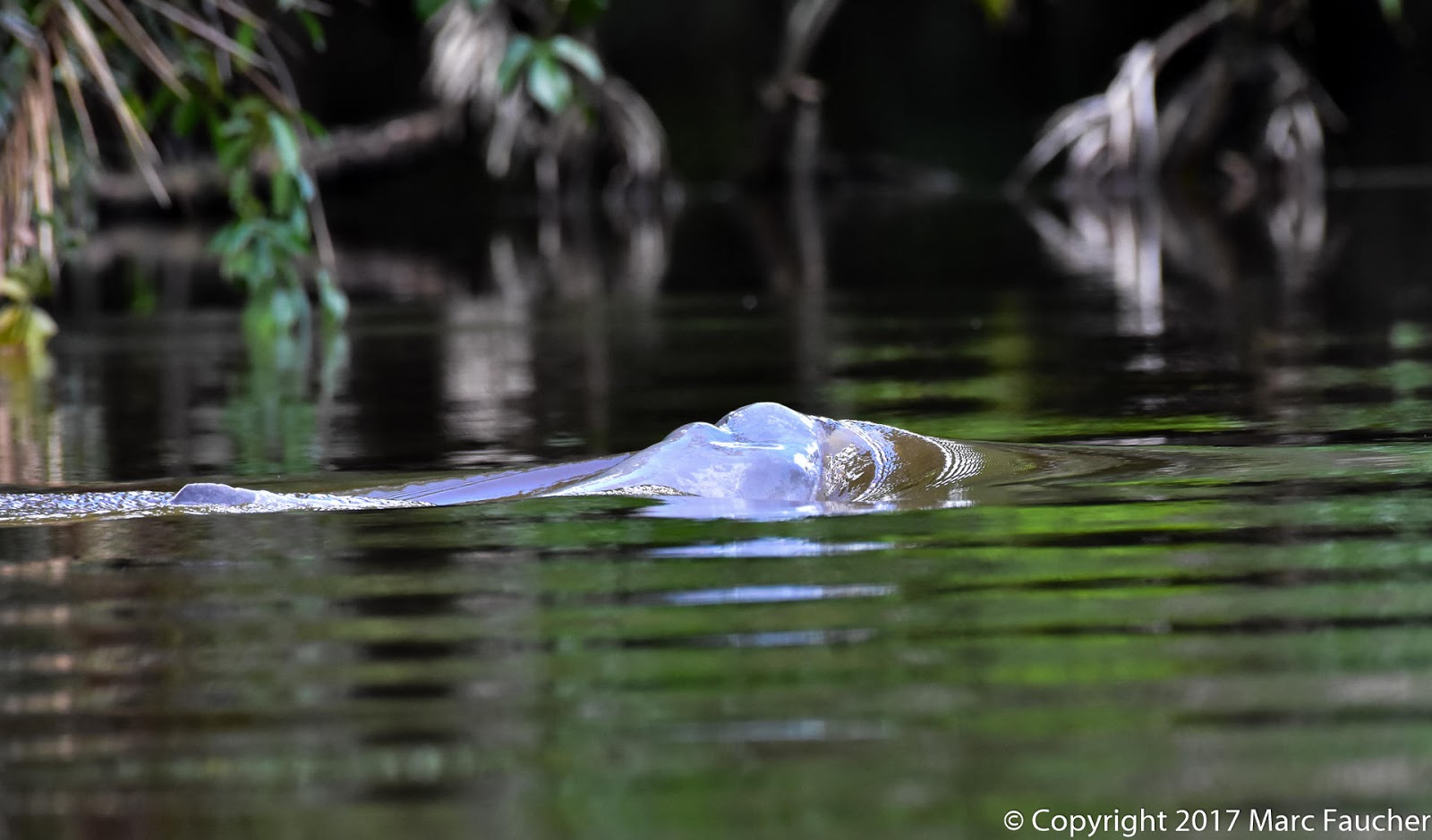 |
| Pink River Dolphin |
After breakfast Marc spotted a monkey in the tree right next to our balcony. I guessed it might be a Yellow-handed Titi, the primate I most wanted to see. Marc got a photo but its hands were hidden so we weren’t sure. We had a short break before heading out to hike the Palmrocha Trail. We were all set to go when Hector heard a chainsaw. The rangers were clearing the trail so it didn’t make sense to walk it. The chainsaws they were using would scare all the animals away. We decided to try another trail. As we were leaving Fabricio spotted a Spix’s Night Monkey in the hollow of a tree. It turned out there were two and they climbed to the top of the tree and peered out.
 |
| Spix’s Night Monkey |
We went to a different trail called Hormigero where we did a short hike. We didn’t see much mammal-wise but did find a hornet spider, leaf frog, morpho butterflies, a clear-wing butterfly, a lineated woodpecker and a tarantula which Fabricio coaxed out of its hole.
 |
| Tarantula |
We returned to the lodge for lunch and a bit of downtime before heading out again around 4:00. This time we headed up the Hormiga River where we heard a strange clicking sound. Fabricio said the noise was made by peccaries when they snap their jaws. We went to investigate and saw a herd of about 20 White-lipped peccaries crossing in the forest.
 |
| White-lipped Peccaries |
We went to another lagoon called Caiman Chocha to watch the sunset and saw a bizarre-looking Bare-necked Fruitcrow with its large neck wattles perched in the top of a tree.
 |
| Bare-necked Fruitcrow |
After watching the sunset we returned to the lodge for dinner. As we were eating a blonde-colored rat scurried along the railing right next to Fabricio. It seemed very tame but no one at the lodge had seen it before. Fabricio thought it might be an Amazon Bamboo Rat.
 |
| Amazon Bamboo Rat |
After dinner we took a boat to the Catolica Trail for a night walk. In a clearing at the very start of the hike we saw a Brazilian Porcupine, the first porcupine we have ever seen in South America.
 |
| Brazilian Porcupine |
We were up early the following morning but rain delayed our departure from the lodge. Once it stopped we headed upriver to look for more wildlife. We encountered a large troop of about 80 Squirrel Monkeys and about 12 White-fronted Capuchins making for some good photos.
 |
| Squirrel Monkeys |
We encountered another large troop of Squirrel Monkeys mixed with White-fronted Capuchins and heard Black Mantle Tamarins, a new monkey for us but could not get a view. Further upriver were Yellow-handed Titi Monkeys and Monk Sakis. We stopped along the river and clambored up the steep river bank using a small tree as a rope. Pygmy Marmosets were known to live here. Sure enough Fabricio spotted a baby hiding in some bromeliads on a tree. Closer inspection revealed an adult and a second juvenile.
 |
| Pygmy Marmoset |
Wow, this section of river was “Monkey Alley”! We saw 5 species and heard a 6th! We were now up to 6 seen species of the 10 primate species known to inhabit this area. We just had to get a view of the Black-mantle Tamarins and find the Common Woolly, Red Howler and Red Titi Monkeys. Nearby was a Linné's or Linnaeus’s Two-toed Sloth.
 |
| Linnaeus’s Two-toed Sloth |
On the way back to the lodge we took a short detour to the hollow tree where a Green Anaconda was known to reside. We had checked this tree twice but both times the snake was hidden inside. This time she was coiled in the tree above her burrow and we could see her head and massive girth. Fabricio estimated her to be about 5 meters long!
 |
| Green Anaconda |
When we returned to the lodge for lunch, one of the guests pointed out some White-fronted Capuchins that were trying to raid the kitchen. One came very close and Marc got good photos.
 |
| White-fronted Capuchin |
After lunch we joined Fabricio on the observation tower to look for monkeys. From our balcony just two levels below we saw the Yellow-handed Titi Monkey again. This time Marc was able to get a photo of his yellow hands so there could be no doubt.
 |
| Yellow-handed Titi Monkey |
There was also a female with a week-old baby. This was the first time Fabricio had seen this infant.
 |
| Female with Baby |
I went above and Marc stayed below. When I returned to our balcony Marc said he had spotted a Tamandua. I was skeptical but sure enough a Southern Tamandua was on a large palm frond scratching his back because of the ants he was feeding on! We watched him for about 10 minutes before he disappeared back into the forest.
 |
| Southern Tamandua |
About 20 minutes later a small troop of White-fronted Capuchins showed up in the same location as the Tamandua. Marc was able to get more good photos. I love it when the animals come to you: Yellow-handed Titi Monkeys, a Southern Tamandua and White-fronted Capuchins all from our balcony!
At 4:00 we headed out again to “canoe” in Tanin Bueno, an oxbow lake created when the Cuyabeno River changed course. Fabricio said that boats had been prohibited from entering the lake to protect the Black Caimans living there but recently the lake was opened to boat traffic. Just before we entered we spotted two Common Woolly Monkeys at mid-level in the canopy. We had now seen 7 species of monkey, just 3 to go!
 |
| Two Common Woolly Monkeys |
We saw Squirrel Monkeys, a Green Kingfisher and Ringed Kingfishers as we negotiated the narrow channel to the lagoon. Once inside the Tanin Bueno Hector and Fabricio paddled us around where we were hoping to see Giant Otters. The scenery was stunning as the sun set behind the partially submerged macrolobium trees in the lagoon.
 |
| Sunset over Tanin Bueno |
Today was a full day trip downriver to another lagoon about 50 km away. Fabricio said he had not been there for 2 years. The lodge packed us lunch and we headed out at 6:40. We finally saw our first Black Mantle Tamarins but they were wary and we didn’t get great views. We stopped for Fabricio to check out an area where Red Titi Monkeys were known to frequent. He climbed the river bank and disappeared. Hector followed and returned 5 minutes later and told to come. I had to use a small tree as a rope to climb the steep, slippery bank. We went to a clearing in the forest where Fabricio said he saw 3 fairly close but we were too late and they had moved off. We saw one in the distance so at least we could now claim we had seen 9/10 species of monkey!
We climbed down to the boat and continued downriver to 3 Siona villages. The first, Sioquiya, was a new village built by evangelicals and housed 20 people. The second,San Victoriano, where 80-100 people lived. A short distance down river was the largest village called Puerto Bolivar with 200 people.
 |
| Puerto Bolivar |
There are around 300 Siona and around 1000 Quechua living in the reserve. We hope the life of the indigenous communities in the Cuyabeno Wildlife Reserve has improved due in part to earnings from ecotourism.
Once we were past the villages we encountered a troop of Black Mantle Tamarins! They were inquisitive and came quite close for good views and photos.
 |
| Black Mantle Tamarin |
Around 1:10 we stopped for lunch at an old fishing camp called Puerto Montufar just above the river. Fabricio hauled the wooden bench from the boat so we’d have a place to sit.
 |
| Lunch |
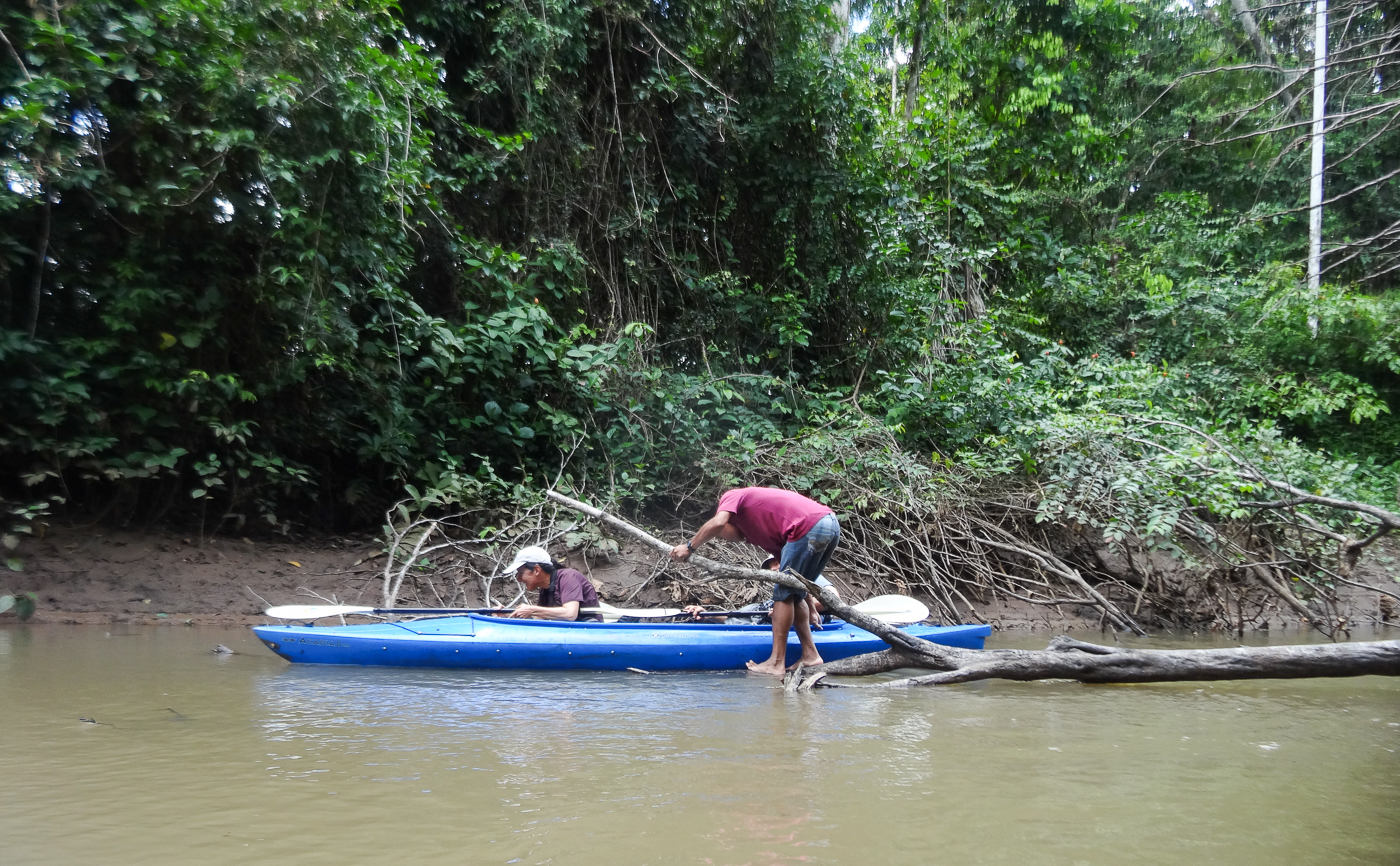
After lunch Fabricio announced that we’d have to turn back. We had already traveled 33 miles! It was now around 2:30 and as it was we’d get back to the lodge well after dark. We started the long journey back but left the main river to explore a side tributary. We slowly motored up the narrow tributary, skirting around fallen trees, powering over submerged logs and paddling where it was too shallow for the motor. Hector was interested to see where this branch led as he had never been here before! We made it up the fork about 3 miles before we had to turn back due to a fallen tree that we couldn’t get around. As we headed back to the main river we heard something crashing through the forest behind us. I thought it may be peccaries but Hector shouted “lobo, lobo!" This means wolf in Spanish. That’s right, Giant Otters are called lobos by the locals. Sure enough five Giant Otters broke through the forest, slid into the river and swam off upstream. Hector and Fabricio tried to paddle up to them. We got one good view of their heads popping up before they disappeared for good.
 |
| Giant Otters |
By the time we got back to main river the sun was setting. When it got dark enough we pulled out our lights to see animals along the river. Fabricio spotted a Paca under some roots. We could only see its head until it shot out when we got too close. We also got a good view of a Kinkajou that was scratching his back on a branch.
 |
| Kinkajou |
We got a better view of a second paca and also saw an Amazon Tree Boa, a Spectacled Caiman and Common Nighthawks. We saw our 22nd mammal of the trip, a Brown-throated Three-toed Sloth. We passed the villages now lit up for the evening. As we motored through Laguna Grande we shut off our lights and enjoyed the view of the stars overhead. We got back to the lodge around 8:40 and went directly to dinner. It was a long but rewarding day adding 5 new mammals to our list!
We left the lodge at 5:30 the next morning and returned to Tanin Bueno. The lagoon was like glass reflecting the partially submerged trees (Macrolobium) at sunrise.
 |
| Tanin Bueno |
We cruised slowly then stopped to drift hoping to see the telltale bubbles of a Manatee. Fabricio managed to spot Red Howlers a long distance away. I could see them in my binoculars and Marc was able to get a photo to confirm that we had seen our 10th and final species of monkey!
 |
| Red Howler Monkeys |
As we rejoined the main river, I asked if we could see if the Common Woolly Monkeys were in the same area we had seem them before. Hector spotted a large troop of maybe 30 individuals nearby. The light was much better for photography but the monkeys were higher up in the trees. There were adults, juveniles and infants being carried on their mother’s back.
 |
| Woolly Monkeys |
We returned to the lodge for breakfast before heading out again at 9:30 to go for a walk along the El Saladero Trail to a salt lick where there was a possibility of seeing tapir, brocket deer and peccaries. We didn’t see any mammals but we got to cross the equator on foot!
 |
| On the Equator |
We returned to the lodge for lunch and spotted the Yellow-handed Titi family in a tree over the restaurant deck. I could see 3 adults but the baby was hidden. They were trying to dry out after the recent rain. Two adults had their tails entwined. Fabricio said it was their way of holding hands, the only monkey to do so.
 |
| Yellow-handed Titi Couple |
At 4:00 we set off to explore Laguna Charapacocha, an area of flooded forest and smaller lagoons. We cruised up a narrow channel and encountered an inquisitive troop of Common Squirrel Monkeys. We stopped at a lagoon to watch the sunset and enjoy our beers, the first sundowners (a tradition in South Africa) in the Cuyabeno Reserve. Fabricio snapped a photo.
 |
| Sundowners on Laguna Charapacocha |
We got back to the lodge in time for dinner and went out after for our last night boat trip upriver. We didn’t see much except an Amazon Tree Boa. On our way back to the lodge we enjoyed the stars overhead and their reflection in Laguna Grande. As we climbed to our room I saw a tiny mouse, mammal #23 on our list, although I’ll never be able to identify it.
A heartfelt thanks goes to our amazing guide Fabricio and our very skillful boat driver Hector for showing us the wonders of Cuyabeno Reserve! They enabled us to find an astounding 23 species of mammals and 80 species of birds! Thanks also to the wonderful staff at Cuyabeno Lodge for making our stay comfortable and accommodating our needs. We hope the Reserve will continue to provide haven for the indigenous people and wildlife that call this rainforest home.
We hope all is well with everyone.
Peggy and Marc
Our Route Map:


Cuyabeno Mammal List
| No. | Species | Scientific Name | Notes |
| 1 | Pink River Dolphin | Inia geoffrensis | Laguna Grande & Cuyabeno River |
| 2 | Common Squirrel Monkey | Saimiri sciureu | Large troops along the river & @ the lodge |
| 3 | Monk Saki | Pithecia milleri | Small groups along the river |
| 4 | Yellow-handed Titi Monkey | Callicebus lucifer | Family of 4 @ Cuyabeno Lodge & along river |
| 5 | Brown-throated Sloth | Bradypus variegatus | Seen at night along Cuyabeno River |
| 6 | White-lipped Peccary | Tayassu pecari | Group of ~20 next to the Cuyabeno river |
| 7 | Southern Tamandua | Tamandua tetradactyla | One on a palm tree at Cuyabeno Lodge |
| 8 | Spix’s Night Monkey | Aotus vociferans | Two in a tree in Laguna Grande |
| 9 | Linné ‘s Two-toed Sloth | Choloepus didactylus | Three seen along the Cuyabeno River |
| 10 | White-fronted Capuchin | Cebus albifrons | Small group @ the lodge & along the river |
| 11 | Brazilian Porcupine | Coendou prehensilis | Seen on the Catolica Trail during a night walk |
| 12 | Kinkajou | Potos flavus | Seen at night along Cuyabeno River |
| 13 | Amazon Bamboo Rat | Dactylomys dactylinus | In the dining room of the lodge at night |
| 14 | Common Woolly Monkey | Lagothrix lagotricha | Seen along the Cuyabeno River |
| 15 | Black Mantle Tamarin | Saguinus nigricollis | Seen along the Cuyabeno River |
| 16 | Proboscis Bat | Rhynchonycteris naso | Seen under the Cuyabeno Bridge & roosting on logs in the river |
| 17 | Greater Bulldog Bat | Noctilio leporinus | Seen fishing in Laguna Grande |
| 18 | Pygmy Marmoset | Cebuella pygmaea | Family of 3 along Cuyabeno River |
| 19 | Giant Otter | Pteronura brasiliensis | Family of 5 in a small tributary of the Cuyabeno River |
| 20 | Spotted Paca | Cuniculus paca | Two seen at night along Cuyabeno River |
| 21 | Red Titi Monkey | Callicebus discolor | Brief look at One along the Cuyabeno River |
| 22 | Venezuelan Red Howler | Alouatta seniculus | Three seen around Tanin Bueno |
| 23 | Mouse | Sp.? | Seen at night at Cuyabeno Lodge |
Cuyabeno Bird List:
- Black-throated Mango
- Orange-winged Parrot
- White-winged Swallow
- Red-capped Cardinal
- Blue-grey Tanager
- Hoatzin
- Tropical Kingbird
- Lesser Kiskadee
- Piratic Flycatcher
- Black Skimmer
- Striated Heron
- Boat-billed Heron
- Black Vulture
- Graeter Ani
- Cocoi Heron
- Ringed Kingfisher
- Muscovy duck
- Double-toothed Kite
- Black-fronted Nunbird
- Great Egret
- Yellow-rumped Cacique
- Russet-backed Oropendola
- White-throated Toucan
- Channel-billed Toucan
- Many-banded Aracari
- Blue-and-yellow Macaw
- Red-bellied Macaw
- Squirrel Cuckoo
- Yellow-tufted Woodpecker
- Great Potoo
- Greater Yellow-headed Vulture
- Black-tailed Trogon
- Black Caracara
- Red-throated Caracara
- Bare-necked Fruitcrow
- Anhinga
- Short-tailed Swift
- Lettered Aracari
- Common Nighthawk
- Ivory-billed Aracari
- Spectacled Owl
- Gilded Barbet
- Slate-colored Hawk
- Spix’s Guan
- Piping Guan
- Speckled chachalaca
- Violaceous Jay
- Green ibis
- Amazon Kingfisher
- Green Kingfisher
- Rufescent Tiger-Heron
- Plumbeous Kite
- Roadside Hawk
- White-eared Jacamar
- Masked Crimson Tanager
- White-banded Swallow
- Lineated Woodpecker
- Crimson-crested Woodpecker
- Amazonian Streaked Antwren
- Great Black Hawk
- Capped Heron
- Sungrebe
- Giant Cowbird
- Fork-tailed Palm Swift
- Red-necked Woodpecker
- Yellow-billed Tern
- Ruddy Pigeon
- Pale-vented Pigeon
- Yellow-crowned Parrot
- Green-backed Trogon
- Blue-crowned Trogon
- Pale-footed Swallow
- Hook-billed Kite
- Blue-headed Parrot
- Maroon-tailed Parakeets
- Screaming Piha (heard)
- Yellow-bellied Dacnis
- Casqued Cacique
- Velvet-fronted Grackle
- Golden-headed Manakin (heard)