Greeting All,
We have switched gears from climbing volcanoes to looking for birds and wildlife. We were able to squeeze in a 2-day visit to the Bellavista Cloud Forest, about a 2-hour drive northwest from Quito. Much of Ecuador's cloud forest has been cleared for agriculture and cattle grazing. In 1991 Richard and his wife Gloria purchased their first piece of land and built Bellavista Lodge 2 years later. Today the lodge protects 700 hectares of cloud forest and more land is being purchased and allowed to revert naturally back to forest. When we arrived we were greeted by many colorful hummingbirds that visit Bellavista's feeders. About 10 different species frequent the feeders this time of year making them easy to photograph.
 |
| Violet-tailed Sylph |
 |
| Buff-tailed Coronet |
After breakfast our guide, Luis, took us on our first hike into the cloud forest to look for different bird species. It's a challenge finding and photographing birds in the dense fog-shrouded forest but with Luis's help Marc got a great photo of a Crested Quetzal.
 |
| Crested Quetzal |
Another hike in the afternoon yielded many more beautiful birds. Here are a few of our favorites:
 |
| Plate-billed Mountain Toucan |
 |
| Toucan Barbet |
That night after dinner an unexpected surprise awaited us. A pair of Olinguitos, a new species of mammal discovered in August, 2013, were in the trees right next to the lodge! The Olinguito, a nocturnal South American mammal has evaded the scientific community for all of modern history and is the first carnivore species to be discovered in the American continents in 35 years!
 |
| Olinguitos |
The following morning I was up early to wait for the Tayra. I had received a tip that this animal visits the lodge around 6:00 AM. Sure enough, a large weasel-like animal appeared on the forest floor and climbed up a tree to a bunch of bananas that had been hoisted up into the canopy to entice animals to visit. The Tayra would grab a banana, climb back down to the forest floor and disappear for about 10 minutes to eat his prize. He made about 6 trips before disappearing for good, no doubt quite satiated after consuming so many bananas!
 |
| Tayra |
We had time for one more birding hike in the cloud forest before returning to Quito. On the drive from Bellavista a female Andean Cock-of-the-rock had built her nest right next to the road!
 |
| Female Andean Cock-of-the-rock |
Early the next morning we started the long journey to Kapawi Ecolodge deep in the Amazon Rain Forest. The trip started with a 4-hour drive to the town of Shell at the edge of the rainforest. From here we took a 50-minute flight in a 10-seater Britton-Norman Islander over a seemingly endless expanse of Amazon Rainforest.
 |
| Amazon Rainforest |
Soon we were enveloped in clouds and rain pelted the windshield. We bumped along and I hoped we'd reach the airstrip at Kutsutkau soon. Our pilot skillfully threaded his way through the clouds to the dirt airstrip below and we landed with a thud.
 |
| Kutsutkau Airstrip |
We unloaded the plane including fuel for the lodge's generator and reloaded our stuff onto a motorized canoe.
 |
| Unloading the plane at Kutsutkau |
A 30-minute trip down the Capahuari River finally brought us to the Kapawi Ecolodge and Reserve where we would spend the next week. The lodge was built in Achuar Territory in 1993 in an effort to protect their pristine rainforest home from oil extraction, logging and mining. Kapawi Ecolodge is situated deep in Ecuador's southeastern part of the Amazon Basin close to the border with Peru. We settled into our cabin, #18, the last cabin in a row of cabins along a drying lagoon.
 |
| Our Cabin at Kapawi Ecolodge |
We explored the trails and rivers in the area with our naturalist guide Valeria and our local Achuar guide Abraham. Here is a map of the area.
 |
| Map of Kapawi Lodge Area |
The best place to look for wildlife was along the rivers. Hanging from a tree along the Capahuari River was a Brown-throated Sloth, a species of Three-toed Sloth. He remained in the same tree for days and we'd be sure to look for him as we passed by.
 |
| Brown-throated Sloth |
Also seen along the rivers were troops of Red-howler Monkeys and Saddleback Tamarins. We had gotten a glimpse of one of these tiny monkeys in Peru back in 1991 but here they were plentiful and not quite as shy.
 |
| Saddleback Tamarin |
A new species of monkey for us was the White-tailed Titi Monkey. We only saw two of these monkeys but it was a reasonably good sighting.
 |
| White-tailed Titi Monkey |
A family of Horned Screamers lived in the lagoon in front of the lodge. We first encountered these bizarre birds last year in Brazil but here they weren't as shy and Marc got a great photo.
 |
| Horned Screamer Family |
Along the Pastaza River were clay licks where colorful Chestnut-fronted Macaws, Yellow-crowned Amazon Parrots, Dusky-headed Parakeets and Orange-cheeked Parrots would gather every morning to eat clay to neutralize toxins in the plants and seeds they ingest.
 |
| Orange-cheeked Parrot |
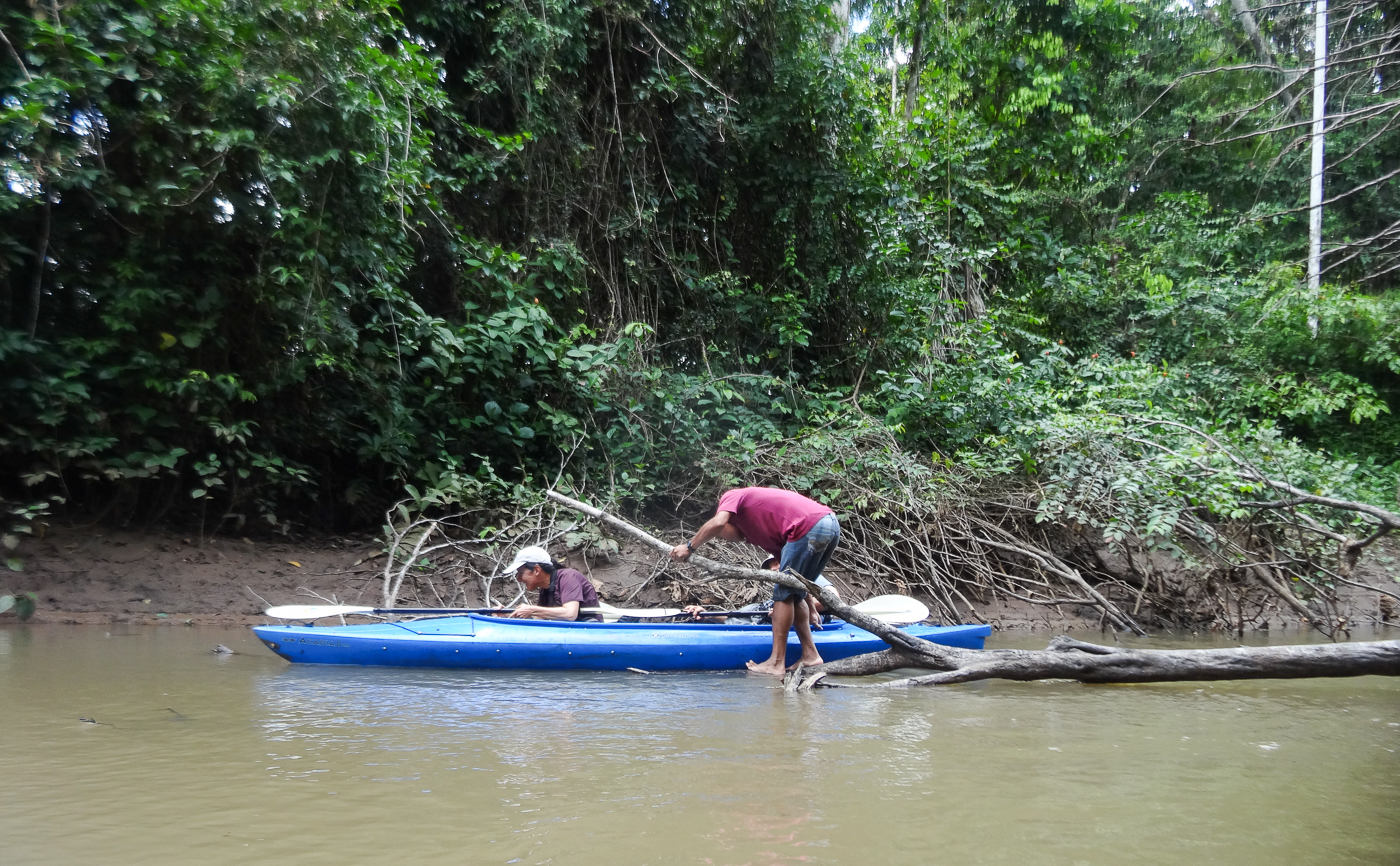
Gray River Dolphins glided along the rivers and would briefly surface to exhale. We glimpsed a Neotropical River Otter but he submerged before Marc could get a photo. Others at the lodge had seen Giant Otters but we weren't so lucky. We searched the main rivers for them but came up empty handed. I suggested we explore a more obscure river, the Ishpingo, but Abraham told us it was narrow and blocked with fallen trees. That did not deter us. We motored upriver as far as we could go in the canoe stopping frequently so Abraham could hack away fallen trees with his machete!
 |
| Abraham Clearing the Way! |
Finally we could go no further as a tree too big to cut lay in our path. No worries, we had brought along two kayaks and transferred into these tiny boats and continued upriver. It wasn't easy going against the current. We had to maneuver around many fallen trees and at times got stuck on top of them. Abraham would come to our rescue and push us off.
 |
| Abraham to the Rescue |
Other times we had to lay in our kayak and squeeze under a large fallen tree!
 |
| How low can you go? |
Our efforts were not in vain. A Giant Otter scolded us for trespassing in his private domain. Not wanting to disturb him for long we turned around and headed downriver. As we rounded a bend the remainder of the otter's family joined him in admonishing us. There were 10 otters in total, the largest family group we had ever seen.
 |
| Giant Otter Family |
We returned to the canoe for lunch then continued downriver in our kayak. We came upon a troop of Saddleback Tamarins that were clearly agitated at us or so we thought. When Valeria and Abraham caught up to us, Valeria exclaimed "look at that baby tamarin on the branch just behind you!". We turned around and there was a tiny baby clinging desperately to a fallen tree branch in the middle of the river!
 |
| Stranded baby Saddleback Tamarin |
He must have fallen into the river and managed to climb out but was now stranded. His mom screeched from the shore but was not sure how to help him.
 |
| Frantic Mom |
The kites circled overhead in anticipation of an easy meal. "We have to save him!" Valeria exclaimed. She grabbed him and Abraham paddled to shore where Valeria released the petrified infant. He scurried up to his waiting mother and the reunited pair disappeared into the forest.
Our search for wildlife did not end when the sun set. A whole new set of creatures appeared after dark. On night walks we encountered creepy spiders and scorpions, poison dart frogs, cicadas, walking sticks and night birds.
 |
| Wolf Spider |
 |
| Ecuadorian Poison Dart Frog |
Sadly, the night monkeys eluded us. On one of our last days Abraham informed us that that Eduardo, one of the boat drivers, had found the night monkeys' daytime roost. Finally, we were able see the wide-eyed family of four who had been visiting a fruiting tree next to the bar.
 |
| Spix's Night Monkeys |
After visiting the night monkeys' roost Abraham had another surprise for us. "Did we want to go to Kapawi Village to see a family of Pygmy Marmosets that were living near his house?" he inquired. "Of course!" we answered. We had been searching for them all over the Amazon and there was a family right in the village. We weren't disappointed. A curious fellow came close and posed for us.
 |
| Pygmy Marmoset |
On our last night we were treated to a glorious sunset over the Amazon Basin.
 |
| Sunset Over the Amazon Basin |
What a fitting end to an amazing week at Kapawi! Our heartfelt thanks to Valeria and Abraham for showing us the wonders of the Amazon rainforest. May Abraham and all members of the Achuar community continue to live in harmony with nature without the threat of outsiders wanting to exploit their rainforest home!
We hope all is well back home,
Peggy and Marc
Ecuador Mammal List:
| No. | Species | Scientific Name | Notes |
| 1 | White-tailed Deer | Odocoileus virginianus | Cotacachi-Cayapas |
| 2 | Vicuña | Vicugna vicugna | Chimborazo |
| 3 | Red-tailed Squirrel | Sciurus granatensis | Bellavista |
| 4 | Olinguito | Bassaricyon neblina | Bellavista |
| 5 | Tayra | Eira barbara | Bellavista |
| 6 | Venezuelan Red Howler | Alouatta seniculus | Kapawi |
| 7 | Saddleback Tamarin | Saguinus fuscicollis | Kapawi |
| 8 | White-tailed Titi Monkey | Callicebus discolor | Kapawi |
| 9 | White-fronted Capuchin | Cebus albifrons | Kapawi |
| 10 | Common Squirrel Monkey | Saimiri sciureus | Kapawi |
| 11 | Pygmy Marmoset | Cebuella pygmaea | Kapawi |
| 12 | Spix’s Night Monkey | Aotus vociferans | Kapawi |
| 13 | Neotropical Otter | Lontra longicaudi | Kapawi |
| 14 | Giant Otter | Pteronura brasiliensis | Kapawi |
| 15 | Tucuxi | Sotalia fluviatilis | Kapawi |
| 16 | Common Opossum | Didelphis marsupialis | Kapawi |
| 17 | Brown-throated Sloth | Bradypus variegatus | Kapawi |
| 18 | Proboscis Bat | Rhynchonycteris naso | Kapawi |
| 19 | Capybara | Hydrochoerus hydrochaeris | Kapawi |
| 20 | Greater Sac-winged Bat | Saccopteryx bilineata | Kapawi |
| 21 | Bat | Sp.? | Kapawi |
| 22 | Black Agouti | Dasyprocta fuliginosa | Kapawi |
| 23 | Kinkajou | Potos flavus | Kapawi |