Friday, July 26, 2013

Stay in the Croc or be Eaten by One!

Greetings All,
After leaving Etosha National Park we headed north to visit an Owambo homestead at Ongula.   The Owambo are pastoralists grazing their herds of goats and cattle and growing mahangu.  Mahangu or pearl millet is the staple food of the north-central regions of Namibia.  

Owambo Woman Pounding Mahangu

Able to grow in low-rainfall, high temperatures and low soil fertility, it is eaten in a variety of dishes and drinks, and the stalks are used to feed cattle and thatch roofs. Once grown, harvested and threshed, the mahangu is stored in giant baskets made of Mopane branches.

Basket for Storing Mahangu
 
That night were were treated to a song and dance performance by the local girls.

Owambo Girls Singing and Dancing


We continued our journey north and then to the west to the Kunene River which forms part of the northern border with Angola.  After not seeing flowing water for nearly two months it was a treat to cruise on the Kunene River.  We stopped on the northern shore (Angola) to take in another magnificent African sunset.

Marc and Peggy on the Kunene River
 
The next day I got up the nerve to go white water rafting.  The rapids weren't big, maybe class I- III but with a twist, we were to paddle our own two-man raft, called a croc through them!

Peggy next to our "Croc"


I was determined to stay in the boat as giant Nile crocodiles ply these waters.

Nile Crocodile
 
Our guides told us that crocodiles didn't like rapids. I hoped they were right.  We were assured that the rapids were easy but when we had to carry our raft over rocks to a canyon just above a waterfall and be lowered 10 feet over the rocky edge to the river below I wasn't sure what we had gotten ourselves into!  Once on the river we had to avoid going over the twenty foot waterfall which we managed to do. Now, the fun began...  We made it through the first two rapids without too much trouble.  On the third rapid we ended up going down backwards.  When we got to the forth, I had lost faith in Marc's navigational abilities and bailed into one of the guide's boat while Marc bailed into another.  We made it through the fourth rapid but the guides made us get back into our boat for the fifth rapid.  They warned us to avoid the big rock in the middle but failed to warn us of a second rock which we managed to get stuck on.  One of the guide boats had to come rescue us.  The sixth rapid was fairly straightforward and we made it through without incident.  We got out of the boats to check out the seventh and most difficult rapid.  It was class IV.  There was no way I was going down it in a two-man raft with Marc at the helm!  We watched the guides negotiate  the rapid, the first losing his passenger, a teenager from Belgium.  The second boat made it through with another daring teenager. We walked around the rapid with the teenagers' mother.  She was worried seeing her son pop out of the boat and go bobbing down the rapid but he ended up with only a few scrapes.  I wish I had my camera to document our journey down the river but we didn't want to get it wet so we only have one photo of us padding on flat water.

Us Paddling Toward Shore

Somehow we managed to make it through six out of the seven rapids without going overboard. While we were loading the rafts onto the trailer, a Himba girl and her brother out herding goats, came to the river to drink.

Himba Boy and Girl

The Himba are traditionally nomads, traveling long distances to find suitable places to graze their goats and cattle.  The previous day we visited an elderly couple and their 10 year old daughter at their homestead near by.  Their home was built out of sticks and mud.

Himba Family next to their Hut
 
We ducked inside to learn a bit more about how they live.  Living in an area with little rainfall, the Himba rarely bathe.  Instead they coat their bodies with otjize, a mixture of ochre, animal fat and herbs.  It protects their skin from the sun and insects and provides some insulation from the winter cold.

Himba Woman applying Otjize


All of their few belongings are made from leather, scrap metal or gourds.  The married women braid their hair and wear a leather headdress and not much else.  When they get married, they wear a sort of apron decorated with cowrie shells.

Himba Belongings including a Pillow in the lower Right
 
After our visit to the Kunene Region we headed south towards the Grootberg Plateau.  
We hope all is well back home.
Peggy and Marc

Thursday, July 18, 2013

Great White Place

Greetings All,
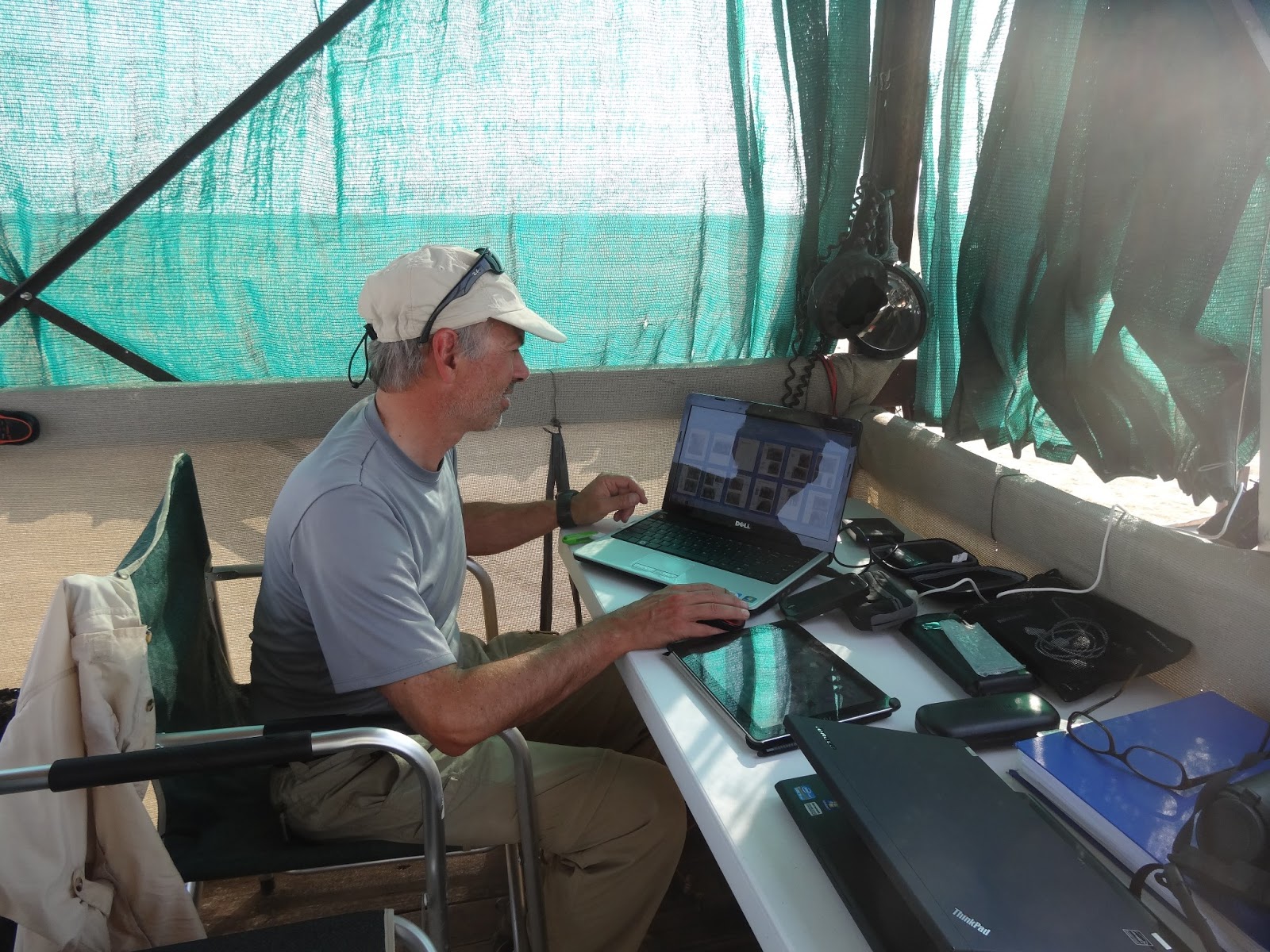
We have finished the Mushara Elephant Expedition.  After two weeks at the waterhole Marc and I cataloged 53 bulls, 28 of them known visitors and 25 new individuals.  We also documented 6 breeding herds including several new herds to the area.  We put together a PowerPoint containing photos and identifying characteristics for each bull.

Marc Working on the PowerPoint

For example, Etosha has a big tear in his left ear and a heart shaped tail.

Etosha's ID Page


Jerry has extreme ear folding and sparse tail hair. 

Jerry's ID Page

By the end of two weeks we could refer to our PowerPoint and identify a bull that had previously visited the water hole.

The herds were much more difficult to document.  There are more individuals and when they're grouped together its difficult to single out individuals for identification.  There were however some very distinct individuals such as Wynonna and her calf Liza.  Wynonna has a "W"shaped cutout in her left ear and a missing left tusk. She is part of the Actors Herd.

Wynonna's ID page


Crumpled Ear is a member of the herd named after her.  She has a very obvious crumpled right ear which makes identifying her easy even at night when most of the herds visit the waterhole.

Crumpled Ear's ID Page


Marc compiled a video library of over 300 gigabytes of footage we took during our two week stay. Hopefully this will make it easier for Caitlin, the lead researcher, to find a particular event.

Marc videoing the Action at Mushara


After two weeks, we were not only getting to know the elephants, we were getting to know the lion pride that makes Mushara their home.  The dominant male who I called "Dark Mane", kept us awake many nights with his grunting roars while mating with one of the lionesses.

Keep Away from my Woman!


 The cubs would visit in the morning and "Bent Ear" would stare at me with an intensity beyond curiosity.

"Bent Ear"


On our last morning a very pregnant  "Bob Tail" paid us a visit.  With her missing tail she looks more like an overgrown bobcat than a lioness.

"Bob Tail" 

After the project, we spent 3 days exploring Etosha National Park on our own.  The park is dominated by the immense Etosha Pan visible from space!  In the language of the Ovambo tribe Etosha means "great white place".  This natural mineral pan was first formed over 100 million years ago. About 16,000 years ago, the Kunene River in Angola would have flowed all the way to Etosha, forming, a large and deep lake. But the river would later change its course due to tectonic plate movement and head for the Atlantic, causing the lake to slowly dry up and leaving the salt pan behind.

Peggy on the Pan

The first afternoon we visited one of the public waterholes.  To our surprise, a breeding herd of elephants came in.  We enjoyed watching them at close range.  As we were leaving another herd came down the road.  We backed up but could only go so far.  We watched with held breath as they drew closer and closer.  Marc didn't want to start the truck and startle them so we held our ground.  They passed within 20 feet of us!  My heart was beating wildly, that was close, a little too close.


Too Close for Comfort!

Our next herd encounter was the following day at a waterhole called Halali.  The waterhole is fenced and the viewing is from some rocks about 20 feet above the waterhole so we were completely safe.  It was fun watching the interactions and a young bull dust bathing or trying to.  He kept blowing the dust in his eyes instead of on his back.


Dust gets in your Eyes

Despite the drought, the animals appear to be doing well.  There is still ample food in the park and water is pumped to numerous waterholes.  How such massive creatures, elephants, rhino, eland and giraffe can sustain themselves on dried grass and leaves is beyond me. Some of our favorite photos from Etosha National Park follow.


A Large Eland Herd Drinks at Mushara 
 
"Blond Mane"
 

A Gang of Giraffe
 
Male Steenbok
 

Black Rhino


Spotted Hyena

We are now heading north to the Kunene River on the border with Angola.  We hope all is well back home.
Peggy and Marc.

Thursday, July 11, 2013

Part of the Herd

Greetings All,
A few days ago we got to view an elephant herd from the bunker.  The bunker is a concrete structure built into the ground 20 meters away from the waterhole.  There is a slit in the front through which you can view and photograph animals that come to the waterhole.

Marc Photographing Elephants from the Bunker  

It's an amazing experience to watch an elephant herd approach from ground level.

Slit Ear's Herd Approaches

The herd that came in is known as Slit Ear's Herd, named after the matriarch that has a large slit in her left ear.  The herd is made up of around 24 individuals.  Herd composition is broken down by size and age.  There are 4 full grown females, aged somewhere between 15 and 45 years, five 3/4-sized individuals aged between 10 and 15 years, six 1/2-sized individuals between the age of 3 and 10 years, seven 1/4-sized individuals from 1 to 3 years old and 3 babies less than 1 year old in the herd.  They stopped at the trough to quench their thirst.

The Herd Drinks from the Trough

Elephants drink a lot of water, about 225 liters per day!  Then can suck up to 9 liters in their trucks at a time and squirt it into their mouths.  We aren't seeing the same herds at the waterhole everyday but they seem to show up every 2 to 3 days.  Once their thirst was quenched, they turned their attention to us.  One inquisitive member of the herd stuck his trunk down into the hatch of the bunker through which we entered.

Trunk in the bunker!
 
Another curious fellow peered at us through the hatch.
 
I See You!


We were quite safe in the bunker and could enjoy being part of the herd.  Slit Ear kept a watchful eye on us.

Slit Ear Keeps an Eye on Us

The youngsters approached the bunker trying to figure out who these strangers among the herd were.

Come out, Come out Whoever you Are!


A teeny baby just weeks old was tucked safely under mom's belly.

Elephant Calf
 
Typically a single calf is born every 4 years after a nearly 2 year gestation.  They are cared for by their mothers and other young females in the herd called allomothers.  Babies wean after 6 to 18 months but may nurse up to 6 years.
 
Slit Ear and her Calf 

Gazing into the eye of an elephant, you get a sense of how intelligent they are.  I wondered what she was thinking.  It's hard to believe that elephants are poached for their ivory.  When I think that this mother who so lovingly cares for her baby and is a member of a family can be killed just so someone can have a trinket made out of ivory, it's makes me angry.  When will human compassion and willingness to share this planet with other beings outweigh our greed and self importance?   


Eye of an Elephant

After about 45 minutes the herd disappeared back into the bush.  Two male Springbok were seriously sparring.  One was actually lifted off the ground by the other and landed on the ground with his leg caught in the victor's horns!


Springbok Males Sparring
 

It was time to return to camp before more elephants showed up at the waterhole.  We'll see what secrets the elephants will reveal in the days ahead.

We hope all is well back home.
Peggy and Marc

Friday, July 05, 2013

Life and Death at the Waterhole

Greetings All,
We are in Namibia's premier National Park, Etosha.  We are part of an elephant research team actually living at a waterhole.  We are assisting Caitlin O'Connell and Tim Rodwell in collecting data on the elephants that visit Mushara waterhole.  A camp complete with a 3-story tower had been set up.  That's our tent on the left of level 1 and home for the next two weeks. 

Marc Pointing to our Tent

One of our first duties was to take video and photographs of bull elephants visiting the waterhole. We have to record when a bull enters the clearing and from what direction.  The challenging part is to identify the bull from photos taken in previous years.  Thankfully, we had Caitlin to assist.  Elephants are identified by cuts, holes or slits in their ears, size of their tusks, hair on their tails, etc.

Mushara Bulls

Late one afternoon we were observing a large breeding herd of  cows, juveniles and calves.  Three young bulls came charging in from the west and scattered the herd.  In all the commotion, a young calf only weeks old got separated from her mother.  A young bull kicked her and she headed back toward the waterhole where only the older bulls remained.  She searched in vain among the giants but mom was nowhere in sight.  The bulls didn't quite know what to do.  We watched helplessly while imploring mom to return.

Baby and the Bulls

It seemed like an eternity but 45 minutes later mom, auntie and cousin came racing back into the clearing.

Help is on the Way
 
When they finally spotted her they rushed over and were reunited

Together at Last

We all breathed a sigh of relief including the old bulls or so it seemed as they sauntered off.  The calf started to nurse as if nothing happened.

What's all the Fuss About?

The next morning started off with a bang, Happy Fourth of July!   I peered out of our tent and a male lion and two lionesses were feeding on a freshly killed kudu not more than 200 meters away.  I dressed and went up above to watch what would happen next.  Another lioness with three cubs approached from the west and joined breakfast.  A large male with a dark mane came from the same direction and claimed the lions share of the kill.

Breakfast at Mushara

After their meal the lions lazed around with fat bellies while the cubs wrestled.

Cubs Playing

The only animal brave enough to approach the waterhole with the lions around was a lone black rhino.

Black Rhino


After the pride had demolished the carcass, they moved off and the opportunistic black-backed jackals moved in.

Jackals Moving In

In just three days we have already witnessed the life and death struggles that play out at the waterhole.  The abandoned elephant calf was reunited with mom and would live to see another day. The ambushed kudu died but would sustain the lion pride until their next kill.

Here are a few more photos of visitors to the waterhole.

Lioness


Oryx Sparring
 
 
Ostrich

We hope everyone had a Happy Fourth of July.  Stay tuned for more stories about living at a waterhole in the African bush.
Marc and Peggy