Showing posts with label Rwanda. Show all posts

Wednesday, September 06, 2017

Paying Tribute to a Conservation Hero

Greetings Everyone,
On July 24 we returned to Volcanoes National Park in Rwanda to search for another endangered primate that makes the highland forests of central Africa its home. The Golden Monkey (Cercopithecus kandti), once considered a subspecies of the Blue Monkey (Cercopithecus mitisis), is protected in four national parks: Mgahinga in southwest Uganda; Volcanoes in northwest Rwanda; and Virunga and Kahuzai-Biéga in the eastern Democratic Republic of Congo. We got a glimpse of a Golden Monkey in Virunga National Park but here in Volcanoes National Park two groups have been habituated making them much easier to see. Surprisingly they were quite close to our lodge and right on the border of the national park. A group of 50 or so were feeding high in the bamboo making it difficult to get a clear view of them. One came down in the open and Marc was able to get a decent photo.

Golden Monkey

While trying to get a better vantage point from which to observe the troop, our ranger/guide came across a snare set to capture a small antelope called a duiker for the bushmeat trade. I was surprised that a poacher would have the audacity to set a snare within the National Park but bushmeat has become big business and the temptation too great. No wild animal including gorillas, chimpanzees, bonobos, antelope, and pangolins are safe from this illegal and unsustainable practice. Our guide quickly disarmed and destroyed the snare before some unfortunate animal fell victim to its grip. 


Disarming a Poacher's Snare

We resumed our observation of the Golden Monkeys as they foraged in the bamboo, sometimes climbing down a nearby shoot.


Golden Monkey

The next morning we set off to make a pilgrimage to Karisoke, the site of Dian Fossey's research camp from 1967 to 1985. Dian first came to Africa in 1963 where she met renowned palaeoanthropologist, Louis Leakey. He was studying the fossils of our ancestors but realized to understand how we evolved we would have to learn about our closest living relatives, the great apes. On the urging of Leakey, Dian returned to Africa three years later to study Mountain Gorillas in the Democratic Republic of the Congo. Political instability in the Congo drove her to neighboring Rwanda where she set up the Karisoke Research Center in September 1967. 

As we set off from the nearest village I couldn't help wondering how much encroachment into the forest had taken place since Dian was here. Our guide, Francois, who worked with Dian when he was in his early 20's replied: "there is actually more forest today since the villagers and their cattle have been relocated outside of the Park". I was surprised. It was not the response I expected but I was happy to hear it.


Start of Hike Showing Bisoke Volcano

We climbed steeply toward a saddle between the volcanoes of Bisoke and Karisimbi in the foothills of the Virunga Mountains. Karisoke gets its name from these two volcanoes. For the research center's name, Fossey used "Kari" for the first four letters of Mount Karisimbi that overlooked her camp from the south and "soke" for the last four letters of Mount Bisoke, the slopes of which rose to the north, directly behind camp.


Nearing Karisoke at the base of Bisoke Volcano

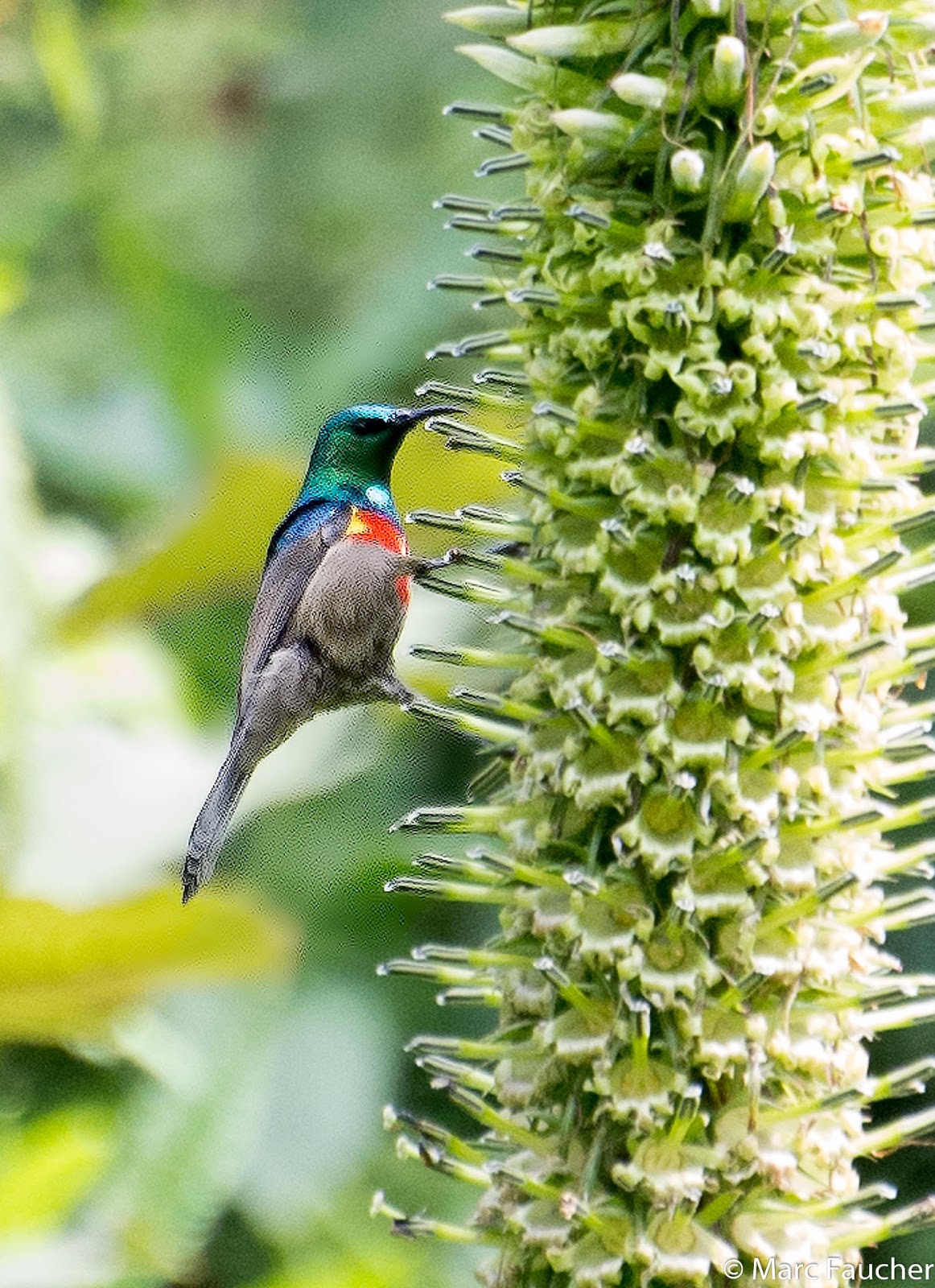
Along the way, we were distracted by colorful sunbirds sipping nectar from the flowers of giant lobelia. 


Northern Double-collared Sunbird

We encountered a group of trackers so we knew that a family group of mountain gorillas was nearby. I was hoping they'd cross the trail but they remained hidden in the forest. We couldn't go off in search of them since we didn't have a gorilla tracking permit. It was thrilling to know that the gorillas that Dian Fossey gave her life to study and protect were thriving in their mountain home! There were about 475 Mountain Gorillas in the early 1960s, but their numbers were dwindling due to poaching and habitat loss. In the early 1980s, the population dropped to about 254 individuals! The world population of Mountain Gorilla is now estimated at 880. In fact, Mountain Gorillas are the only great apes whose numbers are increasing largely due to the efforts of Fossey!

She may not be happy that so many tourists flock to Rwanda each year to see the gorillas but some of the money they bring in goes to the local communities providing them with much-needed income and giving them the impetus to protect the gorillas and their mountain habitat. Throughout the forest were signs of other animals, buffalo, duiker, and a porcupine who benefit indirectly from the gorillas. We arrived at Karisoke around 10:15 in the morning.


Original Sign at Karosoke Research Center

There are not many of the original structures as most of the materials used to build them have been carted off by refugees from the Congo's many conflicts but the feelings I experienced were overwhelming. We stood at the site of Dian's original cabin. All that remained was a rusted stovepipe. 


Site of Dian's Original Cabin

I tried to imagine what it would have been like for a single woman to live alone in the forests of wild Africa. She had become known by locals as Nyirmachabelli, or Nyiramacibiri, roughly translated as "The woman who lives alone on the mountain." She battled poachers and villagers who wanted to graze their cattle here. Many have criticized Dian's methods of capturing and interrogating poachers, pretending to practice black magic to scare them off and shooting their cattle.  Her actions may have been extreme but the situation for the gorillas was dire and Dian was desperate to save them. 


Dian with one of her Gorilla Friends (Credit: Ian Redmond)

Her controversial tactics earned her many enemies and on December 27, 1985, she was hacked to death with a machete by unknown assailants. Standing on the spot of her murder was intense and moving. I couldn't imagine being so passionate about a cause that I'd be willing to suffer such a horrible fate. Yet, Dian was and that is why she is one of my conservation heroes.


Site of Dian's Cabin where she was Murdered

Our last stop was the Gorilla Cemetery and her grave. When we arrived leaves had fallen on the graves and Francois and our porter lovingly removed them. 


Gorilla Graveyard

Our porter had picked flowers for us to lay on Dian's grave. It made me cry, not so much out of sadness but in knowing that 33 years after her death Rwandans respected and admired the woman who had despised and distrusted them. 


Dian Fossey's Grave

If Dian was alive today I hope she would be proud of all that she accomplished in bringing the plight of the mountain gorilla to the world. On New Year's Eve in 1977, Digit, her favorite gorilla, was brutally murdered by poachers as he tried to defend his family. He was only 12 years old when he had been decapitated and his hands hacked off to make ashtrays. His murder was a tragic blow to Dian but Digit's death did raise awareness of the gorillas' plight and, crucially, more money. Fossey subsequently created the Digit Fund (now the Dian Fossey Gorilla Fund International in the USA) to raise money for anti-poaching patrols. To learn more about the fund and how you can help go to:


Dian was laid to rest next to her beloved Digit.


Dian is buried next to Digit

I hope that she would be happy to see that the descendants of the poachers and villagers that she had battled were now working to protect the gorillas and Volcanoes National Park and that they hold no animosity toward the woman who once held them in contempt. It was heartening to hear Francois' feelings about Dian and the work she did.


As we left Karisoke, a Black-fronted Duiker peered at us from the edge of the forest. It was good to see that not only the gorillas were safe in this mountainous forest of central Africa.

Black-fronted Duiker

We encountered a lucky group of tourists who had just visited the group of mountain gorillas that we had passed on the way up. We too had the opportunity to visit the gorillas earlier in our trip on July 9th. You can read more about our encounter on our blog at:


Paying our respects to Dian Fossey was a fitting end to our visit to Rwanda. We were happy to see that the people and wildlife of Rwanda were doing well. It was encouraging to see that the Mountain Gorillas and the villagers can coexist.  We were glad to see the local people benefitting from the Park and the money tourist dollars bring into the country.  It was good to pass by schools and health clinics built by the Dian Fossey Gorilla Fund. May this mutually beneficial relationship between humans and gorillas continue.

We hope all is well with everyone.
Peggy and Marc

Our Route Map:


Our Hike Route to Dian Fossey's Camp


Rwanda and Congo Mammal List

 No. Species Scientific Name  Notes
 1  Mountain Gorilla Gorilla beringei beringei Volcanoes NP, Virunga NP
 2  Vervet Monkey Chlorocebus pygerythrus Ethnographic Museum, Nyungwe Top View 
 3  L'Hoest's Monkey Cercopithecus lhoesti Nyungwe NP, Nyiragongo Volcano
 4  Eastern Chimpanzee  Pan  troglodytes schweinfurthii  Cyamudongo Forest
 5  Rwenzori Black-and-white Colobus  Colobus angolensis  ruwenzori  Nyungwe NP
 6  Dent's Mona Monkey Cercopithecus denti Nyungwe NP, hybrid w/Red-tailed  monkey
 7  Ruwenzori Sun     Squirrel  Heliosciurus ruwenzorii Nyungwe NP
 8  Silver Monkey Cercopithecus doggetti Nyungwe NP 
 9  Antelope ? Nyungwe NP
 10  Eastern Lowland  Gorilla  Gorilla beringei graueri Kahuzi-Biega NP
 11  Golden Monkey  Cercopithecus kandti  Virunga NP (Bukima Camp),  Volcanoes NP
 12  Olive Baboon Papio anubis Virunga NP (Mikeno Lodge)
 13 Mouse sp.? Virunga NP (Mikeno Lodge)
 14 Bat sp.? Mikeno Lodge
 15  Stuhlmann's Blue  Monkey  Cercopithecus mitis ssp.  stuhlmanni  Virunga NP ((Mikeno Lodge)
 16   Black-fronted Duiker Cephalophus nigrifrons Volcanoes NP
 17  Carruther's Mountain  Squirrel  Funisciurus carruthersi Volcanoes NP
 18  Western Guereza  Colobus guereza ssp.  occidentalis  Virunga NP (Mikeno   Lodge)

Saturday, July 22, 2017

Our Closest Living Relatives

Greetings Everyone,
Do you know what our closest living relatives are? Many people think that the answer is gorillas but it is actually chimpanzees and bonobos who share 99.6% of our DNA! Gorillas are a distant second sharing 98% of our DNA. We ventured to Rwanda to look for some of theses critically endangered primates. We arrived in Kigali, the capital of Rwanda, on July 8 and very early the next morning drove 2 hours to reach Volcanoes National Park. The park is one of the last strongholds of the Mountain Gorilla (Gorilla beringei beringei), made famous by Dian Fossey and the movie about her life "Gorillas in the Mist". Today there are 10 groups of habituated mountain gorillas that tourists can visit. Tourist groups are limited to 8 per group so this means 80 people per day can visit the gorillas. By 7:00 quite an entourage had formed.

The Entourage

While having a cup of coffee we were entertained by a local troupe of drummers and dancers to get us in the gorilla tracking mood.

Sacola Traditional Dancers

After the performance we divided into groups. We joined 5 other women and would visit the Pablo Group. To reach this group we had to drive another hour to get to the start of our walk which began through village fields of potatoes and groves of introduced eucalyptus.

Village Potato Fields

There is a lot of pressure on the forest and if it wasn't protected it would be cleared for agriculture and firewood. Today the villagers get direct compensation from the money tourists pay for gorilla trekking permits so they have more incentive to protect the Park and its famous residents.  At the border of the park we entered bamboo forest and climbed about 1300 feet to reach a transition zone with Hagenia trees where the gorillas were feeding.

Entering the Bamboo Forest with Placide

Since we had just been trekking in the Atlas Mountains of Morocco we found the climb easy but others struggled to reach the gorillas. We left our packs behind and the trackers hacked their way through the thick vegetation with machetes. The first gorilla we encountered was a subadult male called a blackback. He has yet to develop the characteristic gray or silver back of a mature male. He was taking a snooze and didn't seem too perturbed by our presence.

Our 1st Mountain Gorilla Encounter

Nearby was an adult female with a one-year old infant. At this age he's still nursing from mom although he's also learning to eat vegetation.

A Baby Nursing

The silverback (or patriarch) of the group, named Gicurasi, was napping but woke to feed on wild celery. Mountain gorillas are mostly vegetarian and an adult male needs to eat 34 kg of vegetation per day to maintain his massive bulk! 

Gicurasi Eating Wild Celery

As Gicurasi lumbered off quadrupedally we could see the characteristic saddle of gray or silver-colored hair on his back that develops with age and gives a silverback his name. Gicurasi took over control of the group about 2 years ago from his famous father, Cantsbee, who at the age 37 years old relinquished dominance to his 20-year old son. Cantsbee had been the leader of Pablo’s group of mountain gorillas for more than two decades, the longest reign of dominance the Fossey Fund has ever observed. 

Gicurasi, the Chief Silverback

The Dian Fossey Fund International is dedicated to the protection, conservation and study of gorillas and their habitats in Africa. To learn more and how you can help go to:


The Pablo Group consists of 25 members but we were seeing maybe 20 of the group's individuals. It was difficult to keep track of them as they moved through the thick undergrowth. We could approach to within 20-feet of the gorillas but they could come nearer to us.

Mountain Gorilla Encounter

After our one-hour visit it was time to leave the group. The trackers stay behind to follow the group until they stop and make their nests for the night. The trackers not only make it easier for tourists to find the gorillas, they provide vital protection from poachers.

Our Gorilla Tracking Team

On our drive back to Kigali the next day we stopped to visit the Genocide Memorial. Many of us remember the horrific genocide that took place in 1994 where 500,000 to one million Tutsis were brutally murdered by their Hutu brothers. It's difficult to comprehend what drove the Hutu to kill the Tutsis but trouble had been brewing since colonial times. On April 6, 1994, the plane carrying Rwandan President Juvénal Habyarimana and Cyprien Ntaryamira, the Hutu president of Burundi, was shot down as it prepared to land in Kigali and anarchy ensued. Today the wounds appear to be healed at least on the surface. The distinction between Hutu and Tutsi is downplayed and people view themselves as Rwandans only. 

The next stop on our tour was Nyungwe National Park, about an 5-hour drive from Kigali. We broke up the journey by stopping at the Ethnographic Museum where baskets, tools, weapons and even a house of early Rwandans were displayed. I was intrigued by the uniquely Rwandan baskets with conical lids. I asked our guide if they were still made today. He said yes by a group of women who have lost their families and have now formed a cooperative. There were a few for sale in the gift shop and I purchased one to support the women's cooperative. I asked to meet the woman who took 2 months to weave my basket and we found her in a house behind the museum. She was surprised that I requested to meet her but I told her I wanted to thank the woman for making such a beautiful basket and for keeping this dying tradition alive.

Basket Weaver with Peggy

We arrived in Nyungwe National Park in the early afternoon and were greeted by the L'Hoest monkeys along the road. Normally hard to see, these vulnerable mountain monkeys are common here and we got great views. 

L'Hoest Monkey

We continued on to the Uwinka Visitor's Center where a canopy walkway had been constructed in 2010. Being 70 meters off the ground and about 150 meters long, it was a great way to see the Nyungwe forest, the best preserved montaine rainforest in Central Africa.

On the Canopy Walkway

The next morning we went in search of our closest living relative, the Common Chimpanzee (Pan troglodytes). They are relatively easy to find here as a group of 45-50 are confined to a 4 square-km patch of forest called Cyamudongo. The trackers had already found them and our guide Solomon led us to the chimpanzees. These chimps are a subspecies of the Common Chimpanzee called the Eastern Chimpanzee (Pan troglodytes schweinfurthi). They were high in a tree making the viewing difficult so our guide led us to two male individuals that were lower down in a tree a short distance away. We watched them as they fed on figs which they chewed into a paste to extract the moisture.

Eastern Chimpanzee with Fig Paste

We watched them feeding for about an hour and a half before they moved off into the forest.

Eastern Chimpanzee

Just outside this tiny remnant of rainforest tea plantations spread as far as the eye could see. We asked where all this tea was going and our guide told us it was exported to Britain and India! Without protection the Nyungwe Forest would have suffered the same fate. Plans are under way to connect the Cyamudongo Forest to the main Nyungwe Forest with a 15-mile corridor. It's a major undertaking involving the planting of many trees and years for them to mature before the chimps will feel safe passing through.

Tea Plantations Outside of Nyungwe Forest

That afternoon we went off in search of some of Nyungwe's other 13 species of primates. In a patch of rainforest bordering a tea plantation was a troop of Angolan Colobus Monkeys (Colobus angolensis ruwenzori). An adult female was protectively holding her week-old baby. At this age the infants are entirely white.

Angolan Colobus Monkeys

David, our guide, told us that this group of Colobus monkeys was actually led by a female Dent's Mona Monkey. I was somewhat skeptical so David went off to search for her. He found her a short distance away and we went to investigate. Sure enough a different monkey was in the trees but she looked very odd. David went on to explain that she is actually a hybrid between a Dent's Mona Monkey (Cercopithecus denti) and a Red-tailed Monkey (Cercopithecus ascaniu).  

A Hybrid between Dent's Mona Monkey and a Red-tailed Monkey

How bizarre! I asked David if she was shunned by troops of Dent's Mona Monkeys or Red-tailed Monkeys and he said no but that she preferred to stay with the Colobus Monkeys. Being a hybrid she has never given birth presumably because she is sterile.

Another View of the Hybrid

Before leaving the park the following morning we drove back to the Uwinka Visitor's Center to search for Blue Monkeys. It was a long shot but I read that they sometimes hang out by the Visitor's Center. We walked along the road and Sam our driver says "is that a Blue Monkey?". Sure enough there was one low in a tree right next to the road. How lucky to see them so close. I later read that this monkey was once considered a subspecies of the Blue Monkey but is now classified as its own species called a Silver Monkey (Cercopithecus doggetti).

Silver Monkey

We're now on our way to the Democratic Republic of the Congo in search of more rare primates. Hopefully we can get through the Cyungugu Border Crossing without too much difficulty.

Cyungugu Border Crossing

Stay tuned to see how we make out in the Congo!
We hope all is well with everyone.
Peggy and Marc

Our route map: