Showing posts with label Florida. Show all posts

Thursday, December 06, 2012

You don't have to Venture into the Everglades to see Great Bird Life

You don't have to venture into the Everglades to see great bird life.  My brother Jim has a wealth of birds just outside his back door.  It doesn't hurt that he lives on a mangrove-lined canal just a hundred yards from the Intracoastal Waterway.  One of our favorite residents is Ozzie, the Osprey.  We now know that she is a female.  Female adult Ospreys have a pattern of brown feathers across the white chest. This is sometimes referred to as a "necklace." The male's chest is plain white. The female is often larger than the male. Other than those details, the male and female look alike.


We decided to keep the name Ozzie although some wanted to change her name to Harriet.  She is an avid fisherwoman, catching big fish in her razor sharp talons and consuming them before our eyes.


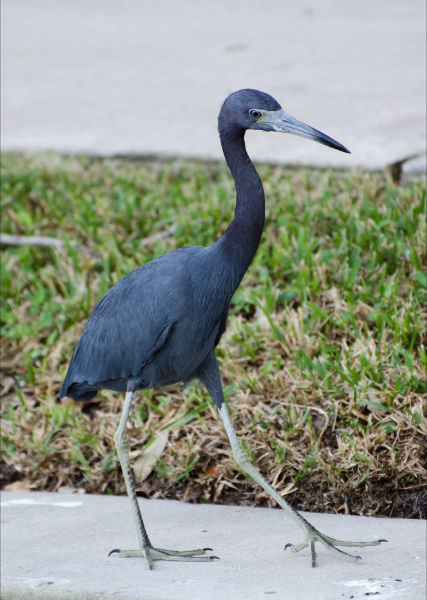
Another resident is a Little Blue Heron.  He patrols the sidewalks and gets grumpy if you approach too closely.  He flies off squawking his annoyance.


Hidden in the mangroves are other birds such as this Great Blue Heron and Anhinga.


A tiny Lesser Yellowlegs was combing the rocks along the canal for a morsel to eat.  Sea Roaches frequent these rocks and would make a tasty meal for the Yellowlegs.


We visited a small pond on the property.  There was a large flock of Hooded Mergansers swimming on the pond.  The males were spectacular with bright white crests that they expand to impress the females.  The males looked quite formal in what resembled starched white shirts with black suspenders.  The females were not as flamboyant yet were elegant with cinnamon crests.


Who's that in Ozzie's tree?  A Red-shouldered Hawk landed on one of Ozzie's favorite perches.  Luckily she wasn't around at the time to chase the Hawk out of her territory.  Eventually he left on his own accord.


Whether in Florida or Vermont backyard birding is fun and educational.  The birds that share our yards are a joy to watch and are a connection to the natural world.  With just a little space to build nests and access to food and water, birds will feel safe and comfortable in your yard.  Time to go home and fill our birdfeeder.  I'm sure the Black-capped Chickadees, Nuthatches and Cardinals are hungry!  


Thursday, November 29, 2012

Saving the River of Grass

After our trip to El Salvador we flew to Miami and attempted to rendezvous with my brother Jim, his girlfriend Julie, Julie's son Jake and my sister Joanne as they were driving back from Naples along the Tamiami Trail.  This road runs along the northeast edge of Everglades National Park then cuts through Big Cypress National Preserve.  I was amazed at all the birds and alligators along the road.  We stopped off at the Oasis Visitor Center where we saw huge gaters sunning themselves!


Hunting had decimated their population and the American alligator was listed as an endangered species back in 1973.  Subsequent conservation efforts have allowed their numbers to increase and the species was removed from the list in 1987.    There are estimated to be 200,000 alligators in the Everglades and one and a half million in the state of Florida - a reason for this gator to smile!


The alligator is an apex predator or top of the food chain.  Other than humans, alligators don't have enemies.  They consume fish, amphibians, reptiles, birds and mammals.  The teeth of the alligator are designed to grip prey but can not rip or chew flesh like some other predators can.


They can live up to 30 to 50 years old and can reach 13 feet in length!  Nearby an Anhinga was drying her wings.  Unlike other water birds, an Anhinga does not have oil glands to water proof it's feathers.  The bird has to wait until it's wings are dry before it can fly or re-submerge.


This bird is often mistaken for the Double-crested Cormorant due to its similar size and behavior. However, the two species can be differentiated by their tails and bills. The tail of the Anhinga is wider and much longer than that of the cormorant. The bill of the Anhinga is pointed, while the bill of the cormorant has a hook-tip as you can see in this close up of a Double-crested Cormorant.


By the way, we never did meet up with my brother and sister until back at his home in Palm Beach Gardens.  Our brief visit to the Everglades only whetted our appetites so we returned on December 5th to look for more birds and other critters.  This time we drove to Royal Palm and walked along the Anhinga Trail.   A beautiful Swamp Lily was blooming along the trail.


The birds did not disappoint us and being used to humans allowed us to approach quite closely.  Black Vultures were hanging out alongside the trail.  They are smaller and do not have red heads like our Turkey Vultures. Even though you're not supposed to feed the wildlife, they must be getting food from the tourists as you can almost touch them.  It did make for a great photo.


The other birds were not so tame but Marc still got some great shots.  The first is of a Great Blue Heron.


We almost missed this beautiful Purple Gallinule but when we went back to investigate a splash I spotted him among the reeds.  Fortunately, he came out on the lilypads to feed on some larvae and Marc was able to photograph him.


I can't decide who's more stunning, the Purple Gallinule or this Green Heron.  You can decide for yourself.


Further along the boardwalk a Peninsula Cooter (left) and a Florida Red-bellied Cooter (right) were sunning themselves on a log.


We headed back to our car where a pair of Red-bellied Woodpeckers were nesting in a tree nearby.  The male is shown here as he is red on top of his head to his bill while the female is red only on the nape.


We decided to drive through the park to the tiny town of Flamingo.  Along the way we passed a guy photographing something along the side of the road.  We stopped to investigate.   Black Vultures were feeding on an Alligator carcass! 


Not everything in nature is pleasant or beautiful but the vultures were doing their job.  They were disposing of the carcass thus helping to prevent the spread of disease.  We can't be sure how the gator died but it was most likely hit by a car.  We arrived in Flamingo situated on the shore of Florida Bay.  Here the freshwater of the Everglades meets the saltwater of the Gulf of Mexico.  We spotted another alligator near the marina but closer inspection revealed a crocodile!  Alligators have a broader snout with overlapping jaws and darker coloration than a crocodile.  They are also less tolerant of seawater but more tolerant of colder climates than crocodiles.  The crocodile was sunning himself on the shore but slipped silently into the water.


It was getting late and time to head back to my brother's.  Along the way we spotted some wood storks feeding in a marsh. 


The wood stork is an indicator species in that it's health is directly linked to the health of the Everglades.  Problems with the quality, quantity, timing and distribution of water have led to the decline of the Wood Stork.  In the 1960's there were 5000 nesting birds but by the 1980's there were as few as 500 nesting birds.  They are now listed as federally endangered.  Efforts are underway to save the Everglades and the animals that live here.  In 1989 Congress extended the eastern park boundary and authorized the world's largest restoration act.  It will take 30 years to execute the plan and only time will tell if it is successful at restoring one of the most unique habitats in the world.
     

Friday, September 28, 2012

Urban Wildlife: September 28, 2012

We are in Palm Beach Gardens, Florida visiting my brother Jim.  You wouldn't expect much wildlife in Southern Florida, but we have spent the last three days exploring the natural areas around Jim's home.  On our first evening we took a walk to Frenchman's Forest Natural Area.  A cement walkway leads trough Oak, Palm and Pine forest.  One bush had brilliant purple berries which we later found out is called American Beauty Bush.

 
We walked out to a boardwalk through a Cypress Swamp but had to make a hasty retreat back to the parking area as the mosquitoes descended upon us.  Back at the parking area we saw a Black Racer snake slither off into the undergrowth.
 
The next day we drove up to Jonathan Dickinson State Park about 30 minutes north.  We had our choice of activities, kayaking, canoeing, hiking or biking.  We chose to kayak down the Loxahatchee River.  We were hoping to see Alligators but we didn't get far.  We heard thunder in the distance and decided to return to the River Store.  We drove to the parking area for the Observation tower.  Along the way was a gopher Tortoise grazing along the road.  We stopped to take a photo.
 
 
A park employee stopped and asked if we were seeing anything good.  I replied "a Gopher Tortoise".  He commented that "they are all over the place".  I said "what do you mean, they are an endangered species and we certainly don't see them in Vermont!"  We climbed to the top of an observation tower on Hobe Mountain.  At 86 feet, Hobe Mountain is the highest point south of Lake Okeechobee!  We had a nice view of the surrounding sand pine scrub.
 
Today we stayed closer to Jim's home and visited John D. MacArthur Beach State Park.  As we approached the Visitor's Center we came upon a White Ibis family probing in the leaf litter. 
 
 
Again we chose to kayak.  This time instead of a river we were kayaking in a brackish estuary.  We couldn't venture too far as the tide was going out and we didn't want to get stranded.  We saw many birds including an Osprey perched in the mangroves.
 
 
We got too close to a Little Blue Heron and he flew off squawking loudly, not before I snapped this photo of him.
 
 
There were many herons hiding in the Red Mangroves.  Many flew off before I could photograph them.  This immature Yellow-crowned Night Heron was an exception.  He allowed us to get quite close and take a photo.   No doubt we disturbed his daytime slumber as these birds are nocturnal.
 
 
We're getting this kayak thing down.  We don't zigzag nearly as much and manage to avoid most obstacles.  Although, we did bang into a cement piling of the pedestrian bridge.  Fortunately, we sustained a small scratch (on the boat) only.  Marc is looking like a real kayaking pro.
 

I was able to get a few more photos of birds.  The first is a Brown Pelican in the mangroves and the second is another White Ibis.


We did see other birds such as Tricolor Heron, Belted Kingfisher, Roseate Spoonbill and Anhinga that I was not able to photograph.  As the tide was going out we kept on getting stranded on sandy shoals in the lagoon. We headed back to the Visitor's center to return our kayak.  On the porch were many Golden Silk Spiders in their nests.
 
 
Although harmless, they look quite frightening.  Nature never ceases to amaze me.  In a place as crowded and developed as South Florida, animals and birds manage to thrive given a little protected space.