Thursday, February 23, 2023

Ghana’s Beguiling Wildlife!

Greetings Everyone,
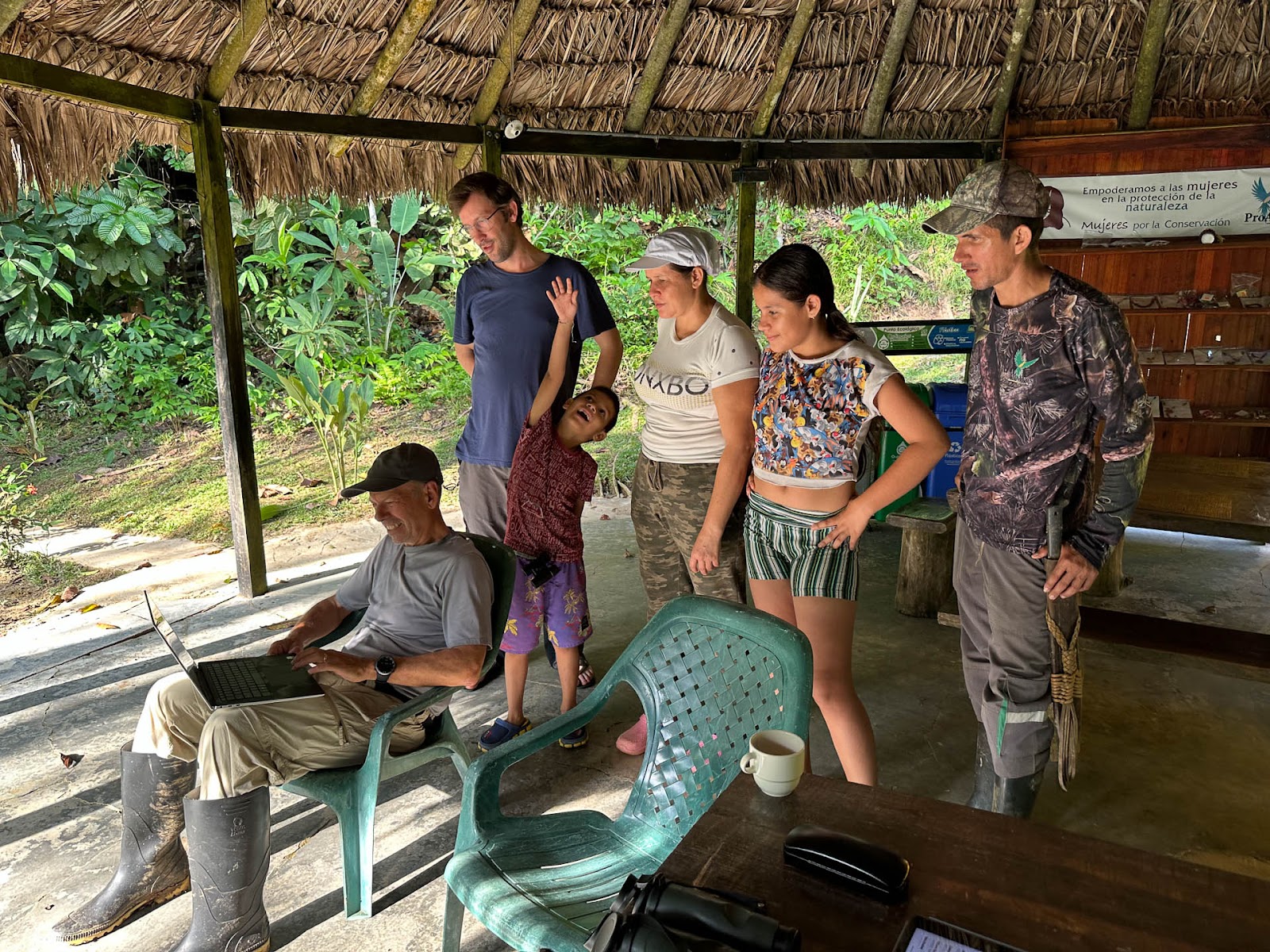
An impromptu inquiry to Ashanti African Tours concerning the availability of a trip to Ghana resulted in us booking the tour we had to cancel in 2020 due to the Covid pandemic. We flew from Phoenix to Washington, DC. From DC, it was a mere 8 and a half hours to Accra, and just like that we were back in Africa! After clearing formalities and picking up our bags, we were met by our guide Jackson and driver Johnson for the long drive to Ankasa Reserve.

We stopped for lunch at the Cape Coast Castle, an imposing fortress and a grim reminder of Ghana’s dark past. The original trading post was established by the Portuguese in 1555 and later taken over by the Swedes in 1653 as a center for the trade in timber and gold. Sadly, it was also one of about forty “slave castles” used in the Atlantic slave trade.

Cape Coast Castle

Young boys were on the beach presumably digging for gold, a reminder that Ghana was formally a British colony dubbed the Gold Coast.


Digging for Gold

We continued our drive west toward the border with the Ivory Coast arriving at our final destination, Ankasa Lodge. It had been a long journey but now we had 3 nights here to explore the reserve. We wasted no time and 40 minutes later we were on our first excursion into the rainforest.  Jackson managed to find 6 roosting Nkulengu Rails in a tree not far from the road.

Nkulengu Rails

The only mammal seen was a Bosman’s or Western Potto high up in the canopy. We returned to the lodge for dinner and turned in after a VERY long travel day.

We were up early the next morning to continue our exploration of the reserve. A stunning pink moth was just outside our chalet. One of the Emperor Moths (Eudaemonia argus), it has no common name. 

Emperor Moth

Mammals eluded us during our daytime search but we found an African Dwarf Crocodile (Osteolaemus tetraspis) in a tiny pond along the forest track. These vulnerable crocodiles are the world’s smallest and are rarely seen. They spend most of their time in the water and seldom come on land to bask in the sun.

African Dwarf Crocodile

Smaller, nocturnal mammals were “easier” to find. Jackson spotted this Beecroft’s Anomulure (Anomalurus beecrofti) on the trunk of a tree during our night drive. These flying squirrels are largely nocturnal and use membranes extending from their forelimbs to their tails to glide from tree to tree. They also have large scales on the underside of their tails to presumably slow them down when landing from a glide hence their other common name Beecroft’s Scaley-tailed Squirrel.

Beecroft’s Anomulure

Hanging from tree limbs high in the rainforest canopy were Hammer-headed Fruit Bats, the largest bat species in Africa. Males differ greatly in appearance from females making Hammer-headed Fruit Bats the most sexually dimorphic bat species in the world! Males are twice as heavy as females and have large resonating chambers on their faces. Marc managed to photograph a female with a more foxlike face.

Hammer-headed Fruit Bat

The biggest surprise of the night was a turtle spotted by our alert driver Abbott on the road. I did a bit of research a few days later and discovered that it was an Ivory Coast Mud Turtle, one of the most recently described turtle species! I contacted Jerome Maran, president of the Association du Refuge des Tortues in France and he confirmed the identification.

Ivory Coast Mud Turtle

On our final morning in the reserve, we finally got a great view and a photo of a Small Sun Squirrel (Heliosciurus punctatus). It posed nicely on a tree right outside our chalet. 

Small Sun Squirrel

The cooks had also found a chameleon near the kitchen and we rushed off to see it. It was later identified as a Senegal Chameleon (Chamaeleo senegalensis).

Senegal Chameleon

After lunch, we started the drive back to Cape Coast. Here we said goodbye to Jackson and welcomed our new guide, Phillip. We continued on to our next destination Kakum National Park and checked into the Rainforest Hotel, our accommodation for the next 4 nights. After dinner, we did a night walk outside the park. No mammals were seen but we heard plenty of Tree Hyraxes. Their blood-curdling shrieks resonate through the rainforest. You think such vocal creatures would be easy to spot but they’re not. We did manage to spot this handsome Fraiser’s Eagle Owl.

Fraiser’s Eagle Owl

The following morning we made our first foray into the park and walked to the world-famous canopy walkway. At this early hour, we were hoping to see monkeys but the walkway was surprisingly quiet. It’s still an exhilarating experience to be suspended 100 feet off the ground in the rainforest canopy.

Kakum Canopy Walkway

We headed back to the canopy walkway in the afternoon to give the monkeys a second try. They did show up but after sunset, unusual for a diurnal species. We did get a distant look at Lowe’s Monkeys in the fading light and Phillip saw a Lesser Spot-nosed Monkey. On our walk back we heard Olive Colobus but could not see them in the near darkness. At the visitors center a Forest Giant Pouched Rat (Cricetomys emini) was raiding the trash cans and made off with a piece of avocado.

Forest Giant Pouched Rat

After dinner at the hotel, we returned to the park for a night walk. As we neared the canopy walkway, I half-seriously suggested we check it out for nocturnal animals. Phillip agreed and we proceeded with the light from our headlamps. It was a bit daunting being so high above the ground in darkness but at least we couldn’t see the ground far below. Amazingly we got great views of two Pel’s Anomalures (Anomalurus pelii) our second species of flying squirrel. They were now at eye level and Marc got some great photos.

Pel’s Anomalure

We were also at eye level with a Bosman’s or Western Potto (Perodicticus potto) and now got a great look at this cute nocturnal primate. 

Bosman’s or Western Potto

The following morning we visited the Abrafo Forest to search for my most sought-after mammal, a Black-bellied Pangolin. This patch of forest used to be a reliable place to find these heavily trafficked animals. Sadly, during the pandemic, a large swath of forest was cleared for agriculture. We didn’t find any animals in the forest except for a family of Red-legged Sun Squirrels encountered at the beginning of our walk. 

That afternoon we returned to the Kakum canopy walkway hoping to get a better view of the monkeys. Once again they eluded us by staying away from the walkway but we did catch a glimpse of Green Bush Squirrels and a Small Sun Squirrel. On the walk back to the visitor center we did encounter the same troop of Olive Colobus but again it was too dark to get a good view or photo. After dinner, we returned to the canopy walkway to search for more nocturnal mammals. We saw the same Pel’s Anomalures and Bosman’s Pottos but nothing new. On the way back the Tree Hyraxes were screaming and we could hear Demidoff’s Galagos close to the trail but frustratingly we could not see them in the dense understory. The highlight of the night was a great view of an Akun Eagle-owl in the parking lot.

Akun Eagle-owl

We returned to the walkway for our final morning search for monkeys. Finally, Phillip spotted a Lesser Spot-nosed Monkey in the distant canopy. This is the eastern subspecies (Cercopithecus petaurista ssp. petauristra). I’m not sure why this monkey species evolved to have a white spot on its nose. Can you think of a good reason? It did pause long enough in the open for a proper view and photo. 

Lesser Spot-nosed Monkey

We explored some new trails in the park not seeing any mammals but got a nice view of a Chocolate-backed Kingfisher and an African Dwarf Kingfisher.

Chocolate-backed Kingfisher

As we neared the visitors center, I could hear quite a ruckus. As we drew closer a massive group (maybe 200) of school kids were coming in! I was happy that we were on our way out.

School Kids at Kakum

By now I was desperate to get a better view of the monkeys so we returned to the canopy walkway for our 7th and final visit. Marc and I chose to stay on the 1st platform since we had seen monkeys near here on two previous occasions. Philip went off to check out the 3rd platform. We should have followed him. There were Lesser Spot-nosed Monkeys feeding in a nearby tree! Philip scared them away trying to get our attention. They actually ran down the canopy walkway cable to escape. By the time we arrived, they were long gone, curses! We made our way to the 5th platform where we got brief/distant views. As on the previous two evenings, we encountered Lowe’s Monkeys and Olive Colobus on the walk back. We’ve never experienced diurnal monkeys remaining active after dark. Could it be a new adaption to increased human visitation on the canopy walkway?

The following morning, with new driver Richard at the wheel, we made the long drive to the Picathartes Guesthouse near the village of Bonkro. After settling into our cabin, we decided to walk to the picathartes nest site in the early afternoon. Up until 2003 the White-necked Rockfowl or Yellow-headed Rockfowl (Picathartes gymnocephalus) was thought to be extinct in Ghana, Today it is the most sought-after bird in Ghana and possibly all of Africa by birders. Benches had been set up at the nesting site where we sat and waited for the birds to return. The White-necked Rockfowl build nests with mud on the roofs of caves or under rock overhangs in a cliff as was the case here. We knew we were early but we were excited to see these unusual birds. Surprisingly, the first pair showed up around 3:30 giving us great views with ample light. With their sizeable black beak, yellow coloration on the head, and piercing black eyes they reminded us of King Penguins. They had a curious method of locomotion, hopping or bounding along the forest floor. They had absolutely no fear of us and approached closely giving us a great show before flying off. Around 4:00 the birds returned along with a second pair giving us another show. What an amazing experience to witness these White-necked Rockfowls at their nesting site completely unfazed by our presence!

White-necked Rockfowl

We were now halfway through our trip to Ghana and I had yet to see my most sought-after mammal, the Black-bellied Pangolin. Stay tuned to see if we’re successful in finding this near-mythical creature!

We hope all is well with everyone,
Peggy and Marc

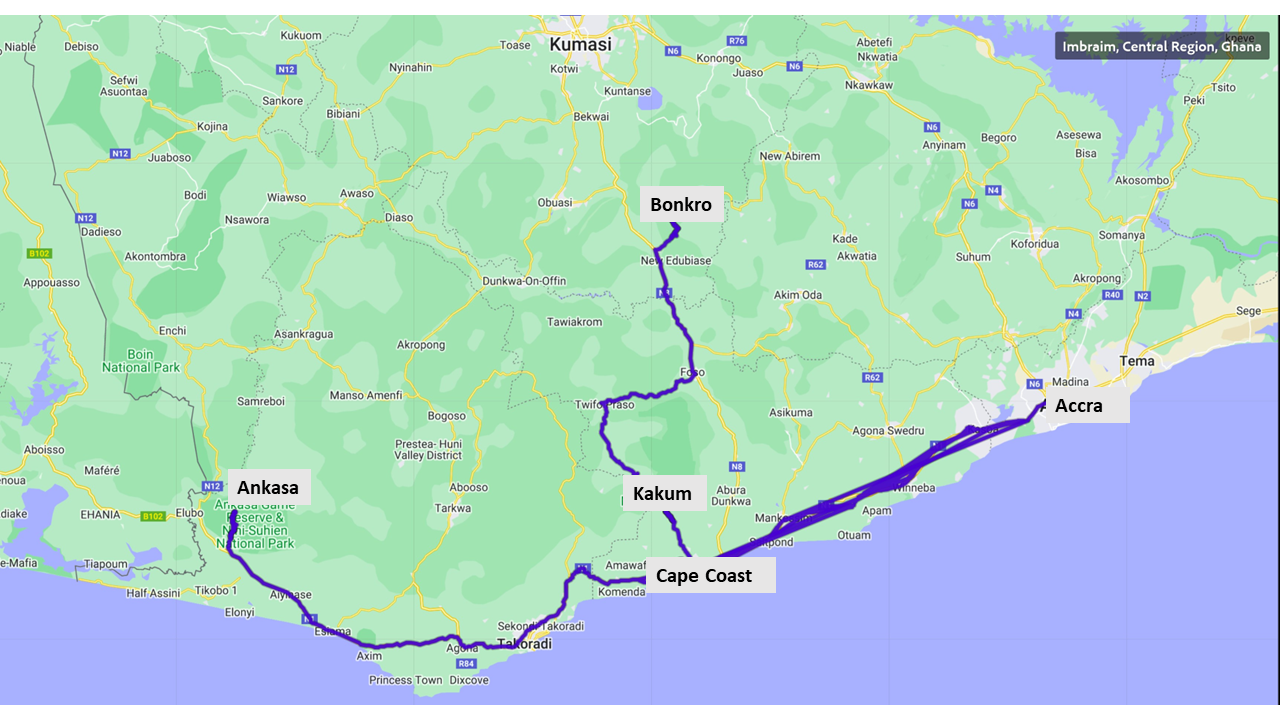
Our route map:
Friday, December 23, 2022

Colombia’s Avian Rainbow

Greetings Everyone,
After a wildly successful “Mission Monkey” in Colombia, we have switched gears to look for some of the country’s colorful birds. On December 23 we flew from Medellin to Cali where we were met for our transfer to Araucana Lodge. When we visited Colombia in 2016 with Chris Calonje of "Columbia Birdwatch", Araucana Lodge was a dream in the making. Now, 6 years later it was reality and we arrived in time for happy hour with a Vermont friend, Liz.

Happy Hour at Araucana Lodge

Early the next morning, Marc, Liz, and I left to explore the Upper Anchicayá region with our guide Gilberto. We used Chris’ old Toyota 4x4 and drove down the highway until Km 30 and turned off onto a side road. It was raining and our chances of seeing the Rufous-crested Tanager were slim. We made a few stops along the way to look and listen for the birds but they weren’t around. We did see a Bat Falcon, Andean Motmot, Lyre-tailed Nightjar, Rufous-throated Tanager, Purplish-mantled Tanager, and Cinnamon Flycatcher.

Purplish-mantled Tanager

We arrived at Doña Dora, our primary destination for the day, to bird at their feeders. When Dora Londoño first moved here, she set up a little cafe for passing truck drivers on their way to the Pacific port city of Buenaventura. A large fig tree in her garden attracted many birds and over time Doña Dora became a popular spot for local birders. Dora added hummingbird feeders and put out fruit to attract a colorful array of tanagers and barbets. Today, Doña Dora is a birding hotspot for domestic and foreign visitors alike.

Breakfast at Doña Dora

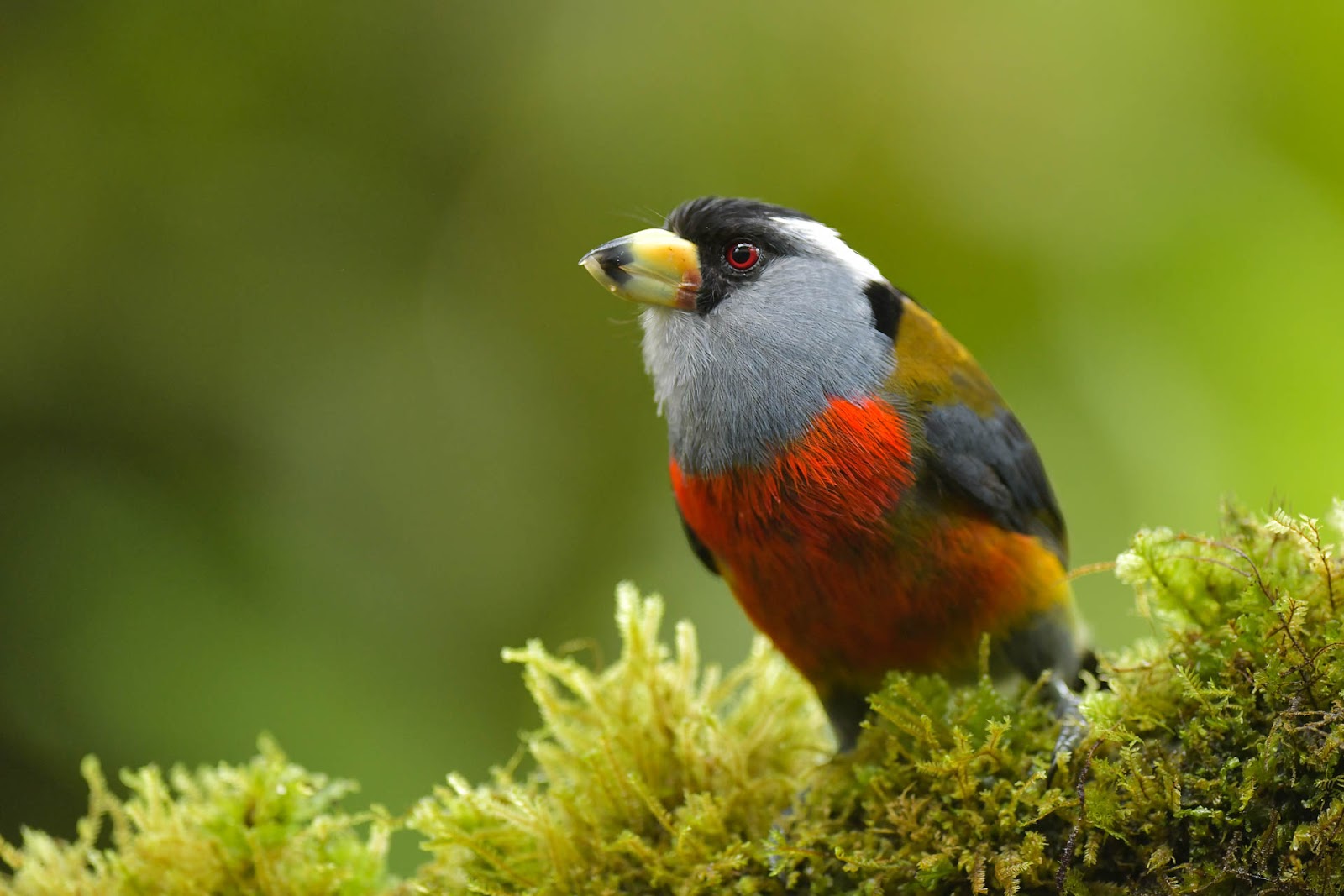
After settling in at a table overlooking feeders stocked with bananas and papaya we noticed immediately the family of Toucan Barbets nesting in the cavity of a nearby tree. This Chocó endemic is only found in Western Ecuador and Colombia and being a canopy species it normally is difficult to see. Here, they frequently visited the feeders a short distance away giving us unparalleled viewing and photographic opportunities.

Male Toucan Barbet

In addition, many brightly colored tanagers visit the feeders. Among them were Silver-throated Tanager, Flame-rumped Tanager, and Black-chinned Tanager. We were entertained by the hummingbirds visiting the tiny feeders set on the table while eating breakfast. One even perched on Marc’s coffee cup!

Green-crowned Brilliant at the Table

We spent most of the morning here visiting the hummingbird feeders and upper balcony. We logged over 40 species of birds! The diversity of hummingbirds was truly amazing with 14 species seen including White-necked Jacobin, Green Emerald, White-whiskered Hermit, Brown Violetear, Green Thorntail, Violet-tailed Sylph, and Velvet-purple Coronet.

Green Thorntail

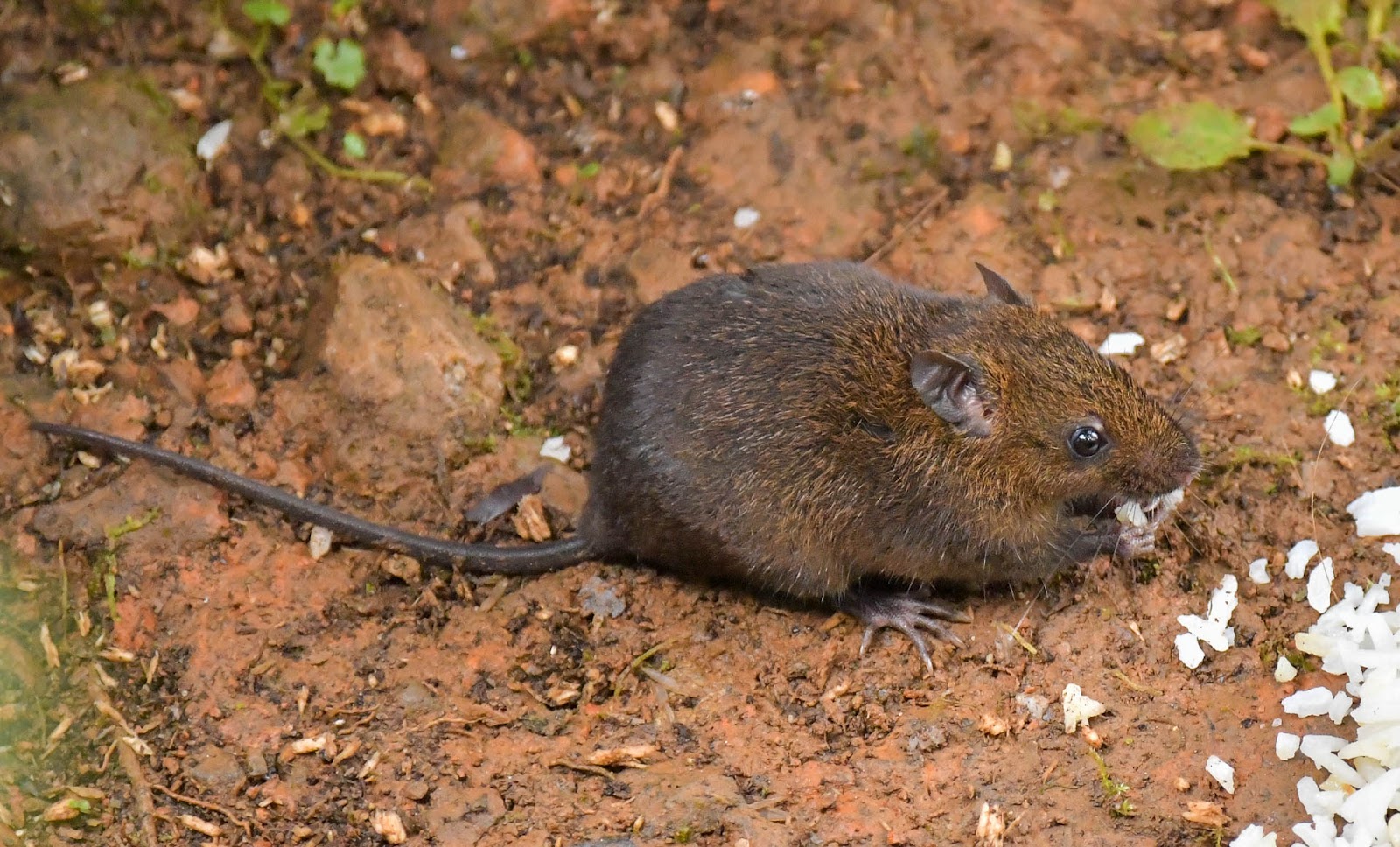
We put out some rice for the rats that Liz had seen on a previous visit. They finally braved the rain and came out to feed. They were later identified as Dusky Rice Rats by Venkat Sankar.

Dusky Rice Rat

The rain let up so we walked up the road about a km where we were able to see Ornate Flycatcher, Yellow-throated Chlorospingus, Glistening-green Tanager, and Rufous-throated Tanager.

Glistening-green Tanager

After lunch, we drove back to the lodge. Being Christmas Eve the traffic was heavy, particularly around Km 30 where we encountered a devil, a drag queen, and an ape-like creature collecting money. The devil was quite persistent but we didn’t give him a donation.


The Devil

The staff at Araucana Lodge had prepared a Christmas Eve feast complete with turkey, stuffing, mashed potatoes, and mushroom gravy for us! We were joined by Chris, his wife Vivian, her sister, and a few other lodge guests for a family-style celebration. 

Christmas Eve at Araucana Lodge

Christmas Day in Colombia with our friend Liz had finally come to fruition after months of planning! We spent a peaceful day birding at the lodge feeders in the morning then were joined by Gilberto for more birding around the lodge grounds. The trail went through a bamboo forest where we got a glimpse of a Parker’s Antbird and Liz spotted 2 Tropical Screech Owls roosting high in the bamboo. We popped out by Chris’ father’s house where we had birded 6 years ago. We got a decent look at a Bar-crested Antshrike which is the bird on the Araucana Lodge’s logo.

Bar-crested Antshrike

The next day’s bird outings included San Felipe, a private hacienda purchased by the Calle family in 1989, that now is being preserved as a nature reserve that caters to birders. The first stop was a blind overlooking some feeders not far from the main house. Here we saw Chestnut Wood-quail endemic to Colombia and a secretive species not easily seen.

Chestnut Wood-quail

We then headed down into the forest to a hide that had been set up to view Little Tinamou. We’ve heard the iconic wailing of these birds often but like many forest-dwelling birds, they are shy and rarely come out in the open. We waited in the hide while the local guide put out food to attract the birds. Sure enough one Little Tinamou showed up and then a second. The female has more of a chestnut color and surprisingly was the vocal one calling to another male in the forest. Not only was it amazing to see these birds but to hear the female calling was really special.

Little Tinamou Pair

We went to a third hide built behind a weather trough. It gave the unique perspective of photographing birds with reflections. Many brightly-colored tanagers showed up including Saffron-crowned, Golden, Palm, Flame-rumped, Scrub, Black-capped, Golden-naped, Blue-necked, and Summer Tanager. We had a veritable “avian rainbow” unfolded before us!

Golden-naped Tanager

We returned to the main blind where more vibrant birds were visiting now that it was a bit warmer. New species included Blue-winged Mountain-Tanager, Orange-billed Nightingale-Thrush, Colombian Chachalaca, Sickle-winged Guan, and Green Jay.

Orange-billed Nightingale-Thrush

After lunch at Araucana Lodge, we returned to Km 18 and drove to a finca at the end of the road called La Florida. The owner Javier and his wife have a small hotel, gardens, a gift shop, and feeders to cater to birders. The weather wasn’t great with clouds and intermittent showers but Javier’s wife served us a much-needed cup of locally-grown coffee.  There were still birds visiting the feeders. Many were species that we had seen but there were a few new species including Long-tailed Sylph, Greenish Puffleg, Southern Emerald-Toucanet, and finally a highly sought-after Multicolored Tanager.

Multicolored Tanager

We went to another hide nearby to see the Scaled Antpitta. Here, a tape was played to call the birds to come and feed on worms put out. A crafty Andean Motmot had learned the call and came to feast on the worms but Javier scared it away.

Andean Motmot

The man on the tape pioneered conditioning Antpittas to come to a feeding station. Although somewhat comical, the method works. 

Calling Scaled Antpittas

We got great views and photos of these birds that would otherwise be nearly impossible. The bird got its fill of worms and left. A second or maybe the same one returned a few minutes later so we got a second show.

Scaled Antpitta

We spent a relaxing morning at Araucana Lodge, a fitting end to our 3 and a half week return visit to Colombia. In the 1950s, Chris’ grandparents purchased 30 acres in the Western Andes of Colombia and built a small finca which they named La Araucana. The finca was a place to escape the hustle and bustle of city life and reconnect with nature. Following in the spirit of their grandparents, the Calonje family built Araucana Lodge to share this special place with others. We thank them for their warm hospitality!

We hope all is well with everyone.
Peggy and Marc

Our route map:


Monday, December 19, 2022

Mission Monkey - Leg 3

Greetings Everyone, 
The last leg of Mission Monkey with Rob Smith of "Wild About Colombia" is underway! We have seen 17 species of primates so far, can we reach 20 species? On December 19, we left Bogota at 4:30 in the morning to avoid rush-hour traffic for the 6-hour drive to the Rio Claro Nature Reserve. We stopped near Rio Claro to look for Silvery-brown Tamarins along a dirt track. Unfortunately, the road led to a quarry where giant dump trucks full of rocks went rumbling past. It was hard to imagine finding tamarins here and as I feared we did not. We arrived at the Canon del Rio Claro Nature Reserve and had lunch before checking into our cabin. That afternoon we met Rob and Arturo, our new local guide to look for tamarins along the reserve road. We walked to one end and then the other finding our first Red-tailed Squirrels but frustratingly no tamarins. 

Red-tailed Squirrel

As dusk approached we decided to walk to a cave where Oilbirds are known to roost. On the path were many local tourists. They come here to raft the Rio Claro, explore nearby caves, or swim in the river. Once we passed the dormitory-style accommodations, the trail was quiet and pleasant. Just before sunset, we reached the cave which was on the other side of the river. A waterfall was cascading from the entrance but we could hear the birds squawking inside. As it got dark they trickled out, then more and more, maybe 100, flew out! It was challenging to get a good view as we didn’t want to shine our lights on them. Marc managed to get a decent photo of some Oilbirds as they flew out of the cave.

Oilbirds

They are strange birds, the only member of the order Steatornithiformes. Their behavior was more bat-like in that they are nocturnal and one of the few birds to use echolocation to navigate. We could hear their clicks as they flew around the mouth of the cave. Unlike their closest relatives, nightjars, they eat fruit and not insects. So, why are they called Oilbirds? The answer is not very pleasant. In the past chicks were captured and boiled down to make oil. Thankfully this practice no longer occurs.

We left the cave and spotlighted back to the lodge. Rob picked up a rat in the beam of his spotlight, most likely in the genus of South American spiny rats, Proechimys.

South American Spiny Rat

There were some other creepy crawlers like spiders and this Dusky-handed Tailless Whip Scorpion.

Dusky-handed Tailless Whip Scorpion

After dinner, we continued to spotlight down the road where Rob found this cute mouse opossum at the base of a tree. It was later identified by small mammal enthusiast Venkat Sankar as Marmosops chucha. It’s a newly described species and doesn’t have a common name.

Marmosops chucha

Early the next morning we walked the reserve road in search of the tamarins but they were nowhere to be found. We returned to the “quarry road” where Rob was certain we’d find them but I had my doubts with all the dump trucks rumbling past. Rob’s persistence paid off and he found them not long after we had set off! The Silvery-brown Tamarins are another Colombian endemic, found here and nowhere else on the planet! They are listed as vulnerable by the IUCN. The Magdalena River Valley is Colombia’s most threatened habitat. Most of the forest has been cleared for human habitation, cattle ranching, coca plantations, and mining. There’s no shortage of cement factories. Despite all this disturbance here was a troop of beautiful Silvery-brown Tamarins giving us the rare privilege of visiting them!

Silvery-brown Tamarin

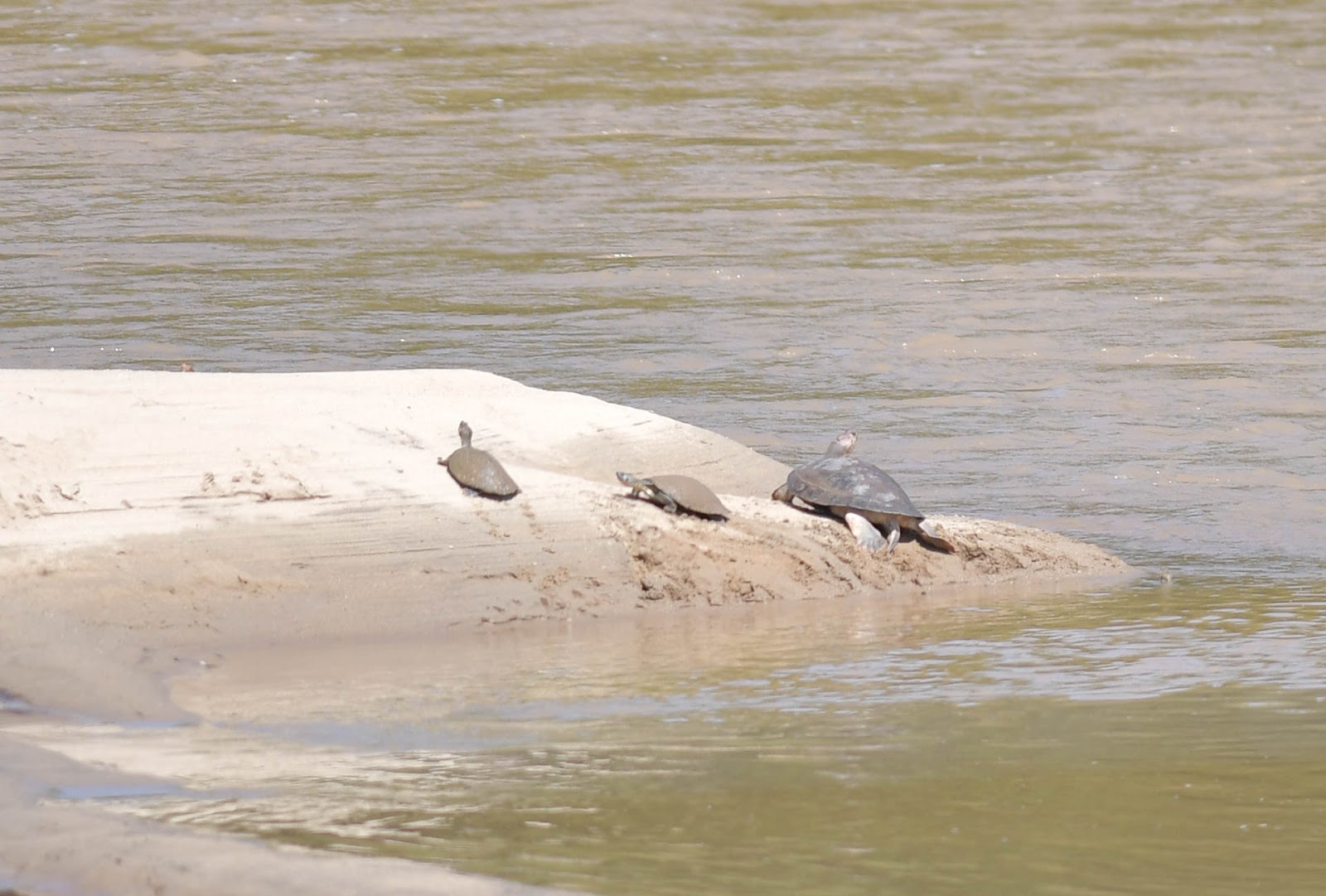
After breakfast, we left for our next destination, El Paujil Reserve. We reached the town of Dos y Medio where we stopped for the customary ice cream before turning off on a dirt track. Along the way, we were treated to many river turtles basking in the sun including the critically endangered Magdalena River Turtle.

Magdalena River Turtles

In the early afternoon, we reached the gate to El Paujil Reserve. Vehicles can no longer make it down to the lodge as the road had been partially washed away during a recent flood. Fortunately, we were met by rangers Elkin and Andrés who shuttled our duffels to the lodge on their motorcycles. We put on our wellies for the steep, slippery descent.

El Paujil Reserve

When we arrived at the lodge, a male Blue-billed Curassow was perched on one of the dining area tables! The reserve was purchased by ProAves, a Colombian NGO to protect these critically endangered and endemic birds. In fact, “El Paujil” is the local name for these mysterious birds, little was known about them prior to 2003.

Blue-billed Curassow 

That afternoon we made the 500-foot climb back up to the ridge to search for our next two primate targets: the Brown Spider Monkey and the Varied White-fronted Capuchin. Rob, Marc, and I headed southwest along the main track and Arturo headed north. About 20 minutes later, Andrés and Arturo pull up excitedly on a motorcycle. They had found a large troop of Varied Capuchins! Rob said we should continue north to look for the spider monkeys as they are harder to find. I deferred somewhat hesitantly to his judgment. The afternoon wore on and we had yet to find a primate. Had we made the wrong decision? We turned a corner and came to a spot with an open view of the forest below. Suddenly, Rob shouts “spider monkeys!”. There were two in a tall ceiba tree about 300-400 meters away. It was far but they were in the open giving us a great view of these critically endangered monkeys. Are you sensing a theme here? Yes, many birds and animals in the Magdalena Valley are critically endangered with extinction and we were overjoyed to see them and help in their conservation efforts. Rob was thrilled to have found these monkeys so quickly. I was too! We watched them until they dropped down out of view.

Brown Spider Monkey

On the way back, we ran into the Varied Capuchins so we got both targets our first afternoon. The Varied Capuchin is also endemic to Colombia and is endangered. 

Varied Capuchin

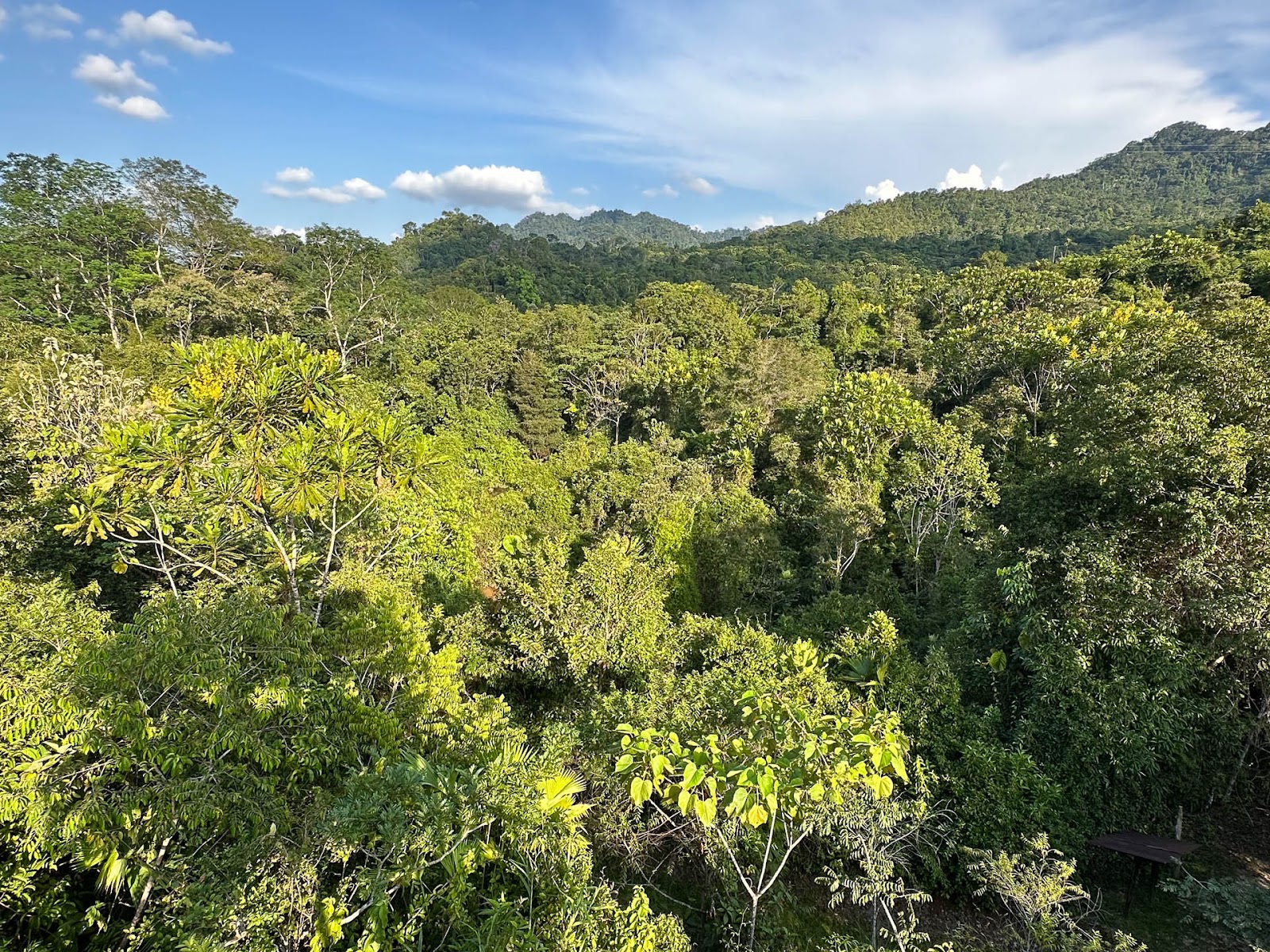
We made a quick visit to an observation tower overlooking this precious 8000-acre reserve protecting some of the last remaining lowland forest in the Magdalena Valley and its rare inhabitants.

View from the Tower

After dinner, we set off on a night walk. We stopped at the observation tower to see if there were any mouse opossums at the hummingbird feeders but there were none. Rob did spot a nice Brown-eared Woolly Opossum for us.

Brown-eared Woolly Opossum

We explored the Cano Trail but it was very muddy and very quiet other than frogs. We returned to our cabin for some rest after a very exhilarating day!

Now that the pressure of finding our two main primate targets was off, we could spend a relaxing day in the reserve. It didn’t mean we’d stop our search for monkeys and other mammals but we could do it at a more relaxed pace. We climbed to the ridge and walked to the “spider monkey viewpoint”. All was quiet at this hour but we decided to wait to see if the monkeys would show. Sure enough, as the sun warmed the forest one made an appearance then another. They actually came closer to the road and joined other members of their group! We followed them getting great views and photos. Marc was able to capture an agile individual in mid-leap!

Leaping Brown Spider Monkey

Further down the road, we encountered the Varied Capuchins. What a treat to spend quality time with these two species of rare and endangered monkeys!

Varied Capuchin

The show wasn’t over yet. Rob took us to a tree where Gray-handed Night Monkeys were roosting, another new species for us. These vulnerable and nocturnal monkeys peered groggy-eyed from their nest cavity so we didn’t linger long. 

Gray-handed Night Monkeys

Our final morning at El Paujil was spent in the dining area watching both male and female Blue-billed Curassows. It’s amazing to have these critically endangered birds calmly walking about with no fear of humans now that they’re not being hunted. Central American Agoutis and Gray-cowled Wood-rails were also feeding on seed that Andrés had put out.

Central American Agouti

We showed Monica, Elkin, and their children Marc’s amazing photo of the leaping Brown Spider Monkey. It was rewarding to share our photos with this family who work so hard to keep this reserve going. The flood that occurred in June caused a lot of damage to the buildings and infrastructure of the reserve. In just 5 months, Elkin and Andrés were able to make the repairs so that guests can once again visit El Paujil. 

Reviewing Photos

We made the final climb to our vehicle and drove back to Dos y Medio where we dropped Arturo off. We continued on to Los Colores where we spent our final night with Rob. Mission Monkey was a huge success! We were able to see 21 species of primates, many endemic and endangered, in their natural habitat. Along the way, we met many Colombians working to protect the forest home of these monkeys and other endangered animals and birds. It was a privilege to be among the first foreign visitors to some of the fincas and reserves dedicated to conservation and ecotourism. A big thanks go to Rob Smith and Claudia Díaz of "Wild About Colombia" for making this trip possible and working out all the logistics. We wish them continued success with sharing Colombia’s rare and endemic primates with others! There’s still so much to see in this biodiverse country, we’ll be back!
We hope all is well with everyone,
Peggy and Marc

Our route map:


Colombia Mammal List: December 5 to 26,  2022

 
No.   
SpeciesScientific Name Comments
   1Colombian Squirrel Monkey
Saimir i cassiquiarensis albigena 

ssp. of Humbolt’s Squirrel Monkey
   2Ornate Titi MonkeyPlecturocebus ornatusendemic & vulnerable
   3Brumback’s Night MonkeyAotus brumbacki endemic & vulnerable
   4Colombian Woolly MonkeyLagothrix lagotricha lugens endemic & critically endangered 
   5White-bellied Spider MonkeyAteles belzebuth endangered 
   6Linne’s Two-toed SlothCholoepus didactylus 
   7Common Woolly MonkeyLagothrix lagothricha lagothricha vulnerable 
   8Black-capped Capuchin Sapajua apella Tufted Capuchin 
   9Colombian Red HowlerAlouatta seniculus   
 10Collared Titi MonkeyCheracebus lugens Black Titi
 11O’Connell’s Spiny RatProechimys oconnelli 
 12Lowland TapirTapirus terrestris  
 13Southern Opossum Didelphis marsupialis 
 14Black-headed Uacari Cacajao melanocephalus Golden-backed Uacari 
 15Black AgoutiDasyprocta fuliginosa 
 16Mottled-face TamarinSaguinus inustus “El Diablito”
 17Lesser Dog-like BatPeropteryx macrotis  
 18Common Vampire BatDesmodus rotundus
 19Lesser Spear-nosed BatPhyllostomus elongatus  
 20Seba’s Short-tailed BatCarollia perspicillata most likely
 21Southern Tamandua Tamandua tetradactyla 
 22Orinoco River DolphinInia geoffrensis humboldtiana Boto
 23Ecuadorian Squirrel MonkeySaimiri cassiquiarensis macrodon ssp. of Humbolt’s Squirrel Monkey 
 24Black Mantle TamarinLeontocebus nigricollis  
 25Red Titi Monkey Plecturocebus discolor White-tailed Titi
 26Miller’s SakiPithecia milleri vulnerable  
 27Colombian Black-handed TitiCheracebus medemi endemic & vulnerable 
 28South American CoatiCoati nasua only guides saw 
 29Greater Sac-winged BatSaccopteryx bilineata   
 30Lesson’s Saddle-back TamarinLeontocebus fuscus 
 31 Western Pygmy MarmosetCebuella pygmaea vulnerable   
 32Caqueta Titi MonkeyPlecturocebus caquetenis  endemic & critically endangered 
 33Red-tailed SquirrelSciurus granatensis 
 34Silvery-brown TamarinSaguinus leucopusendemic & vulnerable  
 35 Brown Spider MonkeyAteles hybriduscritically endangered  
 36Spiny RatProechimys sp.? 
 37Mouse Opossum Marmosops chuchanewly described 
 38Varied White-fronted CapuchinCebus versicolorendemic & endangered
 39Gray-handed Night MonkeyAotus griseimembra Vulnerable 
 40Central American AgoutiDasyprocta punctata 
 41Brown-eared Woolly Opossum Caluromys lanatus 
 42Dusky Rice RatMelanoyps caliginosus