Sunday, December 04, 2022

Mission Monkey in Colombia

Greetings Everyone,
After a nearly 3-year hiatus, it was time to get back out in the field to continue exploring this wondrous world. We had been in touch with Rob Smith of Wild About Colombia since 2019 and it was time to make the return trip to Colombia a reality. Our focus would be on searching for rare and endemic primates. We met Rob in Bogota on December 4 and set off early the following day for Villavicencio and our first primate target, the endemic Ornate Tití Monkey. 
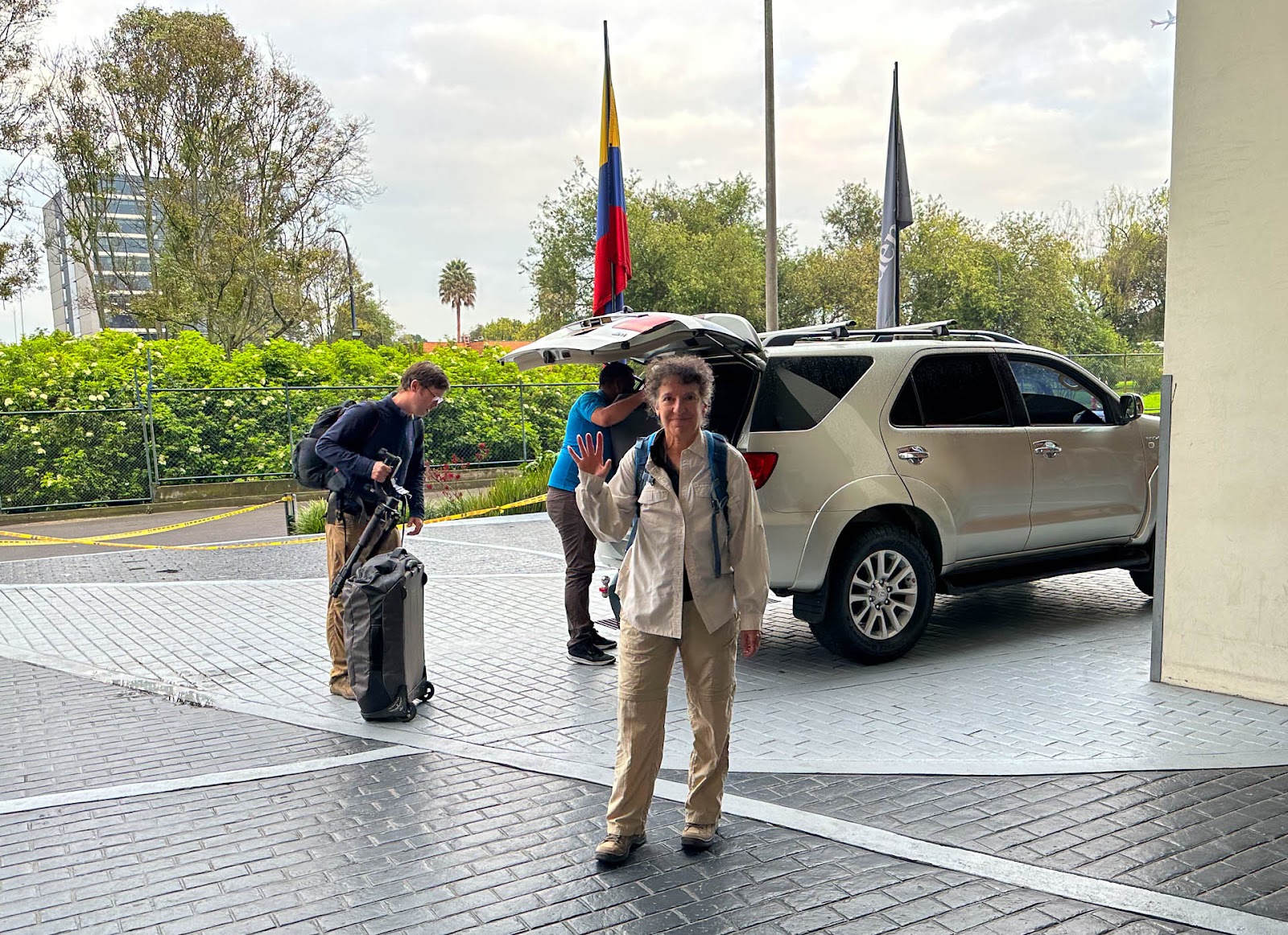
Leaving Bogotá

Surprisingly these monkeys don’t live deep in the jungles of a national park but prefer the forest edges along cattle pastures. A local NGO is working with ranchers to protect these monkeys and we were granted permission to search for them on a private finca or farm. It didn’t take long to spot our first primate, not a titi but a Colombian Squirrel Monkey, a subspecies of the widespread Humboldt’s Squirrel Monkey.

Colombian Squirrel Monkey

Shortly after, Rob spotted another monkey, an Ornate Tití! These titi monkeys are classified as vulnerable by the IUCN and occupy a small range in eastern Colombia. It was a treat to view this tiny family group and another on the finca.

Ornate Tití Monkey


We spent the night at Rancho Camaná, another finca that owners Martha, Nathalia, and Elvis are preserving for conservation. The family has chosen to transform their cattle ranch into a nature reserve and invite guests to visit their bird feeders, gardens, and forest. Their most notable residents were a family of Brumback’s Night Monkeys, another Colombian endemic species. Nathalia showed us their roosting place high up in a big stand of bamboo. As night approached the family left the roost and promptly went to feed in a mango tree nearby. 

Brumback’s Night Monkeys

Like so many other animals these monkeys are vulnerable due to habitat loss. Their forest home is being cleared for cattle ranching, agriculture, and human habitation. It was heartening to see Rancho Camaná doing their part to protect the Brumback’s Night Monkeys' forest home and working with others in the community to do the same.

Elvis joined us the next day to visit another finca near the town of Vista Hermosa where Colombian Woolly Monkeys are known to live. To reach this remote village, we transferred to a 1981 Toyota Landcruiser for the bumpy ride and river crossings.
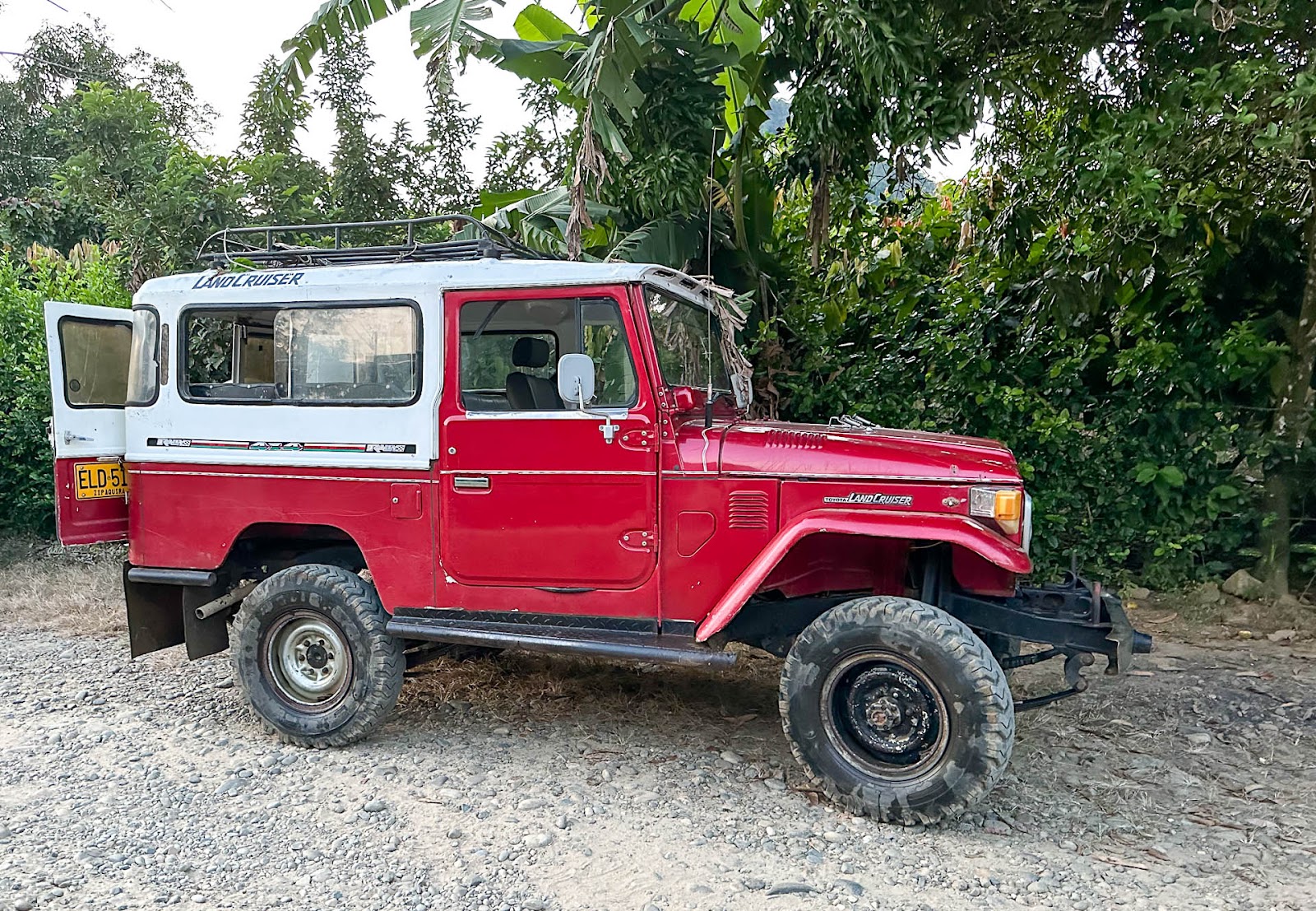
1981 Toyota Landcruiser 

We hiked a half mile along a stream when Rob spotted the Colombian Woolly Monkeys! They were quite relaxed and allowed us to approach closely for good views and photos, an indication that they are not hunted in this area. They are much darker than other woolly monkeys we’ve seen. Some scientists believe they are a subspecies of the Common Woolly Monkey while others ascertain they are a separate species. Whatever the case, they are classified as critically endangered and to see them so relaxed close to a village was amazing!

Colombian Woolly Monkey

The next day brought us to another finca in search of our next primate species, the endangered White-bellied Spider Monkey. We were joined by Cesar, a local rancher who like Elvis has become more interested in conservation and ecotourism. He led us to a ridge on his farm from which we had a good view of the forest on the other side of a stream. We sat and waited for the monkeys to appear but they didn’t show. After 2 hours I had about given up hope when Cesar spotted them feeding in a tree alongside a waterfall! They were quite a distance away so we hiked along the stream to the base of the waterfall. We couldn’t get any closer but we did get good views of this family group.
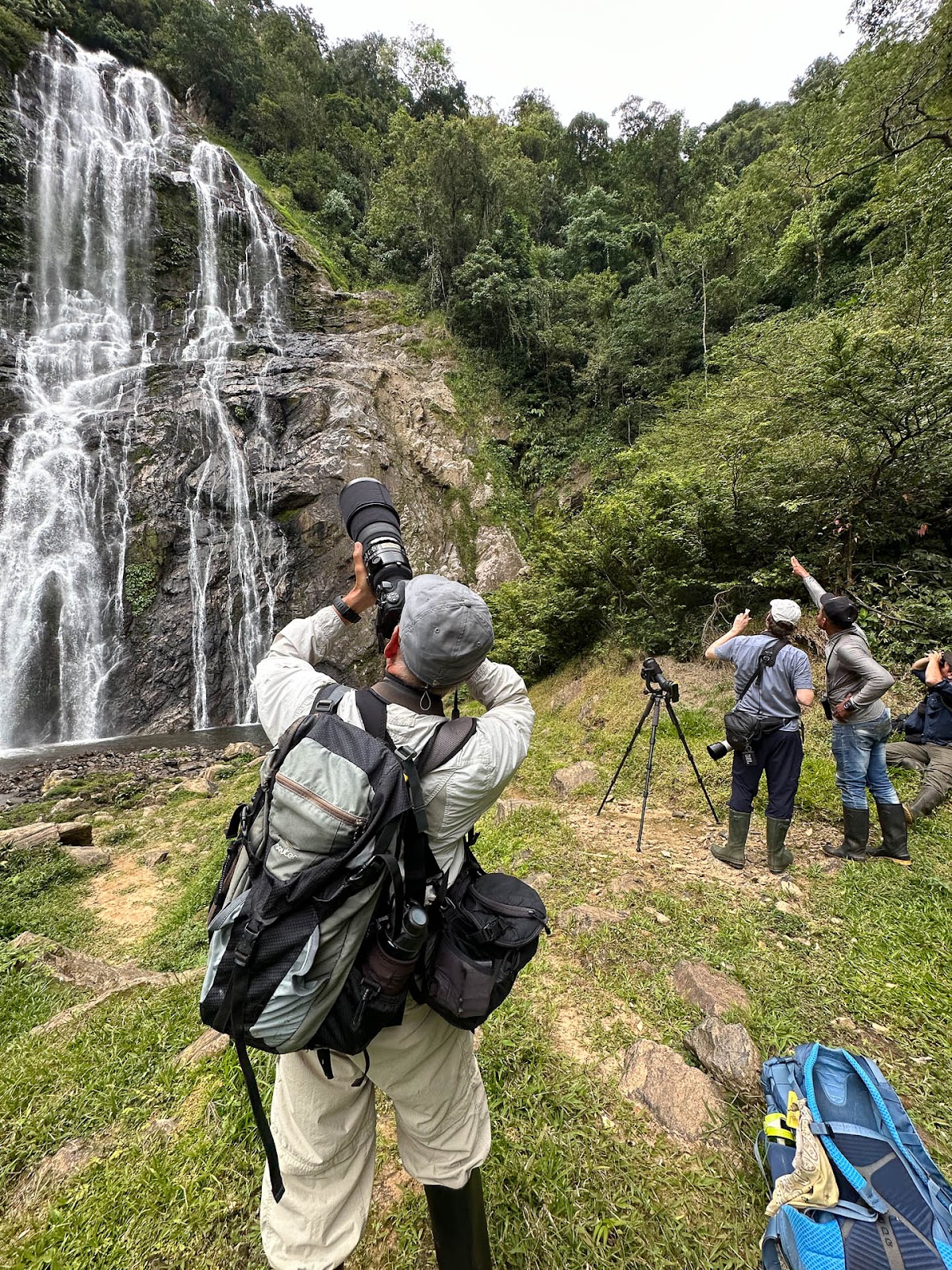
Spotting the Monkeys


White-bellied Spider Monkeys

We went to lunch at another farmhouse where we were treated to a local feast of sancocho, the traditional soup full of potatoes, yuca, and plantains, grilled chicken, and rice. It was a novel wildlife viewing experience for us searching for animals on privately owned fincas and then having lunch at a different farmhouse. It was Rob’s way of spreading our tourist dollars around and encouraging the locals to protect the forest and wildlife in it. If the farmers can generate income from ecotourism, they are less apt to cut the forest and hunt the wildlife.

Sancocho

After such a hearty meal, it was off to Cesar’s lodge for a siesta. Although not quite complete, Cesar is constructing a tiny ecolodge which he hopes one day will be used by tourists visiting the area to see wildlife instead of just the waterfall. We did a bit of birding and Cesar took us to a tree behind the lodge where a Linné's Two-toed Sloth was snoozing.

Linné's Two-toed Sloth

We said goodbye to Cesar and wished him the best of luck with his new endeavors. We all got a bit teary-eyed when he informed us we were his first foreign guests!

The next day we said goodbye to Elvis and continued on to San Jose del Guaviare where we met our new local guide, Wilma. Not far from town was a patch of forest with a surprising diversity of primates. We saw 4 species of monkeys, three new to our trip: the Colombian Red Howler Monkey, Black-capped or Tufted Capuchin, and Common Woolly Monkey.

Common Woolly Monkey

We had to venture further afield to the village of Cerro Azul to locate our next primate targets. On the long drive, we did manage to find one, the Collared or Black Titi Monkey in a patch of forest alongside the road. They were high in the forest canopy but came closer out of curiosity affording us a good view.

Collared or Black Titi Monkey

Our next two monkey species proved to be more difficult to find. We searched for the first in Cerro Azul Reserve but encountered more Common Woolly Monkeys and Tufted Capuchins before reaching the end of the trail. We headed back hoping to see our prime target on the return. Rob and Wilma heard something on the trail ahead. Could it be the elusive Golden-backed Uacaris? No, it turned out to be the even more elusive South American Tapir! Wilma and another local guide Norbe had not seen one here before. We got good views and photos despite the fading light.

South American Tapir

We returned to the forest after dark but a night walk only produced an opossum, most likely a Brown-eared Wooly Opossum and a Linné's Two-toed Sloth that we nearly missed in a tree over our heads. We had one more day to find the uacaris so the pressure was on. We revisited the same trail the following morning with no luck so we tried another trail with the same result. We returned crestfallen to the farmhouse for lunch. Time was running out, we had to find the uacaris this afternoon or choose between them and the Mottle-face Tamarins on our final morning in the area. We set off after lunch and patrolled the same trail where they had been seen in the past. 

Setting Off

We stopped short of the trail's end and waited in vain for the monkeys to show up. We accepted defeat and started our return to the farmhouse. I turned back and noticed that Norbe was urgently trying to get our attention. He had found the Golden-backed Uacaris! We rushed back to his location and caught glimpses of them high in the trees. Not satisfied with our encounter we followed them deeper into the forest. Finally, they paused long enough to give us a proper look and for Marc to get an extraordinary photo! Unlike most New World Monkeys, they have short, non-prehensile tails. Why a monkey would evolve without a prehensile tail which comes in very handy with an arboreal lifestyle is beyond me.

Golden-backed Uacari

The next morning we visited another finca to search for our final primate target, the Mottle-face Tamarin. The locals refer to them as "Diablitos" or "Little Devils" and I hoped they wouldn’t be difficult to find as the uacaris. We were met by the farmer who owns the finca who would hopefully guide us to the Diablitos. We were joined by Norbe and our 3 local guides who went into the forest to search for the Little Devils while we walked the forest edge on the more open pasture side. Wilma found 3 Collared Titis but no tamarins. We were seeing plenty of birds, an Ornate Hawk Eagle, a Laughing Falcon, and White-throated Toucans but no mammals. The crafty Little Devils outmaneuvered us and we returned to the farmhouse for breakfast. There were old Ocelot skins hanging on the walls. It’s a good thing that the farmers are no longer hunters and are getting into ecotourism. Just as we were finishing breakfast, Anderson, one of the farmer’s sons ran up excitedly. He had found the tamarins! We rushed off after him into the forest to the location. Sure enough, they were there, high up in the trees! We followed them, getting clear views when they paused on an open branch to screech at us. 
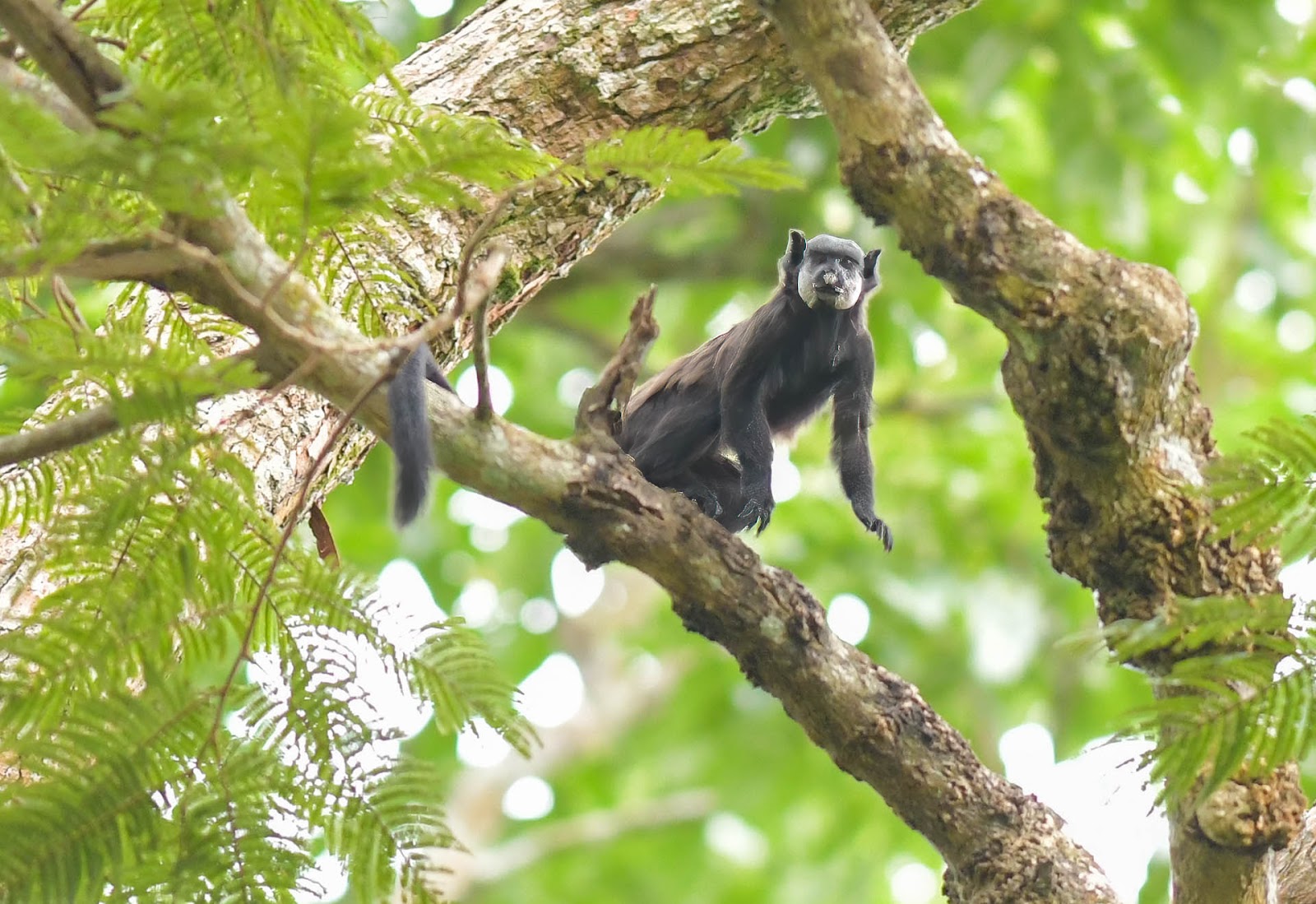
Mottled-face Tamarin

What a relief, we had seen our 10th primate target for this section of the tour. We returned to the farmhouse satisfied with our experience. We said goodbye to the family thanking them for their hospitality and of course for the Mottle-face Tamarins! It was still early enough to return to Cerro Azul to finally see the rock art for which the reserve is famous. 

Hiking to Cerro Azul

We climbed 400 feet to the main panel, an impressive collection of human and animal figures thought to be 12,000 years old! Little is known about this site including who the artists were.

The Main Panel at Cerro Azul

To get to the upper panel we followed the trail to a cave. You can bypass the cave but we wanted to see the bats inside. Our Covid masks came in handy here and we put them on before entering the cave.

Masking Up

There were many bats hanging from the ceiling and we could identify the Common Vampire Bat, Lesser Dog-like Bat,  Lesser Spear-nosed Bat, and Seba’s Short-tailed Bat. It was hot and I was sweating into my mask. Between the slippery rocks, the bats flying around, and trying to avoid hitting my head on the ceiling, I was relieved to see light at the other end.

Bats in the Cave

We continued to a viewpoint overlooking the rainforest. It was good to see such a large swath of forest after seeing so much cleared for pasture and agriculture. 

Rainforest Panorama from Cerro Azul

From here we visited the upper panels, one with impressive tapir figures and another with a giant ground sloth now extinct.
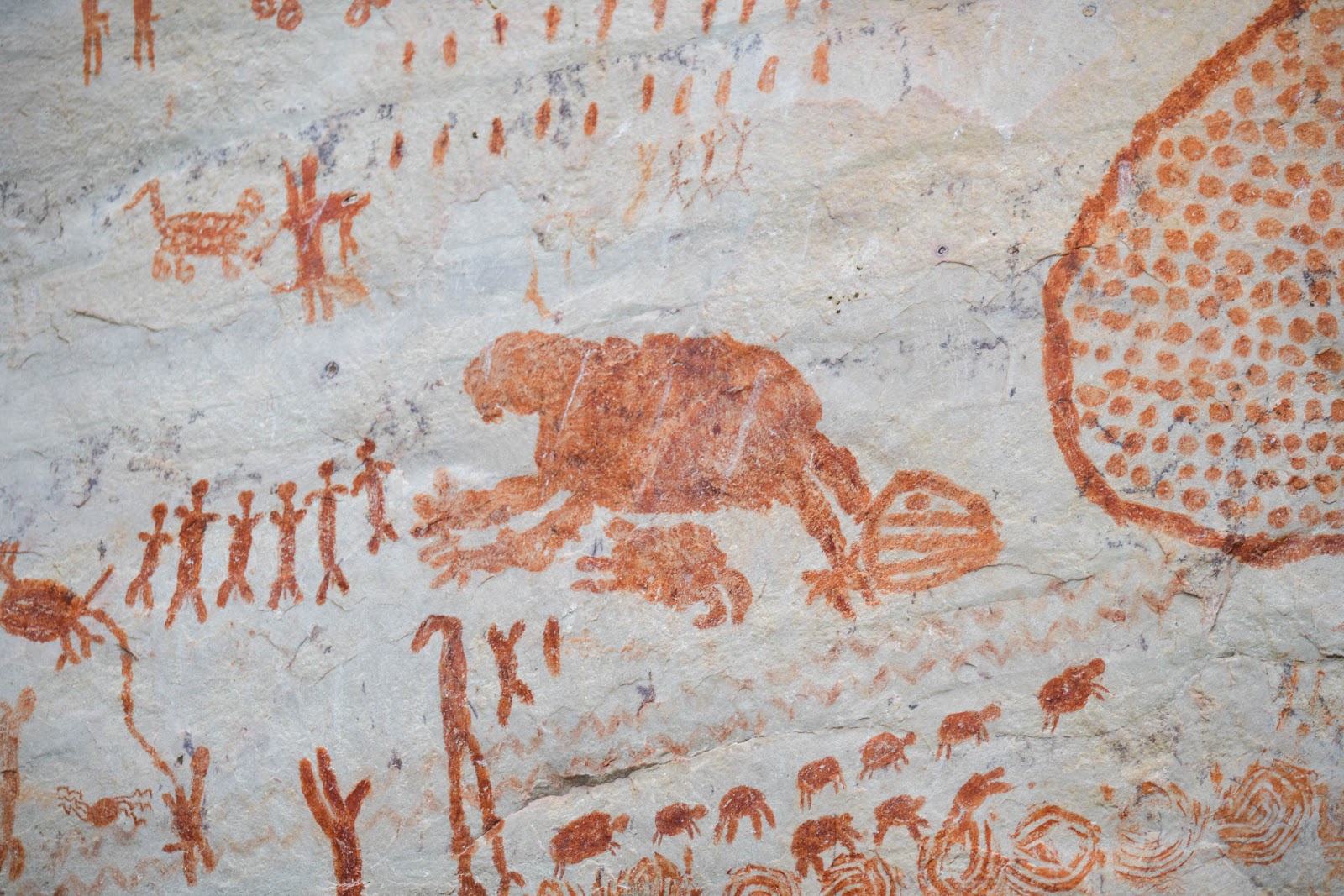

Giant Ground Sloth

As we headed back down, we saw something moving next to the trail. It was a Southern Tamandua! We got a brief, partially obstructed view but waited to see what the tamandua would do. Amazingly, it came back out onto the trail in full view only 20 feet away! We watched as it climbed a palm tree searching for ants. Marc got great photos although he had too much lens.
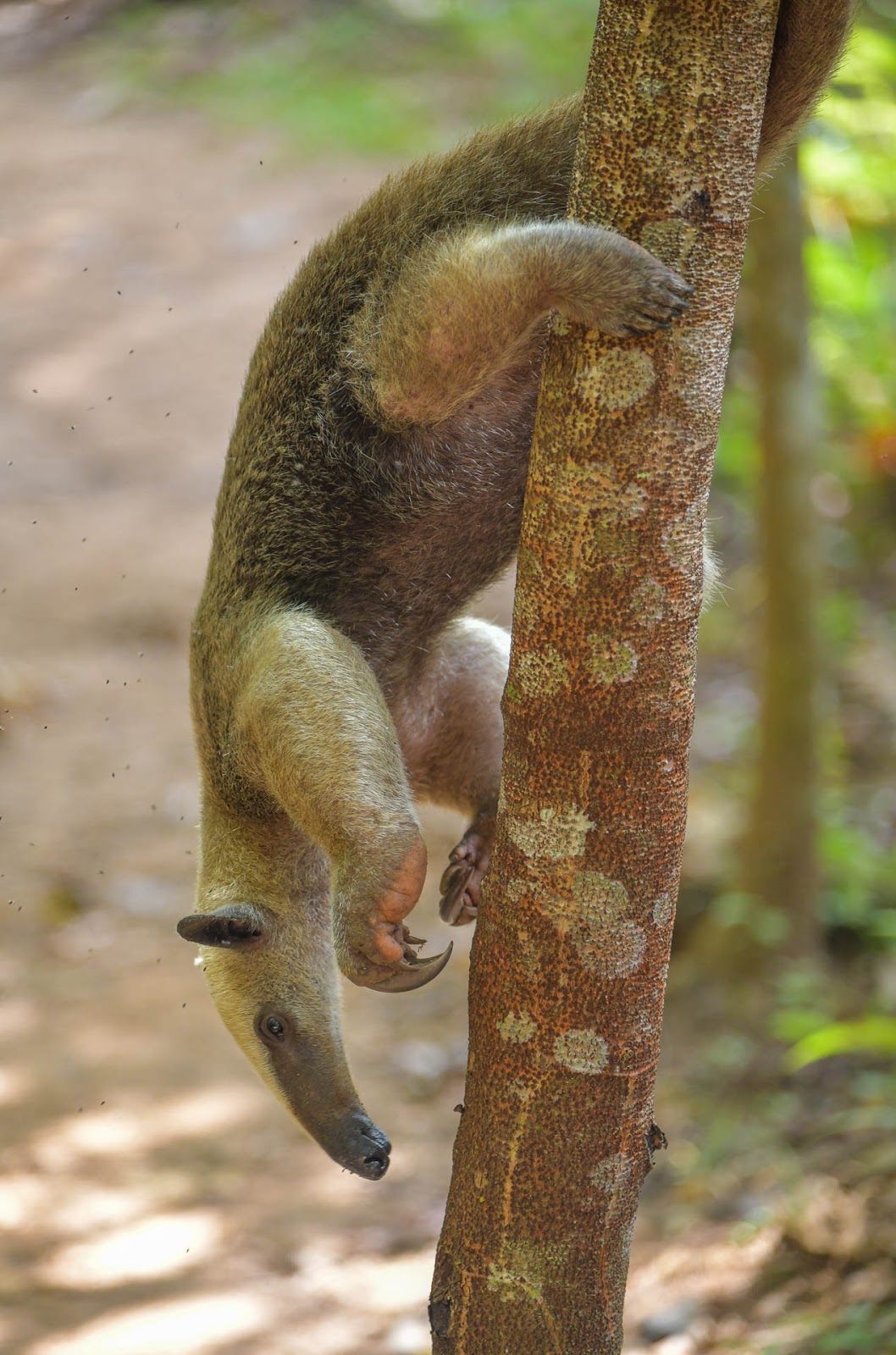
Southern Tamandua

We drove back to San Jose del Guaviare that afternoon making one detour to see the Orinoco River Dolphins. They weren’t far from the dock and Marc played whack-a-mole catching a few fins and beaks only.

Orinoco River Dolphin

The first leg of “Mission Monkey” had come to an end. We had been successful in seeing all 10 of our primate targets in addition to other mammals and many birds. Stay tuned for the second leg of our search for Colombia’s rare and endemic primates!

We hope all is well with everyone.
Peggy and Marc


Our route map:


Friday, March 06, 2020

Zakouma, Africa’s New Crown Jewel!

Greeting Everyone,
We’re in Zakouma National Park in Chad where we’ve just had an incredible wildlife experience (see our previous blog post). It will be difficult to top but we were up for the challenge. That afternoon we visited the Riguek region of the park consisting of vast plains interspersed with wetlands. A pride of 7 lions comprised of 2 adult lionesses with 5 nearly grown cubs was snoozing in the afternoon heat. 

Pride of Lions

As the sun sank lower, the sky became alive with millions of Red-billed Quelea coming in for a drink. They flew in a synchronous flow called a murmuration. How they managed to avoid mid-air collisions is beyond me. These small sparrow-like birds feed mainly on grass seed but also cause extensive damage to cereal crops hence the nickname “Africa’s feathered locust”.  The sound of their combined wing beats was deafening.


As it cooled down, the lions became more active. The youngsters began to play with each other, stalking and pouncing. One cub spotted a Large-spotted Genet and chased it but it got away. The pride headed out to the road and we followed them. Finally, they tired of us and sauntered off to hunt.

Lions at Night

We went into night drive mode seeing another 5 genets and finally a Pale Fox, a new canid for us!

Pale Fox

The following morning we returned to Riguek to see if the pride of lions had made a kill. We found the pride plus a radio-collared lioness. They hadn’t made a kill and we thought that they might go on a hunt but they decided to rest so we left them in peace.

Pride of Lions at Riguek

We went off in search of a large herd of Tiang that commonly graze on the floodplain. They are a subspecies of the Topi, a handsome African antelope with a black face, a reddish-brown coat with contrasting black patches on their forelegs and thighs and tan stockings.

Tiang

There were also herds of buffalo, waterbuck, reedbuck, and hartebeest grazing in the area. The bird life was equally impressive with huge flocks of Great White Pelican, Black-crowned Cranes, Spur-winged Geese, African Open-billed Storks, White-faced Whistling Ducks, Knob-billed Ducks, and Garganey. If this isn’t a Ramsar site it should be!

Flocks of Birds

A few Tantalus Monkeys, a new primate species for us, were frolicking outside the camp’s dining area. It was nice to see wild animals completely relaxed around humans yet not to the point where they had become a nuisance. These monkeys were not fed and knew enough not to come into the restaurant.

Tantalus Monkey

As we set off for our afternoon game drive, Doug joked with Bonaventure about finding us 3 cheetahs. Bonaventure replied that the workman had seen 3 cheetahs earlier that afternoon not far from camp. Doug said you’re kidding and Bonaventure assured him it was true so we set off to find them. Despite our best efforts, we could not locate them but at least we tried. By now the sun had set and we went into night safari mode. The drive got off to a slow start then Doug amazingly spots the Cheetah! There were three in the dry grass about 70 meters from the road. They were in the open and we got good views and photographs.

Cheetahs

Cheetahs are rarely spotted in the park and to see three was extremely lucky. The cheetahs here are a critically endangered subspecies, the Northwest African Cheetah (Acinoyx jubatus hecki) also known as the Saharan Cheetah. Based on data from 2007 to 2012, there are only around 450 Northwest African Cheetahs in the wild with approximately half existing in the Central African Republic and Chad.

On the drive back to the camp we encountered a lioness with her two 3-month-old adorable cubs on the road. We had now seen 4 species of cats in Zakouma, just the Leopard and Serval to go!

Lioness and Two Cubs

The following day we made a final visit to Riguek. Doug heard a lion roaring and we found a large male with an impressive mane.

Male Lion at Riguek

Not far away the radio-collared lioness and the pride of 7 resting in the shade. They had flies and dried blood on their faces so they must have made a kill last night.

The Rest of the Pride at Riguek

That evening we had dinner on a wooden platform high above the Salamat River. A nearly full moon rose over the river making for a tranquil scene.

Moonrise Over the Salamat River

On the game drive the following morning we encountered a lone cheetah drinking at a waterhole, possibly a male that had made a kill the night before. What incredible fortune to see 4 of these rare and endangered felines!

Lone Cheetah at a Waterhole

We took a break from wildlife watching and drove outside the park to a village that was having its weekly market. Just outside the park gate, a smaller village was holding some sort of women’s celebration. Most of the villagers had gathered around the performers and it was difficult to get a view of what was going on.

Village Gathering

We drove for another hour to get to the village where the market was being held. Along the way, we encountered nomads on their donkeys bringing goods to sell. It was the real deal with people from local villages coming together to sell clothes, vegetables, meat, fish, goats, knives, milk, soap, spices, and everything imaginable.

Local Market

On the long drive back to Tinga Camp, we did our final night drive of the trip. The pressure was on to find a leopard and serval. We were finding plenty of other nocturnal animals, African Civets, White-tailed Mongoose, and a Side-striped Jackal but sadly no felines. Suddenly Marc spotted an animal in the grass, could it be, yes, an Aardvark another creature that is rarely seen! We got an open and prolonged view before it disappeared into the tall grass. Although not a leopard or serval, the Aardvark made for a grand finale to our night drives!

Aardvark

On the way to the airstrip the following morning, we did our final safari in Zakouma National Park. We encountered the same pride of 6 lions seen yesterday. In fact, we saw lions on most of our game drives. It turns out that there was an Italian conservation biologist, Chiara Fraticelli, here studying carnivores in the park. Chiara had requested that lodge guests take photos of the carnivores they encounter and send them to her to assist in her data collection. We readily agreed to help and when I returned home I created a project in iNaturalist which is a compilation of all our carnivore sightings. 


Our eventful week in Zakouma National Park had come to an end. Although we had missed seeing the large breeding herd of elephants, we had seen our first Caracal in the wild, observed 4 rare and critically endangered Northwest African Cheetahs, spotted a near-mythical Aardvark, and had the extraordinary privilege of giving water to a wild bull elephant with a garden hose! No wonder, Zakouma is the new crown jewel of Africa’s national parks!

We hope all is well with everyone,
Peggy and Marc

Our Route Map:


Zakouma Mammal List: March 3-10, 2020

 No.   SpeciesScientific Name Comments
   1AardvarkOrycteropus afer 
   2African Savanna ElephantLoxodonta africana 
   3Northern Lesser GalagoGalago senegalensislifer
   4Patas MonkeyErythrocebus patas lifer
   5Tantalus MonkeyChlorocebus tantalus lifer
   6Olive BaboonPapio anubis 
   7Unidentified rodent

   8African Savanna HareLepus victoriae 
   9Northwest African CheetahAcinonyx jubatus ssp. hecki 
 10Caracal Caracal caracal lifer
 11African Wildcat Felis lybica 
 12Northern LionPanthera leo ssp. leo 
 13Large-Spotted GenetGenetta maculata 
 14Egyptian MongooseHerpestes ichneumon lifer
 15Banded Mongoose Mungos mungo 
 16White-tailed MongooseIchneumia albicauda 
 17Spotted HyenaCrocuta crocuta
 18African Golden WolfCanis lupaster glimpse only
 19Pale FoxVulpes pallida lifer
 20Side-striped JackalCanis adustus 
 21Common WarthogPhacochoerus africanus 
 22Kordofan Giraffe Giraffa camelopardalis ssp. antiquorum
 23Lelwel HartebeestAlcelaphus buselaphus ssp. lelwel 
 24Red-fronted GazelleEudorcas rufifrons lifer
 25Central African Savanna Buffalo Syncerus caffer ssp. aequinoctialis 
 26Northern BushbuckTragelaphus scriptus 
 27Common DuikerSylvicapra grimmia 
 28Roan AntelopeHippotragus equinus ssp. scharicus 
 29Defassa WaterbuckKobus ellipsiprymnus ssp. defassa 
 30Buffon’s KobKobus kob ssp. kob 
 31 Bohor ReedbuckRedunca redunca 
 32TiangDamaliscus lunatus ssp. tiang 
 33African CivetCivettictis civetta 


Mammal Sightings Map

Postscript: Little did we know that our visit to Chad would be our last international trip for nearly 2 years! When we returned to N’Djamena it was clear that the Coronavirus pandemic had only grown worse. Cases were being reported in Egypt, our next destination so we cut our trip short and returned home on March 13, 2020, the very day a State of Emergency was declared in Vermont.

Monday, March 02, 2020

Watering an Elephant!

Greetings Everyone,
At the crossroads of North and Central Africa, Chad may not seem like a tourist destination. Stories of terrorist attacks, kidnapping, and crime are rife but the opportunity to visit Zakouma National Park was just too great. When our friends Martin and Jane from the U.K. signed up for a trip we decided to join them. We flew from Addis Ababa, Ethiopia via Abuja, Nigeria to N’Djamena, the capital of Chad. Here we were met and driven to the Radisson Blu overlooking the Chari River. I was hoping to spot hippos in the river but sadly there were none.

Chari River

Early the next morning we returned to the airport for our charter flight to Zakouma National Park. The flight took us over a hazy, arid landscape with few roads or villages. As we neared the park, I spotted our first mammals, African Savanna Elephants, and Kordofan Giraffes! We landed on a dirt airstrip where Doug our guide was waiting. Along the drive to Tinga Camp, we encountered an old male elephant, then a second, 6 stunning Kordofan Giraffes, a few Olive Baboons, a single Lelwel Hartebeest, and a Buffon’s Kob. The Kordofan Giraffe (Giraffa camelopardalis ssp. antiquorum) is a critically endangered subspecies of giraffe. In Zakouma National Park, the giraffes are doing well. During a series of aerial surveys conducted between 2005 and 2016, the population has continued to increase from 292 to 947!

Kordofan Giraffes

We settled into our chalet before lunch where colorful Red-throated Bee-Eaters swooped by and two magnificent Northern Bushbucks made a brief appearance.

Red-throated Bee-Eater

That afternoon we went on our much anticipated first safari. The mammal spotting was sporadic with a few of each species encountered. There were elephants, Kordofan Giraffe, our first Defassa Waterbuck, Common Warthog, Red-fronted Gazelle, and African Buffalo. We encountered a big troop of Olive Baboons and Tantalus Monkeys, a new species for us. The biggest surprise was a very big, around 45, group of Banded Mongoose!

Banded Mongoose

Bird highlights were a group of 25 Black Crowned Cranes, 100’s of Spur-winged Goose, colorful Little Bee-Eaters, and an Abyssinian Roller.

Abyssinian Roller

After the sun had set, we switched to night safari mode. I saw the eyeshine of a galago and later a second was spotted. There were two white-tailed Mongoose, although one had a black-tipped tail and a distant Large-spotted Genet. Finally, the canids came out. First, what was probably an African Golden Wolf, then a Side-striped Jackal, and lastly a Spotted Hyena. Not a bad haul for our first day in Zakouma National Park!

Spotted Hyena

The following morning we spent quite a bit of time around waterholes and the Tinga River. There were many West African Crocodiles, and birds such as Marabou Storks, African Fish Eagle, Hadada Ibis, Grey Heron, kingfishers, and bee-eaters. Doug spotted a male lion and we went to investigate. Nearby, there were two lionesses. It was great seeing lions again as they have become quite scarce since our first visit to Africa back in 1990!

Lioness

A herd of Central African Savannah Buffalo was grazing on the floodplain. This subspecies is lighter in color resembling Forest Buffalo more closely rather than the Savannah Buffalo that we have seen in other parts of the continent.

Central African Savannah Buffalo

We waited by the river for animals to come and drink. A troop of Olive Baboons, Common Warthogs, Defassa Waterbuck, and Lelwel Hartebeest, a new subspecies of hartebeest for us, showed up.

Lelwel Hartebeest

On the way back to camp, a herd of Roan Antelope was encountered. The scharicus subspecies of Roan Antelope are native to Central Africa and are mostly found in Cameroon, the Central African Republic, Chad, and eastern Nigeria. We’ve seen many of these mammal species in other parts of Africa but here in Zakouma exist subspecies not found in the safari strongholds of East and Southern Africa.

Roan Antelope

As darkness fell over the park, we set up for spotlighting. The first feline of the trip, an African Wildcat, was found. In the same area, a Side-striped Jackal was on the prowl. To our surprise, the jackal tried to attack the cat and it hissed and puffed up scaring the jackal off. I doubt the jackal was a serious threat but you know the saying about fighting like cats and dogs.

African Wildcat

Early the next morning we embarked on a marathon safari day to travel to the south end of the park to hopefully see the large herd of elephants found there. Our driver, Bonaventure, had GPS coordinates for the radio-collared elephants so we were expecting them to be easy to find. They were on the other side of the Salamat River so we drove around and along the river hoping to catch the herd when they came out of the thick vegetation to drink. Jane spotted a lone individual at the far end of the river and we hoped that the rest of the herd would follow but we weren’t that lucky. We tried to get closer to them in the vehicle but the bush was too thick so we had to walk in. We could hear them but we just couldn’t see them. Curses, they crossed the river again! A flat tire delayed our attempts to relocate them but in crossing the river we encountered an amazing flock of Great White Pelicans, 1000+ birds strong!


Flat Tire

Great White Pelicans

It was now clear that the only way to reach the elephants was on foot and it was doubtful that we’d be able to catch up to them so we gave up our pursuit. Although it was very disappointing not seeing the elephants just knowing they were close by was a triumph considering that the nearly 4000 elephants that once roamed here were nearly extirpated by ivory poachers a mere 20 years ago! Today the herd has rebounded back to 636 due to the effective management of the park by African Parks since 2010. The year 2021 marked the fifth straight year without a single recorded poached elephant, a success story!

On the long drive back, Doug spotted an African Wildcat walking along the road but it moved off into the tall grass. Fortunately, it re-emerged on the road and Marc was able to get a photo as it was walking away. I noticed tufts on its ears. When Marc looked at his photo, he said “It’s a Caracal!”. Sure enough, we now have a Caracal to add to our world feline list! 

Caracal

After getting our tire properly fixed the following morning, we set off to locate a pair of lionesses who had just killed a Roan Antelope. We found the lionesses at their kill. They were panting heavily in the heat of the day, trying to digest bellies full of meat.

Pair of Lionesses

We left them and continued our drive when Martin spotted a male elephant. Five more followed him onto the plain to a small waterhole where they sprayed mud on their hot hides. In this area of the park, only males elephant dare to venture. The breeding herds stay down south where there are fewer people and they feel safer.

Male Elephants

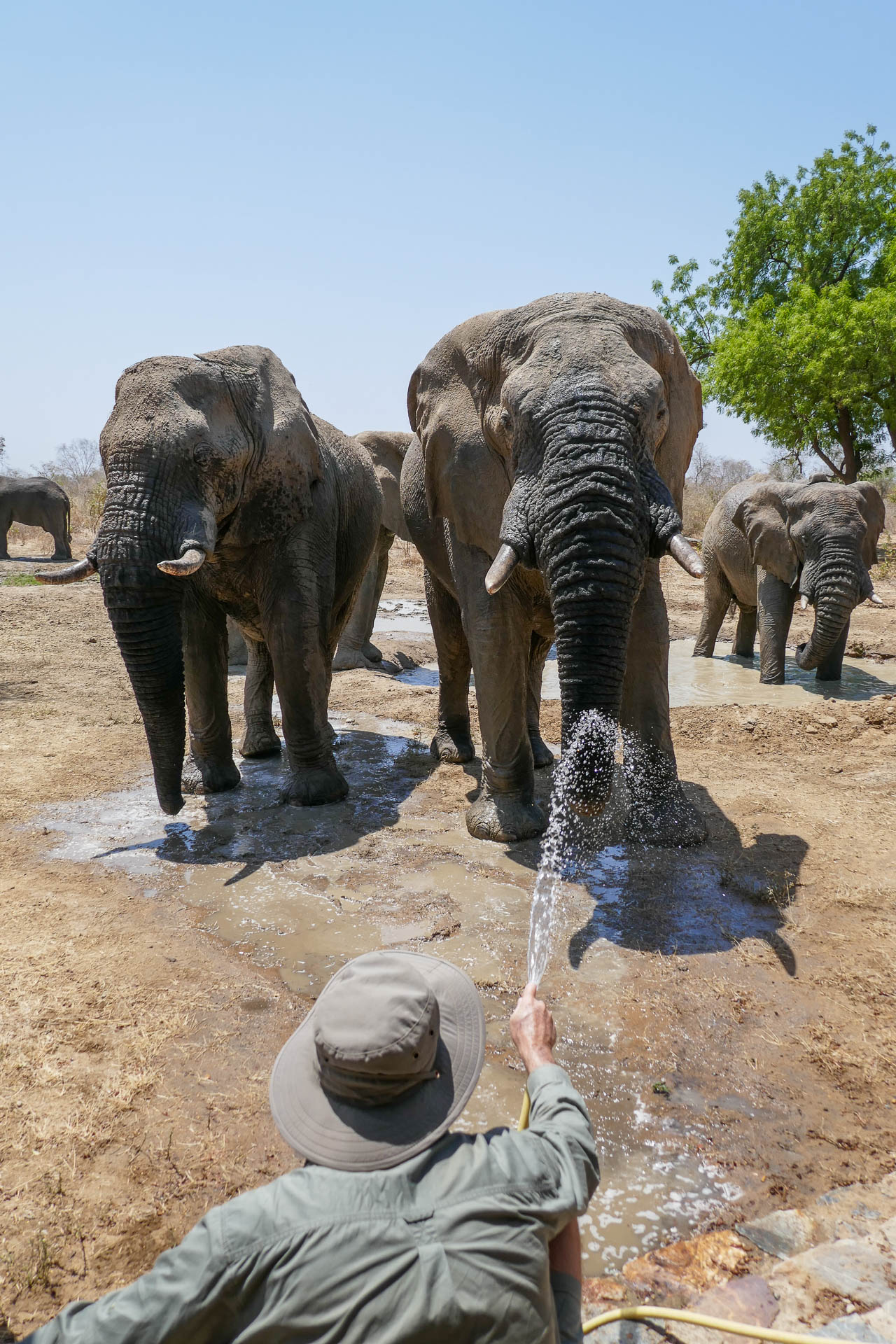
We left the elephants and were driving past the park manager’s compound when we spotted two more elephants. They were on their way to an artificial waterhole created by the park. We stopped at a hide to observe them. Doug was telling a story about how the first park manager got wild bull elephants to trust him to the point where he’d give them water from a garden hose. I was thinking that this sounded far-fetched when Bonaventure said we had been invited inside to give it a try! There was an electric fence around the house but Doug opened a door and sat on some stone steps with a garden hose. Unbelievably a large bull elephant came forward and allowed Doug to pour water directly into his trunk! It took several minutes to fill his trunk then he would spray the water from his trunk into his mouth, amazing! 

Doug Watering the Elephants

Doug asked if anyone else wanted to try and I said “Sure!”. What an extraordinary wildlife encounter, to be so close to a wild bull elephant! It took trust on both sides but I felt completely at ease with this elephant and he seemed very relaxed. Marc took photos and a video while I “watered the elephant”. We each took a turn and I think Doug was surprised that we all dared to get so close to a wild elephant that could kill us in an instant. After the experience, I was overcome with emotion and got choked up. What a privilege to share sure a moment with a wild elephant!


It’s hard to imagine topping this experience. Stay tuned to see what other surprises Zakouma National Park has in store for us.
We hope all is well with everyone,
Peggy and Marc

Our Route Map: