Greeting Everyone,
After our wildly successful visit to Cuyabeno Reserve, we returned to Quito where we picked up a rental car for the drive to Maquipucuna Lodge. I had read that this lodge and adjoining reserve is one of the best places to see wild Andean Bears. The Maquipucuna Reserve is the dream of Rodrigo and Rebeca who visited the area in 1985 and fell in love with the pristine forest. They worked diligently to raise the funds to buy 3500 hectares of montane rainforest that was being held as collateral from a bankrupt Spanish logging company. In 1987 Fundación Maquipucuna became the first NGO in Ecuador to purchase land for conservation. The reserve has now grown to nearly 6000 hectares at the heart of the Chocó Andean Corridor, one of the earth's top five biodiversity hotspots. To learn more about the Reserve and how you can help go to:
I had been working with Rebeca for almost a year to time our visit with the arrival of the bears. The bears only come near the lodge when the fruit of the pacche trees (genus Nectandra) are ripe. Rebeca told me the fruit was ripening and that mid-November would be a good time come. The drive from the Quito Airport was a bit tricky with many roundabouts to negotiate and some winding back roads but we arrived on November 11 in time for lunch.
 |
| Our Arrival at Maquipucuna Lodge |
Arcenio would be our guide during our stay. He’s from the nearby village of Santa Marianita and is intimately familiar with the area’s birds and animals. Unfortunately the bears had yet to come down from their cloud forest home to feed on the pacche fruit so instead, we focused on birds. One of the highlights was the Rufous Motmot that hung out around the lodge and even has a nest in a mud bank just outside our room.
 |
| Rufous Motmot |
The next morning our focus was still birds and we headed up the road past the lodge in search of specialties like this beautiful Golden-headed Quetzal.
 |
| Golden-headed Quetzal |
After lunch, we went birding on some of the trails behind the lodge. Again we were seeing some great birds like these Torrent Ducks and a Golden Tanager but I was keen to see the bears.
 |
| Torrent Duck Pair |
 |
| Golden Tanager |
The next day we headed out early to venture into the cloud forest in search of the bears. We followed the Sendero Principal, an old road built by a Spanish logging company, past an old farm and up into the cloud forest. As we climbed higher the trail became more obscure but we were starting to see signs of the bears! Scat (I’ll spare you a photo), claw marks on trees and hair on small trees that the bears use as scratching posts indicated that the bears were around.
 |
| Marc Hiking in the Cloud Forest |
We climbed steeply on an ancient trail used by the Yumbo, a pre-Incan people, to get from the Andes to the coast. When the trail ended we were forced to return. Arcenio pointed out the ripe pacche fruit that had fallen on the ground. These lipid-rich avocado-like fruits are an important food source for the bears. They resembled black olives.
 |
| Pacche Fruit |
The trees that had fruit were spotty, there should have been enough to attract the bears but where were they? On the 4th day of our 5-day visit, we were getting desperate to see the bears. We were spending a lot of time on Sendero Principal where the fruit was ripe including many hours on a bamboo bench waiting for Carlos, one of the trackers, to find the bears.
 |
| Waiting on the Bamboo Bench |
After lunch, we headed back into the forest with Arcenio when he finally got the call that a bear had been spotted! We rushed off to the location passing the bamboo bench where a woman who had just arrived was sitting. She saw us racing by and followed. We saw Carlos on the trail ahead but the woman and I stopped a short distance before and got a view of an Andean Bear perched high in a pacche tree! Marc and Arcenio went to Carlos' location but Marc could not see the bear. I was happy to have seen the first bear of the “2017 Andean Bear Season” but was sad that Marc missed it. The woman who had just arrived and had seen the bear felt guilty that she had seen it so easily when Marc who had been searching for days missed it. That’s how it goes with wildlife viewing. Timing is everything!
The next morning we were out early in search of the bear. Hopefully, he had brought friends. We searched until 9:00 with no luck. The others returned to the lodge for breakfast but Marc and I persevered. We waited on the bamboo bench while Arcenio investigated the forest on the opposite side of the trail. He returned with a smile and thumbs up, he had found the bear! We followed him into the forest to the edge of a deep ravine. The bear was feeding in a tree on the other side of the ravine and we couldn’t get closer. We positioned ourselves to see the bear climb down the tree through a tiny window in the forest. Finally, he climbed down and both Marc and I got good views and he was even able to take some photos.
 |
| Andean Bear |
The Andean Bear (Tremarctos ornatus), also known as the Spectacled Bear, is the last remaining short-faced bear (subfamily Tremarctinae). Its closest relatives are the extinct Florida Spectacled Bear and the giant short-faced bears of the Middle Pleistocene to Late Pleistocene age. Andean Bears are the only surviving species of bear native to South America. The species is classified as Vulnerable by the IUCN because of habitat loss.
That afternoon we went out searching for more bears. It was getting late and the others grew tired of the wait and returned to the lodge. Marc and I hung back and Arcenio said he’d check up the trail one more time. He returned shortly excited that he had found a bear. We rushed off to the location and it took Arcenio a little searching to locate the bear but there he was feeding in a pacche tree not far from the trail. This was our closest encounter yet and we got good views as the bear perched on an open branch before descending and disappearing into the forest.
 |
| Our Next Andean Bear Sighting |
Another surprise awaited us when we returned to the lodge and viewed the videos from our trail cam that we had set up along Sendero Principal. To see what we captured walking along the trail the night before click on the following link.
On our final morning at Maquipucuna, we went out in search of what we hoped would be one last sighting. We came up empty-handed and returned to the lodge for our departure. When we arrived a group of 60 schoolchildren had descended upon the lodge. We had been warned but nothing could prepare us for the transition from peace and tranquility to chaos and the exuberance of youth. We wanted to make a hasty retreat but were convinced to stay for lunch.
 |
| The Arrival of Schoolchildren |
Afterwards, we drove to the Yellow House in Mindo where we’d spend the next 3 nights. This birding lodge is run by some friendly ladies, Maria Elena, and her sister. The following morning we went off in search of birds on the trails behind the Yellow House. We walked through a guava tree plantation and a cow pasture for almost a mile. We thought we had taken a wrong turn but ran into an American guy doing bird surveys and he told us we had just reached the trails.
 |
| Crimson-rumped Toucanet |
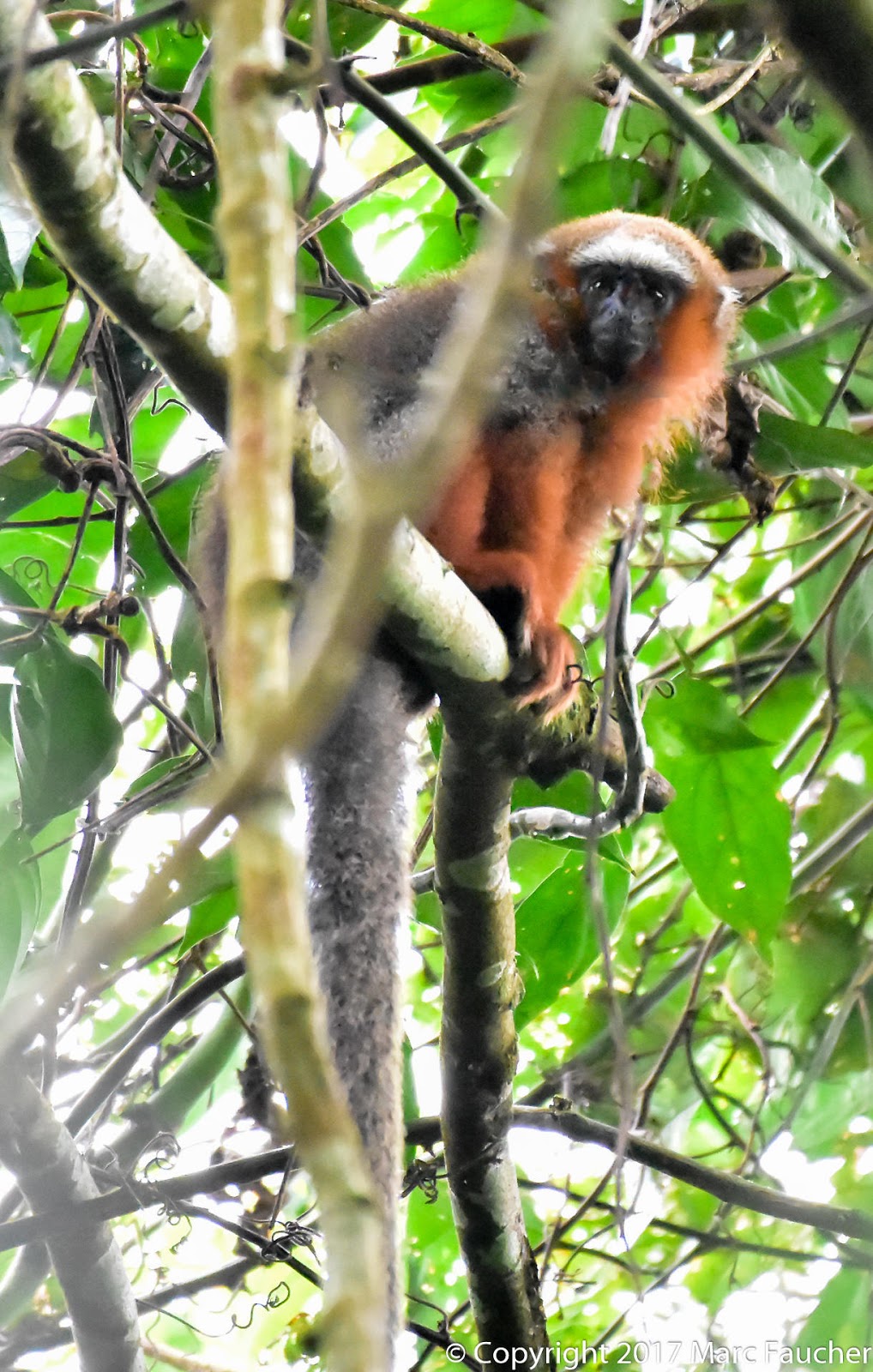
We returned to the lodge for breakfast before heading out again. We climbed past a little cabin called “ James’ Hut” and heard monkeys in the trees. A small troop of White-fronted Capuchins was crossing the trail. Marc was able to get some good photos.
 |
| Ecuadorian White-fronted Capuchin |
I did some research and found that these Capuchins may be the critically endangered Ecuadorian White-fronted Capuchins (Cebus aequatorialis) which are found on the west slope of the Andes. I sent an email to Dr. C. Dusti Becker, the director of the nearby Reserva Las Tangaras, and she confirmed that they were the rare Ecuadorian species of White-fronted Capuchin!
That evening I sent an email to Becca who was volunteering at Maquipucuna and asked her if the schoolkids had left and if more bears had been sighted. Her response was "yes and yes". We made arrangements to return to Maquipucuna for one more night. When we returned we found out that Rodrigo and Rebeca, the owners of the lodge, would be arriving with some biologists from the just-concluding “25th International Conference on Bear Research & Management” held in Quito. It would be good to finally meet Rebeca and to talk to some biologists working on bear conservation and management from around the world.
We arrived in the morning and went searching for the bears. A mother and cub had been spotted close to the lodge yesterday but we did not find them. When we returned to the lodge for lunch Rebeca and Rodrigo had arrived with about 25 biologists! It was a bit chaotic and when we returned to the forest in the afternoon to look for the bears the pressure was on. We were with a small group of 5 and a new guide Mauricio and were lucky to find a bear first. He was feeding in the same patch of forest across from the bamboo bench as the bear in our second sighting. We were able to get good views and photos before the bear biologists showed up.
 |
| Another Bear Sighting! |
The following morning we were hoping to get one last bear sighting but came up empty-handed. We returned to the lodge for breakfast. We had some interesting conversations with some of the bear biologists including a couple who work for the state of Alaska. They told us how to apply for a permit to visit the McNeil River where up to 70 grizzlies congregate to feed on salmon. We also showed Rodrigo our video with the two Pumas and gave him a copy. We were planning on leaving after breakfast but Rodrigo told us a bear had been located so we decided to go see it.
The bear had been found by Carlos and his grandson deep in the forest off the Swamp Trail. We, along with the 25 bear biologists, attempted to get a view but when we got too close the bear became agitated so we backed off. Clearly, such a large group visiting a bear at the same time is not a good practice. Rodrigo and Rebeca plan on working with some of the bear biologists to come up with a protocol of how to view the bears without stressing them. This will become important in the future as more people visit Maquipucuna to see the bears.
 |
| Bear Biologists Viewing an Andean Bear |
We left Maquipucuna after our 5th and final bear sighting. We were very fortunate to witness the start of the “2017 Andean Bear Season”. A big thank you to our guides Arcenio and Mauricio for showing us the bears and many of Maquipucuna’s other treasures. Thanks to Carlos and his grandson for spending hours in the forest locating bears so we could get a good view. Last but not least a heartfelt thanks to Rodrigo and Rebeca for having the foresight and will to protect this amazing place. We wish them the best of luck in the future and hope many others will experience the joy of seeing a wild Andean Bear in its natural habitat!
We hope all is well back home.
Peggy and Marc
Maquipucuna and Yellow House Mammal List:
| No. | Species | Scientific Name | Notes |
| 1 | Andean Bear | Tremarctos ornatus | 5 sightings of at least 2 different bears at Maquipucuna |
| 2 | Common Opossum | Didelphis marsupialis | One seen on a night walk at Maquipucuna |
| 3 | Red-tailed Squirrel | Sciurus granatensis | One seen @ Maquipucuna & three @ the Yellow House |
| 4 | Puma | Puma concolor | Two caught on out trailcam @ Maquipucuna |
| 5 | Spotted Paca | Cuniculus paca | One caught on out trailcam @ Maquipucuna |
| 6 | Central American Agouti | Dasyprocta punctata | Several seen @ the Yellow House |
| 7 | Ecuadorian White-fronted Capuchin | Cebus aequatorialis | Troop of 6 seen on Main Road above the Yellow House |
| 8 | Mouse Opossum | Sp.? | One found dead near Maquipucuna Lodge |
Maquipucuna Final Bird List:
- Crested Guan Penelope purpurascens
- Wattled Guan Aburria aburri
- Turkey Vulture Cathartes aura
- Black Vulture Coragyps atratus
- Gray-headed Kite Leptodon cayanensis
- Hook-billed Kite Chondrohierax uncinatus
- Barred Hawk Leucopternis princeps
- Roadside Hawk Buteo magnirostris
- Barred Forest-Falcon Micrastur ruficollis
- Plumbeous Pigeon Patagioenas plumbea
- Ruddy Pigeon Patagioenas subvinacea
- Ruddy Quail-Dove Geotrygon montana
- Barred Parakeet Bolborhynchus lineola
- Red-billed Parrot Pionus sordidus
- Squirrel Cuckoo Piaya cayana
- Common Potoo Nyctibius griseus
- White-collared Swift Streptoprocne zonaris
- Green Honeycreeper Chlorophanes spiza
- Tawny-bellied Hermit Phaethornis syrmatophorus
- White-necked Jacobin Florisuga mellivora
- Purple-bibbed Whitetip Urosticte benjamini
- Sparkling Violetear Colibri coruscans
- Green-crowned Brilliant Heliodoxa jacula.
- Booted Racket-tail Ocreatus underwoodii
- Golden-headed Quetzal Pharomachrus auriceps
- Collared Trogon Trogon collaris
- Masked Trogon Trogon personatus
- White-necked Jacamar
- Broad-billed Motmot Electron platyrhynchum
- Rufous Motmot Baryphthengus martii
- Red-headed Barbet Eubucco bourcierii
- Crimson-rumped Toucanet Aulacorhynchus haematopygus
- Pale-mandibled Araçari Pteroglossus erythropygius
- Collared Aracari Pteroglossus torquatus
- Smoky-brown Woodpecker Veniliornis fumigatus
- Golden-olive Woodpecker Piculus rubiginosus
- Guayaquil Woodpecker Campephilus gayaquilensis
- Red-faced Spinetail Cranioleuca erythrops
- Buff-fronted Foliage-gleaner Philydor rufum
- Ruddy Foliage-gleaner Pteroglossus torquatus
- Plain-brown Woodcreeper Dendrocincla fuliginosa
- Spotted Woodcreeper Xiphorhynchus erythropygius
- Strong-billed Woodcreeper Xiphocolaptes promeropirhynchus
- Blue-lored(Immaculate) Antbird Myrmeciza immaculata
- Plain Antvireo Dysithamnus mentalis
- Western Slaty (Black-crowned) Antshrike Thamnophilus atrinucha
- Slaty-capped Flycatcher Leptopogon superciliaris
- Ornate Flycatcher Myiotriccus ornatus
- Scale-crested Pygmy-Tyrant Lophotriccus pileatus
- Western Wood-Pewee Contopus sordidulus
- Black Phoebe Sayornis nigricans
- Rusty-margined Flycatcher Myiozetetes cayanensis
- Streaked Flycatcher Myiodynastes maculatus
- Golden-crowned Flycatcher Myiodynastes chrysocephalus
- Tropical Kingbird Tyrannus melancholicus
- Dusky-capped Flycatcher Myiarchus tuberculifer
- Masked Tityra Tityra semifasciata
- Cinnamon Becard Pachyramphus cinnamomeus
- Red-eyed Vireo Vireo olivaceus
- Blue-and-white Swallow Notiochelidon cyanoleuca
- House Wren Troglodytes aedon
- Bay Wren Thryothorus nigricapillus
- Gray-breasted Wood-Wren Henicorhina leucophrys
- Southern Nightingale-wren Microcerculus marginatus
- Black-billed Peppershrike Cyclarhis nigrirostris
- Pale-eyed Thrush Platycichla leucops
- Swainson's Thrush Catharus ustulatus
- Bare-eyed (Ecuadorian) Thrush Turdus nudigenis maculirostris
- White-shouldered Tanager Tachyphonus luctuosus
- White-lined Tanager Tachyphonus rufus
- Lemon-rumped Tanager Ramphocelus icteronotus *
- Blue-gray Tanager Thraupis episcopus
- Palm Tanager Thraupis palmarum
- Fawn-breasted Tanager Pipraeidea melanonota
- Golden Tanager Tangara arthus
- Silver-throated Tanager Tangara icterocephala
- Bay-headed Tanager Tangara gyrola
- Blue-necked Tanager Tangara cyanicollis
- Swallow Tanager Tersina viridis
- Metallic Green Tanager Tangara labradorides
- Orche-breasted Tanager Chlorothraupis stolzmanni
- Yellow-throated Bush-Tanager Chlorospingus flavigularis
- White-winged Tanager Piranga leucoptera
- Buff-throated Saltator Saltator maximus
- Black-winged Saltator Saltator atripennis
- Tropical Parula Parula pitiayumi
- Blackburnian Warbler Dendroica fusca
- Slate-throated Whitestart Myioborus miniatus
- Three-striped Warbler Basileuterus tristriatus
- Thick-billed Euphonia Euphonia laniirostris
- Orange-bellied Euphonia Euphonia xanthogaster
- White-capped Dipper Cinclus leucocephalus
- Torrent Duck Merganetta armata
- Slate-throated Redstart or Whitestart Myioborus miniatus
- Scarlet-rumped Cacique Cacicus uropygialis
- Large-headed Flatbill Ramphotrigon megacephalum
- Common Pauraque Nyctidromus albicollis
- White-whiskered Puffbird Malacoptila panamensis
- Rufous-breasted Antthrush Formicarius rufipectus
- Barred Puffbird Nystalus radiatus
Yellow House Final Bird List:
- Cattle Egret Bubulcus ibis
- Turkey Vulture Cathartes aura
- Black Vulture Coragyps atratus
- Barred Hawk Leucopternis princeps
- White-tipped Dove Leptotila
- Red-billed Parrot Pionus sordidus
- Bronze-winged Parrot
- Squirrel Cuckoo Piaya
- White-necked Jacobin Florisuga mellivora
- Green-crowned Woodnymph Thalurania fannyi
- Rufous-tailed Hummingbird Amazilia tzacatl
- Andean Emerald Amazilia franciae
- Green-crowned Brilliant Heliodoxa
- Rufous Motmot Baryphthengus martii
- Purple-throated Woodstar
- Chocó Toucan Ramphastos brevis
- Yellow-throated Toucan
- Olivaceous Piculet Picumnus
- Golden-olive Woodpecker Piculus rubiginosus
- Red-faced Spinetail Cranioleuca erythrops
- Scaly-throated Foliage-gleaner Anabacerthia variegaticeps
- Buff-fronted Foliage-gleaner Philydor rufum
- Lineated Foliage-gleaner
- Strong-billed Woodcreeper Xiphocolaptes
- Choco (Golden-faced) Tyrannulet Zimmerius albigularis
- Slaty-capped Flycatcher Leptopogon superciliaris
- Ornate Flycatcher Myiotriccus ornatus
- Acadian Flycatcher Empidonax virescens
- Black Phoebe Sayornis nigricans
- Rusty-margined Flycatcher Myiozetetes cayanensis
- Tropical Kingbird Tyrannus melancholicus
- Cinnamon Becard Pachyramphus cinnamomeus
- One-colored Becard Pachyramphus homochrous
- Red-eyed Vireo Vireo olivaceus
- House Wren Troglodytes aedon
- Bay Wren Thryothorus nigricapillus
- Scaly-breasted Wren
- Bare-eyed (Ecuadorian) Thrush Turdus nudigenis maculirostris
- White-shouldered Tanager Tachyphonus luctuosus
- Lemon-rumped Tanager Ramphocelus icteronotus *
- Blue-gray Tanager Thraupis episcopus
- Palm Tanager Thraupis palmarum
- Golden Tanager Tangara arthus
- Bay-headed Tanager Tangara gyrola
- Blue-necked Tanager Tangara cyanicollis
- Flame-rumped Tanager
- Yellow-throated Bush-Tanager Chlorospingus flavigularis
- Buff-throated Saltator Saltator maximus
- Tropical Parula Parula pitiayumi
- Blackburnian Warbler Dendroica fusca
- Slate-throated Whitestart Myioborus miniatus
- Bananaquit Coereba flaveola
- Thick-billed Euphonia Euphonia laniirostris
- Orange-bellied Euphonia Euphonia xanthogast
- Orange-crowned Euphonia
- Yellow-bellied Elaenia
- Pacific Antwren
- Black-winged Saltator