Sunday, May 26, 2013

Greetings from Namibia

Greetings All,
We have embarked on our next adventure in Namibia in southwest Africa.  After a 14+ hour flight across the pond, we arrived in Johannesburg, South Africa.  We had a tight connection and made it to the gate as our flight to Windhoek, Namibia was boarding.  Our work visas finally arrived via email but we had already boarded the flight to Johannesburg and could not print them out.  We decided to enter Namibia as tourists and deal with our work visas later.  We made it through passport control OK although, the officer did ask what we were going to do in Namibia for 9 weeks.  I replied that we were retired and had more time to travel.

After a good night's sleep, we were ready for the four hour drive to the Kalahari.  We rented a Ford Ranger 4x4 with manual transmission.  With two spare tires in the back, a full tank of diesel, and a cell phone we were ready for our journey south.  The hardest part was backing out of the Guest House driveway. Our first destination was the Bagatelle Kalahari Game Ranch.  As we pulled into reception we were greeted by an Oryx seeking shade in the carpark and Skanky, a female Springbok. Skanky was sporting a pair of stylish horn guards to prevent her from stabbing the tourists.


We went on a game drive in the afternoon and spotted more Oryx, Springbok, Greater Kudu, Plains Zebra and Blue Wilderbeest.

 
Back at the lodge it was time to feed the Cheetahs.  There are three resident male Cheetahs.  They were actually given to the Game Ranch by the Cheetah Conservation Fund, the organization we will be volunteering at the month of June.  All three Cheetahs were orphaned and have been at the Game Ranch for 8 years.  Springbok was on the menu for the evening and the boys chased us after our land rover had entered their enclosure (we were still in the vehicle).  Stephanus threw each cheetah a hunk of springbok which they grabbed and rushed off to eat in peace.

 
We left the Game Ranch around 9:30 this morning to continue our drive south.  Our final destination is Fish River Canyon Lodge.  After the Grand Canyon, the Fish River Canyon is the largest canyon in the world.  The Lodge is perched on the rim of the canyon with spectacular views.


The climate here is arid and not much grows except for clumps of milk bush, a type of euphorbia with poisonous milky latex and bizarre looking quiver trees.  The Quiver Trees can grow up to 300 years old and can store water in their fibrous trunks.  They are called Quiver Trees because the Bushman use the branches to make quivers to carry their arrows.

 
Tomorrow we start a 4-day hike to the bottom of the canyon and along the Fish River.  Unfortunately, Namibia is experiencing a drought.  The rains did not materialize this year.  The Fish River is drying up which is not good for the wildlife.  We'll get a close look tomorrow.

Happy Memorial Day.
Peggy and Marc

Sunday, May 19, 2013

Migrating Marvels

Greetings All,
I have lived in Vermont all my life but it wasn't until this year I discovered the amazing variety of songbirds that migrate through the state each spring.  Follow this link to a table which lists the approximate arrival date of each migrating bird:

Vermont Spring Migration

Our curiosity was piqued after seeing the Green Mountain Club's Taylor Series event on "Birding the Green Mountains: Habitats, Elevational Gradients, and Climate Change" by Dr. Allan Strong of the University of Vermont. We realized we had heard many of these birds after spending countless hours in the Vermont woods hiking or mountain biking but we had never taken the time or effort to identify them.

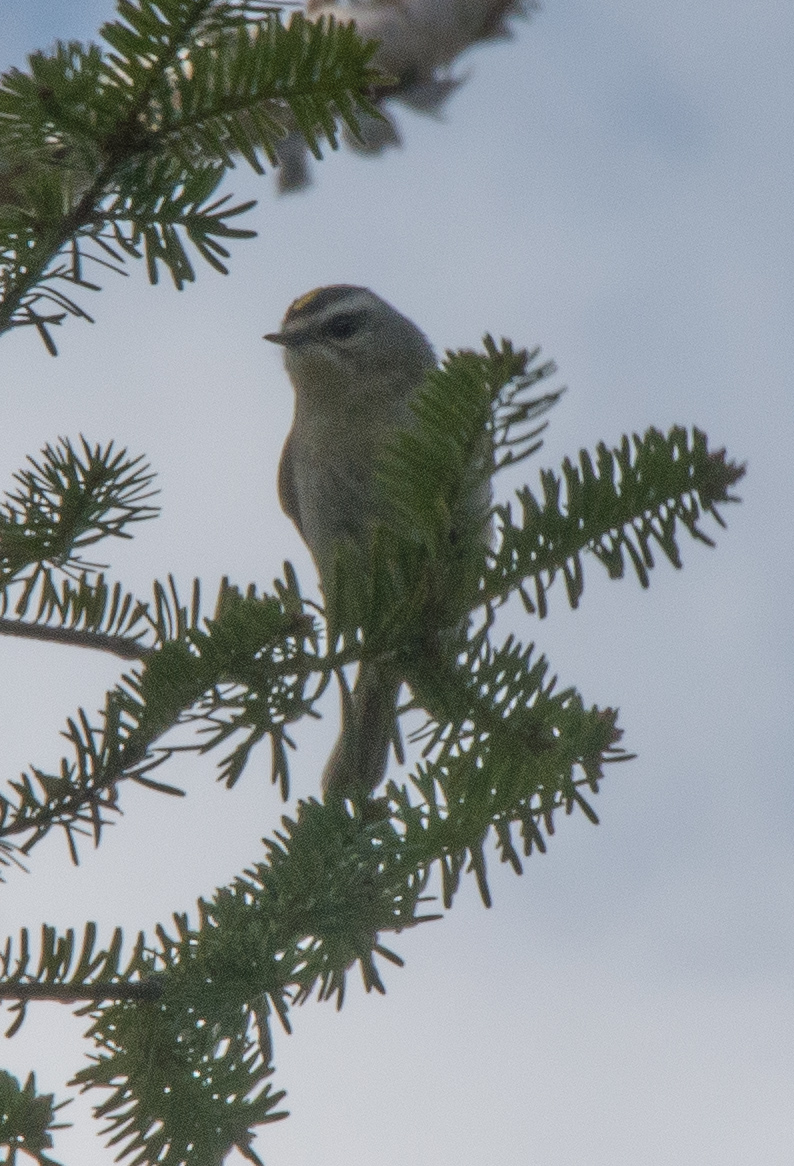
It takes a trained eye and more importantly a trained ear to determine the species.  Our friend Liz Lee suggested we take one of the Green Mountain Audubon Society walks to learn more about birding in Vermont.  We did a practice walk in the Jay Range in the Adirondacks and realized it's more difficult to spot the birds than we thought.  Photographing them is a greater challenge.  In the Adirondacks we managed to photograph a mere three species:  Black-throated Blue Warbler, Golden-crowned Kinglet and Rose-breasted Grosbeak.

Golden-crowned Kinglet
The next morning we went on our first walk with the Green Mountain Audubon Society (GMAS) in Geprags Community Park in Hinesberg.  Led by GMAS board member Bill Mercia, we managed to see or hear a whopping 44 species of birds!  I have to admit, I didn't see or hear all 44.  My favorites were the Golden-winged Warbler, Ruby-crowned Kinglet, American Redstart and Yellow-rumped Warbler.

Golden-winged Warbler
To learn more about the Green Mountain Audubon Society go to:

Green Mountain Audubon Society

We practiced our newly learned skills the next morning at Charlotte Park and Wildlife Refuge.  There was a chorus of bird song but on our own we were having difficulty identifying them.  We did manage to get reasonably good photos of Chestnut-sided Warblers, Gray Catbird and American Redstart.

Gray Catbird
We located a woodpecker nest and saw an adult fly out but were unable to identify it.  Our best guess is a Northern Flicker.

On the morning of May 17, we joined Mike Winslow, staff scientist for the Lake Champlain Committee, for a bird walk in Oakledge Park in Burlington.  We managed to spot about 20 species. Marc got a great photo of a Red-eyed Vireo.

Red-eyed Vireo
For more information about the Lake Champlain Committee and Bird Friday go to:

Lake Champlain Committee

We did our final bird walk of the season this morning at Honey Hollow in Jonesville.  Right from the parking lot we spotted Baltimore Oriole, Common Yellowthroat, Chestnut-sided Warbler and Song Sparrow.


Common Yellowthroat
Baltimore Oriole

A little further up the road we heard then spotted a magnificent Indigo Bunting.

Indigo Bunting
The Ovenbirds, Vireos and Wood Thrushes were singing from the thick understory.  We couldn't always spot them but at least we had learned what they were from their calls.  A female Blackburnian Warbler (thanks, Liz) was collecting spider's web for her nest on a branch over the road.

Female Blackburnian warbler
I spotted a Red-breasted Nuthatch feeding it's chick in a nest cavity but when we approached both adult and chick disappeared.  We also spotted a Rose-breasted Grosbeak by his melodic song.

Unfortunately, the Warbler migration is starting to wind down and the leaves are popping out.  It's making it more difficult to spot the birds.  I encourage all to grab a pair of binoculars and get out early to look for these beautiful birds.  I look forward to next spring when the colorful warblers will once again be migrating through our woods!

For more bird photos go to:

Marc's Spring Migration 2013 Collection

Marc's Spring Migration 2014 Collection

Marc's Spring Migration 2015 Collection

Marc's Spring Migration 2016 Collection

Marc's Spring Migration 2017 Collection

Marc's Vermont Birds 2018 Collection

Marc's Vermont Birds 2019 Collection

Marc's Vermont Birds 2020 Collection

We moved to southeast Arizona in late 2021.  Here are bird photos from Arizona:


Wednesday, May 01, 2013

El Yunque and Dino Angel

Greetings All,
We are back in Florida and returning home tomorrow.  We did get to hike in El Yunque National Forest, a cool, mountainous, sub-tropical rainforest on the northeastern end of Puerto Rico.  The Luquillo Mountains are the first land mass encountered by the moisture-laden trade winds formed off the coast of Africa. Our first hike took us to the 3543-foot summit of El Yunque Peak.  We hiked up on a good trail through Mountain Sierra Palm forest with ferns and bromeliads.  The view from the top was somewhat obscured by clouds but we did get glimpses of the surrounding mountains and coastline below.  


On the way back down we took a spur trail to the observation tower on 3088-foot Mt. Britton.  


This tower and others in the National Forest were constructed between 1933 and 1942 by the Civilian Conservation Corps (CCC).  President Franklin D. Roosevelt established the CCC as part of the New Deal Initiative, a program to help end the Great Depression. 

The next day we hiked along the Big Tree Trail to La Mina Falls.  This is a popular destination for tourists and locals alike.  Many people were clambering over boulders to get to the pool at the base of the Falls.


We could hear birds in the forest but they were difficult to see.  We did not see the rare Puerto Rico Parrot (there are only 85 left in the wild) but did get a good look at a Scaly-naped Pigeon which is found throughout the Caribbean.


Other than bats there are no native mammals in Puerto Rico.  We did get a glimpse of an introduced Indian Mongoose crossing the road.  These animals have become pests and are the largest carrier of rabies.  There were land snails along the trail and one posed nicely on a brightly flowered Heliconia.


After our hike we headed to the Marina Puerto del Rey for the start of our second Bio-bay tour. This Bio-bay is located on the island of Vieques so we had to take a 45-minute catamaran ride to get there.  We were joined by 22 others including a group of 4 young women dressed in fancy dresses, jewelry and sandals for the tour.  Did they get a different email than us?  They looked like they were going on a fancy dinner/booze cruise rather than going on a Bio-bay tour.  We were served rum punch, piƱa coladas and the popular rum and diet coke on the boat ride over so it was sort of a booze cruise.  Once on the island we were served dinner before going on the actual tour at 8:30.  We boarded a pontoon boat powered by electric motors and you could immediately see the bio-luminance caused by the wake of the boat.


Our tour guide asked if anyone wanted to stick a foot into the water and a young woman eagerly answered "yes!". She just happened to be wearing a bathing suit so she was able to go completely into the water.  Swimming in the Bio-bays has been banned since 2007 but this tour gets around it by allowing 2-3 "swimmers" per tour as long as you have two points of contact on the ladder.  I wanted to go swimming with the dinoflagellates too but I didn't have a bathing suit.  Oh, what the heck, I didn't know these people and would never see them again.  I volunteered next and stripped down to my underwear to swim with the Dinos!   It's not as crude as it sounds.  I had a jog bra on and it was too dark to see anything.  I climbed down the ladder and held on with one hand and a foot.  I swirled the free arm and leg through the water letting the Dinos do their magic.  It's an entirely different experience when you're actually in the water with them.  The tour guide told me to hook both my feet through the ladder and create a "Dino angel" with both my arms!


After I got back in the boat our tour guide, Ricky, told us that although swimming in the Bio-bays was banned in 2007, it wasn't enforced until 2011 after a woman was attacked by a shark!  Now, he tells me though it wouldn't have kept me from going into the water.

All too soon it was time to return to shore.  We had another surprise in store for us.  A man flagged our bus down and asked if we wanted to see a nesting sea turtle.  "Heck yes" was the overwhelming response.  We followed the man to a nest where a rare Hawksbill turtle was just finishing up covering her eggs.  


She had just laid 160 of them and will nest up to 5 times this season.  Three species of sea turtles, Leatherback, Green and Hawksbill nest on Vieques.   The Hawksbill Turtle is critically endangered due to human fishing practices and the collection of their shells for jewelry and other decorative items.

What a magical evening!  We are looking forward to returning to Vermont where spring wildflowers and biking await.  We'll see many of you soon.
Peggy and Marc

Sunday, April 28, 2013

Fascinating Forts and Dino Magic

Greetings All,
We have spent the last few days exploring Puerto Rico.  Yesterday we visited Old San Juan.  There is a lot of history here including two forts that were built in the sixteenth through nineteenth centuries.  The first one we visited was Fort San Cristobal.  It was built by the Spanish from 1765 to 1783 to protect the city of San Juan from land-based attacks.  We entered the fort through a tunnel and stopped at the dungeon where prisoners drew ships on the wall while waiting to be released.


The impressive stone walls are as high as 150 feet and garitas or sentry boxes are built onto the outer walls.  On the eastern corner of the fort is the Garita del Diablo.


Legend has it that sentries would disappear from here presumably taken by the devil.  The living quarters were set up to show where the soldiers slept.  Wooden bunks lay side by side with woolen blankets and the soldiers' hats and other belongings set at the foot of each bed.  Uniforms hung from pegs on the wall behind the bunks.


From Fort San Cristobal we walked to Castillo San Filipe de Morro (El Morro).


This imposing citadel stands guard over San Juan Harbor.  The Spanish started construction in 1539 and many enlargements and modifications have been made over the years.   The lighthouse was rebuilt by the US in 1908 after being damaged during the Spanish-American war in 1898.  The war ended with the signing of Treaty of Paris. Spain ceded ownership of the islands of Puerto Rico, Cuba, Guam and the Philippines to the United States.  The lighthouse has recently been refurbished.

 
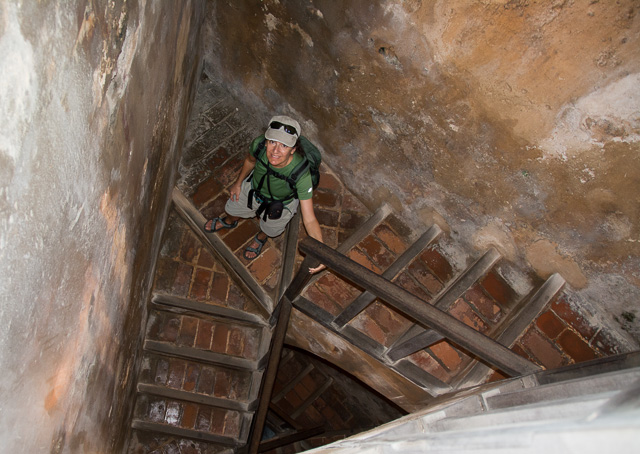
A unique triangular staircase was used by the soldiers to get from level to level.


We just happened to be visiting during the reenactment of the Battle of 1797.  The  British Navy, under orders given by Sir Ralph Abercrombie, attacked the Port of San Juan back in 1797. To commemorate that event, a reenactment is held each year in Old San Juan, usually on the last weekend of April.  Men and women were dressed in the uniforms and clothing of the period.  They marched in formation to the beat of drums and stopped in front of us.  


The reenactors demonstrated how they loaded and fired their muskets and canons.  I couldn't believe how loud they were.  I had to plug my ears.


The event really brought the fort to life and we learned a bit of history to boot.
 
Last night we visited one of Puerto Rico's bio-luminescent bays, Laguna Grande.  We opted to take an electric boat that holds up to 6 passengers rather than a kayak.  There are now 9 companies offering kayak tours in the bay.  They can take up to 30 kayaks each so it has created a major kayak jam.  You have to negotiate a narrow mangrove channel in the dark to get into the bay.  As we were going in, hundreds of kayaks were coming out.  It was a bit hectic with inexperienced kayakers hitting each other, running into the mangroves and even hitting us.  Once into the bay all the kayakers were gone and peace and quiet resumed.  We were given plastic wands to stick into the water.  As we swirled them around the boat, the water glowed!  Millions of single-celled organisms called dinoflagellates were emitting light in response to the friction we were creating.  I scooped up some water with my hand and it sparkled like glitter, Dino Magic!
 
It's difficult to photograph this phenomenon but Marc gave it his best shot.

 
Enough for now.  We're finishing up with some hiking in El Yunque National Forest and a visit to another bio-bay.
We hope all is well back home.
Peggy and Marc
Friday, April 26, 2013

Champagne Beach and Boiling Lake

Greetings All,
Our trip to Dominica is coming to an end.  Heavy rain continued to plague us during most of our stay but we managed to get a few more activities in.  On Tuesday we visited Champagne Beach.


The draw here is the unique opportunity to swim through bubbles caused by gas escaping from underwater vents. We pretty much had the beach to ourselves and with a snorkel, fins and my trusty life jacket set off to explore the bay.  There were many colorful fish, yellow tube sponges, spiky sea urchins, fan corrals and an eel.  I wish we had an underwater camera to capture some of the beautiful creatures that live here.  Marc managed to photograph some of the bubbles with my point and shoot.


After snorkeling, we went whale watching out of Roseau.  We grabbed front row seats and pulled out our cameras and binoculars.  We were ready but where were the whales?  We searched for four hours cruising along the shore of Dominica, first south than north, but we didn't spot a whale or even a dolphin.  Marc had to settle for photographing flying fish.


We returned to the dock an hour late, just as the lights of Roseau flickered on.

A couple of days ago we took a short hike on the Glasse Trail.  The trail used to be a road that was used by fisherman to get their boats into the Atlantic.  After a few too many hurricanes, the village decided to abandon fishing.  The trail led down through rainforest to the coast.  The Atlantic Ocean crashed against the rugged cliffs.  There were a few pools carved out of volcanic rock.  


A small flock of White-tailed Tropicbirds soared around the cliffs where they were nesting.  Dr. Birdy tried to show us these birds when we were on our birding tour but they weren't around.


Since the chance of hiking to Victoria Falls was slim (there's still too much water in the river) we decided to try our luck at whale watching again.  With a 80% change of seeing whales we couldn't be unlucky two days in a row.  We grabbed our front row seats again and had high hopes but after several attempts to pick up the whale's clicks on the hydro phone we knew our chances were diminishing.  I had given up hope of seeing anything when a woman pointed out tiny brown fins in the water.  I caught a glimpse and Marc missed them entirely.  They dove down and we did not see them again.  According to the crew they were Pygmy Killer Whales.  Although not the sperm whales we were hoping to see, they were a new species for me.  We headed back to Roseau which was in the clear but the mountains remained cloaked in clouds


Yesterday was our last full day on Dominica.  We saved the best for last, a 6-hour hike to the Valley of Desolation and the Boiling Lake.  We set out at 7:30 and drove for a hour and a half.  It had rained during the night but appeared to be clearing up.  We had high hopes as we set out with our guide, a French couple and another couple from the US.  We climbed log stairs through rainforest then down again to cross a river.  We could hop across on rocks.  As we climbed higher, it started to rain in earnest.  We gave up trying to keep our boots dry and splashed on through water that now flowed down the trail.  We caught a glimpse of the steam rising from the Boiling Lake  below us.  The lake is a flooded volcanic fumarole heated by gas and molten magma beneath the Earth's crust.  Look closely between the rain drops.  The Valley of Desolation is the barren area on the right and you can just make out the steam from the Boiling Lake on the left.  


We started our decent into the Valley of Desolation and were met by another French couple and their guide that had passed us earlier.  Why were they returning?  With all this rain their guide felt it too dangerous to continue.  Carlos, our guide agreed that the threat of a landslide had become too great to risk.  I looked forlornly at The Valley of Desolation and knew it was the right call.


We headed back down and reached the river crossing.  The water had risen and the others in front of us were crossing on a tree that had fallen over the river!  I followed them, sitting on the tree and skooching across on my butt.  The vines snagged my shorts and scratched my legs but we made it across.


Trenches cut along the trail keep a lot of water off the trail but it was still slippery and you had to watch every step.


We finally returned to the truck and wrapped ourselves in yellow beach towels for the long drive back to the lodge in the open back of the truck.  Despite all the rain we had a good trip.  Dominica is a fascinating place to visit.  We'll return one day to give whale watching another try, to get to the Boiling Lake and to visit the tiny tree frogs that sang us to sleep every night. 


We're on our way to Puerto Rico now.  We hope it isn't as wet!
We hope all is well back home,
Peggy and Marc

Monday, April 22, 2013

Dominica Deluge

Greetings All,
We are on the tiny island of Dominica in the eastern Caribbean.  We so much enjoyed whale watching in New Zealand that when we arrived home I did an Internet search on other places in the world you can see Sperm Whales.  Dominica popped up.  It's surprising how many similarities Dominica has to New Zealand.  Both have a deep water canyon off shore which attracts whales and dolphins, both have boiling lakes (New Zealand has the largest and Dominica has the second largest in the world) and both countries have tree ferns.

So here we are in Dominica for a week. We arrived Thurs. night and up until today it has been raining cats and dogs.   Not the brief showers you commonly get in the tropics but torrential downpours that wash out roads and hiking trails and swell rivers to the point of flooding.... and this is the dry season!  We have managed to do some short tours around the lodge.  Friday we went into the tiny town of Delices to visit a local home and family business.  Joseph along with his wife and six children grow and process a plant that is locally known as Torloma.  

Joseph's wife holding a Torloma Plant
 
The tubers are harvested, washed and ground into a pulp.  The pulp is suspended in water and the starch settles to the bottom of a large blue barrel.   It is dried then ground into a flour to make cereal or thickener for gravy.

Joseph's daughter next to the finished product

It's amazing how people living in the tropics all around the world use a similar process for extracting starch from plants such as cassava, manioc, false banana and palm.  The end result doesn't have much nutritional value but has lots of calories and fills you up.

Saturday we visited the capital city of Roseau to take in the market and to visit Trafalgar Falls.  With all the recent rain, these were the only falls that we could safely walk to.  Water thundered over the falls dropping 200 feet onto the rocks below.

Trafalgar Falls

Yesterday we were able to go birding in Morne Diablotin National Park with Bertrand Jno Baptiste aka Dr. Birdy.  He is Dominica's foremost ornithologist and has written a guide on the birds of Dominica. We were in search of Dominica's  two endemic parrots.  After much searching we spotted a Sisserou or Imperial Parrot from a viewpoint.  There are only 300 of these birds left in the wild.  She was across the valley, about 400 meters away, feeding on the fruits of a tree.  She was difficult to photograph as she bobbed up and down on the branch, a real test for Marc's new camera and zoom lens.

Sisserou or Imperial Parrot

The second endemic parrot, a Jaco or Red-necked Parrot, was much closer.  They are more common than the Sisserou with about 3500 Red-necked Parrots in the wild.  A small flock were feeding on spiky fruit in a tree next to the road.

 Spiky fruit that the Red-necked Parrots were Feeding On

Jaco or Red-necked Parrot

We saw a host of other birds (humming birds, thrushes, warblers, hawks and doves) and two Agouti, a large rodent introduced from Central America.

Agouti

Today we were actually able to do a hike from the lodge without getting wet.  We got our first view of the surrounding rugged mountains.


We encountered some of the local critters along our route.  The first was a freshwater crab with just one claw.  The second is a little snake that we met on the path to our cabin.


We're hoping that the weather and water clarity will continue to improve and that we'll be able to go snorkeling at Champagne Beach tomorrow.  There is an underwater volcanic vent here and you can swim through the bubbles without getting boiled I hope.  There are also seahorses, octopus and turtles.  In the afternoon we hope to go whale watching.  If all else fails we can hang out in my lounge drinking local rum and beer!


We hope all is well back home.
Peggy and Marc