Saturday, March 09, 2013

"A Journey of Contrasts"

Greetings All,
We have just finished a five-day trek on the Heaphy Track.  The Heaphy Track runs through Kahurangi National Park in the northwest corner of the South Island of New Zealand.  The track route was first used by Maori jade collectors who traveled from Golden Bay on the north coast to the jade rivers on the west coast.  At 51 miles, the Heaphy is New Zealand's longest "Great Walk".    The Track is not a circuit and its two ends are 288 miles apart by road making logistics a bit tricky.  We arranged transport through a local company called Trek Express.  They picked us up from our motel in Nelson Monday morning and drove us 3 hours to the start of the track at Brown Hut.


The first day of the trek was the most difficult but not too bad.  We had to climb 2600 feet over 10.5 miles.  The track, once graded for a road, climbed gradually through beech forest before reaching Flanagans Corner, the highest point on the track at 3000 feet.


We reached Perry Saddle Hut, our objective for the night, at around 4:30.  The Hut had been rebuilt last year so it was very nice.  There was a large kitchen and dining area and three bunk rooms.  We picked two bunks and boiled water for a delicious freeze-dried dinner of honey soy chicken.

We opted to do the trek in five days so the second day was a short one, about half a day.  We had to walk 8 miles to Saxon Hut.  Today's route took us across the red tussock grasslands of Gouland Downs.


A Weka popped out of the grass and crossed the trail in front of us.


Tiny red Sundews grew in the drainage ditch along the trail.


We passed a pole to which trampers have tied old hiking boots over the years, although there were a purple pair of high heels!


As we neared Saxon Hut I could hear a motor.  What on earth is a vehicle doing up here?  As we rounded the corner a DOC employee was doing trail maintenance with a mini backhoe, the ultimate tool for creating water bars!


We chatted a bit and I asked him where the best place was to see the rare Blue Duck.  He told us we could see some at Saxon River or Blue Duck Creek, both not far from Saxon Hut.  We continued on to the Hut and settled in.  After lunch we went in search of the elusive Blue Duck.  We crossed a bridge over the Saxon River - no ducks.  We crossed a bridge over Blue Duck Creek - no ducks.  We continued on and I found an open spot on the creek.  I told Marc it would be a good place to sit and wait for the ducks.  After about 20 minutes Marc started getting antsy.  I asked him the time and he replied "4:55."  I told him "just give it five more minutes."  He responded "What do you think, they are just going to swim by?"  Two minutes later a beautiful pair of blue ducks did just that!


The blue duck (or whio; Hymenolaimus malacorhynchos) is a unique threatened species of waterfowl endemic to New Zealand. It is the only member of its genus and has no close relative anywhere in the world.  The male whistled and the female growled back as they swam up river.  We followed them to another open area and watched as they preened, fed, flapped their wings and chased one another.


It was a perfect sighting of an extraordinary bird!  When we returned to the Hut, the ranger had been there.  Today is census day in New Zealand.  He left forms for us to fill out even though we're not Kiwis (nickname for New Zealanders).  They wanted to count everyone in New Zealand - even visitors.  I hope this doesn't mean we have to start paying New Zealand taxes!


We had another short day, about 9 miles to hike to MacKay Hut.  We left the grassland behind and entered the forest.  Some had heard Kiwis (the bird) calling last night.  This is the only Kiwi we saw along the track.


The forest was filled with unusual mosses, lichen, fungus.  A carnivorous land snail,  Powelliphanta, also lives here.


At MacKay Hut you get your first view of the Heaphy River emptying into the Tasman Sea far below, about 2200 feet down and a day's walk away.


We settled into our cramped quarters but managed to secure the only two bunks not connected to others.


I finally discovered the secret to sleeping in crowded huts where snoring is almost a certainty - noise canceling earbuds!  I picked up a pair in Nelson and they did the trick.  Marc photographed a beautiful sunset over the Tasman Sea.


Our fourth day of hiking was our longest.  We had to cover 13 miles to reach the Heaphy Hut near the mouth of the river we could see from Mackay Hut.  We were on the trail by 7:30 and entered a forest filled with interesting birds.  The Robins fought over Marc when he sat in the trail.  They pecked at his boots and trek poles to get his attention, "photograph me, photograph me"! they chirped.

Look closely, there is a robin pecking Marc's left boot


Little Fantails swooped down and perched close by displaying their white and gray tail feathers. 


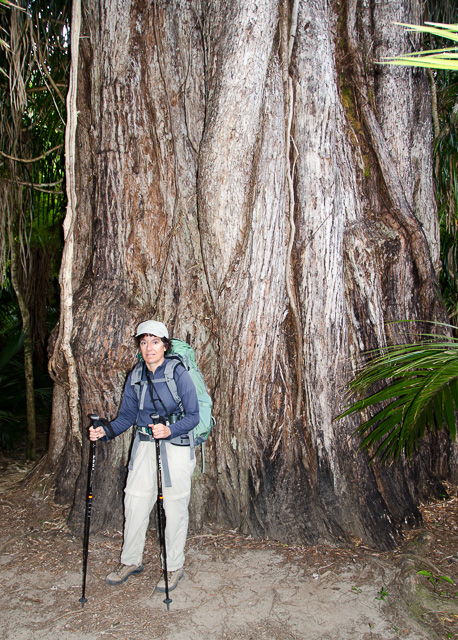
As we got closer to the coast, the forest became more lush.  Tree ferns, Nikau Palms and giant Rata trees grew along the track. 

We arrived at the Heaphy Hut around 1:00 and selected our bunks.  Like the Percy Saddle Hut, the Heaphy Hut had been rebuilt last year.  A large kitchen/dining area overlooks Heaphy Beach and the bunks are in four separate rooms, each accommodating up to 8 trampers.  After lunch we went for a walk along the Heaphy River to it's mouth where the river surges out through a narrow gap into the sea. 


On the beach I spotted two penguins!  As we got closer I could see they were only Shags, pretty birds nonetheless.


A Tui, another one of New Zealand's endemic birds, was feeding in the cabbage trees near the Hut.  They are striking birds with a white tuff under their throats which contrasts with their glossy black color.


It was time to prepare dinner back at the Hut.  One group was on a gourmet tramping tour and had a real beef stir fry.   The rest of us had our freeze-dried dinners.


Marc prepared roast chicken complete with mashed potatoes (in plastic bag).


The fifth and final day of the Track took us 10 miles along the West Coast past beaches littered with drift wood and strewn with boulders.

 
One of our fellow trampers has spotted a native New Zealand Wood Pigeon perched in a tree above the track.


Our final climb was up Kohaihai Saddle.  From the top there was a great viewpoint from which we could see Scott's Beach and as far back as Heaphy Beach.


We climbed back down and crossed a suspension bridge over the Kohaihai River before reaching the Kohaihai car park at the end of the trek.  It was about 12:15 and we had until 1:30 for the Trek Express bus to pick us up.  Most of us that hiked from the Heaphy Hut were waiting for the same bus.  It arrived in time and we piled in for the long drive back to Nelson.


We arrived in Nelson around 8:00 a bit weary but satisfied with our trek. The Heaphy Track is truly a journey of contrasts with lush rainforest, sub-alpine tussock grasslands, high rugged mountains, lowland forest and palm fringed beaches.
We hope all is well back home.
Peggy and Marc

Saturday, March 02, 2013

Better the Second Time Around

Greetings All,
We've spent the last three and a half days hiking around Aoraki/Mount Cook National Park.  Aoraki is the Maori name for Mount Cook which at 12,316 feet is the highest mountain in New Zealand. During our first afternoon in the park we hiked up the Hooker Valley towards Mount Cook. The track crosses the Hooker River twice on swing-bridges before reaching its source, the Hooker Glacier terminal lake.


A friendly Kea, a mountain parrot, came to check us out.  It's difficult to photograph birds when they are so elusive!


The weather the next day was glorious, perfect for our longest and toughest hike up to Mueller Hut. Our first objective was Sealy Tarns.  We hiked to them up a steep and eroded trail 26 years ago!  Now there are wooden steps, supposedly 1810, leading to the tarns or small mountain lakes. 


The views of Mt. Sefton and Mt. Cook were spectacular.


We continued the climb up to Mueller Hut on a steep, rocky track.  A saddle at the top of the ridge afforded more incredible views.  


A tiny Rock Wren flitted in the boulders around us.


We rounded a bend and the Mueller Hut came into view.


The present Mueller Hut was opened in 2003 by Sir Edmund Hillary.  The first to summit Everest, Hillary got his start in mountaineering in these mountains.  We had lunch on the front deck savoring the sunny weather and incredible views. 


We headed back down, grateful for the wooden steps, all 1810 of them!


The next morning we decided to take a break from hiking and take a boat trip on the Tasman Glacier terminal lake.  This allowed us to get up close to icebergs that had just calved off the glacier during the early hours of Saturday morning, February, 23. The calving caused the entire 2133 foot-wide front face of the Tasman Glacier to break away into the lake. The ice broke into around 20 huge icebergs, including one described as the largest ever seen on the Tasman Glacier terminal lake. The walls of this iceberg are 130 to 165 feet above the water and 650 to 820 feet below the surface of the lake.  Since the iceberg isn't moving, it must be stuck on the bottom of the lake.  


In the afternoon we hiked up to the Red Tarns.  We sat on a bench for awhile taking in the view of Mt. Cook with the Red Tarns in the foreground.  They owe their coloring to a red pond weed that grows in the water.

 
Incredibly the great weather held for a fourth day and we were able to get in another hike, this one to Ball Hut.  The route followed an old road built back in 1930 along the moraine of the Tasman Glacier to the hut.   The moraine is a massive pile of dirt and rock that has been gouged out by the glacier as it moves down the valley.  A cairn marked a route up the moraine and we followed it to the top.  We thought the trail would stay on top of the moraine but it was only a viewpoint.  The moraine was too narrow and unstable to walk along.  We were 300 feet above the glacier.  At this point it was covered in gravel so didn't look like a glacier at all.  We could see back to the terminal lake and the giant iceberg we saw up close yesterday.

 
Global warming is taking its toll on New Zealand glaciers.  The Tasman Glacier,  New Zealand largest, is retreating rapidly.  Now approximately 17 miles long and 1970 feet deep the Tasman Glacier is melting and calving at an exponentially increasing rate resulting in a terminal lake that is rapidly growing in size.  In the early 1970s, there were several small meltwater ponds on the Tasman Glacier.   By 1990, these ponds had merged into Tasman Lake - which means that the lake had not yet formed when we were here 26 years ago!   It is estimated that the entire Tasman Glacier will disappear in 10-19 years!  We went back to the road which led to the top of the moraine with more great views over the glacier and the mountains beyond.

 
We had to make a large detour around the back of a more recent landslide, cross a boulder field and eventually back to the road.  Orange wands marked the new route.  The road didn't last long before eroding away into the glacier.  We reached the hut, a tiny red structure that sleeps only three.  We had lunch on the edge of the moraine then followed the road a bit further to get a look at the Ball Glacier from the left coming down to join the Tasman Glacier from the right.

 
We couldn't have asked for better weather.  It was great seeing Mt. Cook and the other mountains and glaciers of the Southern Alps after so many years.  The area is changing fast.  If we want to see the Tasman glacier again, we can't wait another 26 years!
We hope all is well back home.
Peggy and Marc

Wednesday, February 27, 2013

Pinnipeds in Peril and Penguin Paparazzi

Greetings All,
We took our friends Jerry and Cilla's great advice and visited the Catlins. This area lies along the  southeastern coast of the South Island of New Zealand between Invercargill and Dunedin.  Here is a link to a map of the Catlins:

  http://www.catlins.org.nz/userfiles/file/pdf-downloads/TearOffMap12Front.pdf

A mosaic of rolling farmland dotted with sheep and cows are interspersed with patches of temperate rainforest along rugged cliffs that drop off to isolated beaches. The area is sparsely populated and remote. You get the sense that this is the way New Zealand was years ago. The big draw for us was the opportunity to see some unique and rare wildlife:  Hector's Dolphins, Yellow-eyed Penguins and New Zealand Sea Lions. We went to Porpoise Bay to look for the Hector's Dolphins. At about 5 feet in length, it is one of the smallest cetaceans (whales, dolphins and porpoises) and New Zealand's only endemic cetacean. There are only 8000 Hector's Dolphins left in the world. We scanned the bay with our binoculars and spotted dorsal fins in the distance! We went down to the beach and sure enough the Hector's Dolphins were cruising the bay.


We watched as they surfed the waves, leaped out of the water and poked their heads up. Marc was fortunate to capture a few of these moments.


I wanted to get closer but we didn't have a kayak or wet suits. A few brave souls went into the water in batching suits. The dolphins were curious and came to check out the kayakers and swimmers.  Oh, to be so close to such a rare creature!

We visited Surat Bay in search of New Zealand Sea Lions. A short walk through some dunes brought us to the beach. A couple told us there was a large Sea Lion just ahead. We found him half buried in the sand, trying to snooze despite the pestering flies. We continued past, rounded the corner and continued down a long stretch of isolated beach. We came across another two bulls and Marc stopped to photograph them.


I continued on finding a third male and two female sea lions napping together. Marc was still back at the second group of sea lions but I continued on. A group of 5 including a pup were snoozing together.  I sat on a log to watch them.


Marc finally joined me and we enjoyed the sea lions in complete isolation or so we thought. Two guys on dirt bikes came roaring up the beach and stopped right at the sea lions. Incredulous! What did these yahoos think they were doing? They pulled up next to another sea lion and got off their bikes. "What nerve!"I thought. One guy put on these long green rubber gloves. What on earth is he doing? Turns out they were there to pick up a dead pup for autopsy.


New Zealand Sea lions are "nationally critical", the highest threat category in New Zealand.  The death of even one pup is a concern for a species whose population has declined sharply over the last 10-12 years.  This pup may have been abandoned by it's mother or succumbed to a bacterial infection.

The third rare creature that we wanted to see is the Yellow-eyed Penguin. It was now 6:30 PM with just enough time to reach Roaring Bay. At this time of day the adults are returning to their nests to feed their chicks. Yellow-eyed penguins mate for life and always return to their favorite nesting site. There are only a few hundred of these rare penguins living along the Catlins coast. We arrived at a hide just past 7:00 PM. It was full but we managed to squeeze in. A penguin, about a hundred feet away, had already come ashore and was preening itself. A second stood motionless on the beach in the process of molting or maybe a chick waiting for its parents. Two more adult penguins popped out of the surf and headed up the beach. Three chicks came out to greet them begging to be fed.


We watched until they disappeared into the vegetation. I think we saw a total of 7 penguins before heading back to the car.

The next evening we went to Curio Bay to look for more penguins. We got there around 5:30 PM. A single molting penguin was nearby and we could see a second one on a rock far away. I went back to the car to put on more clothes and a penguin had emerged from the water around 6:00 PM, preened itself and started to rock hop to the vegetation where a hungry chick waited.


A guy spotted another penguin on the other side of the bay, high up on some rocks. More people showed up and started to spread out over the rocks, some close to the waters edge. A ranger showed up around 7:00 PM and pushed the crowd back to give the penguins enough space.   The Penguin Paparazzi had now grown to 100!


The next penguin didn't pop up until 7:25 PM. This got the crowd to it's feet. It was far away. At least another 3 penguins popped out of the ocean during the next half hour. The sun was getting too low for photos and we were getting cold so we left around 8:00 PM.

We had booked a Yellow-eyed penguin tour for the next night but it was cancelled. The tour operator suggested Roaring or Curio Bays. We had been to both those locations and so had most of the other tourists visiting the Catlins. The tour operator mentioned a third place, Long Point. The car park for Long Point was about 11 miles from the main road and it was a 30 minute walk to get to the Point. Perfect, this was the secret, secluded penguin spot that we were looking for. Surely, the Penguin Paparazzi wouldn't follow us here. We followed the tour operator's cryptic directions and found the car park. There were no cars, a good sign. We walked along a sheep pasture on top of a cliff and could see a brown hut below, our destination.


We sat on some rocks and waited patiently for the penguins to arrive. Marc spotted another couple sitting on some rocks 50 yards away. How did they get here?  We had not seen them on the path along the coast.  A penguin popped up about 150 feet away and then another. They took their time preening before slowly heading toward their nests. A third penguin appeared 80 feet away!  It preened for what seemed like forever before it started plodding to its nest.


Its chick popped out of the vegetation and greeted its parent by begging for food. They disappeared into the vegetation and a rabbit followed.


The other couple got up to leave and spotted us for the first time. They came over to chat and we answered in hushed whispers. They told us that we didn't have to be that quiet around the penguins. It turns out they owned the farm on top of the cliff. What an amazing place to live!

After they left, we had the seclusion I had hoped for. We watched as more penguins came ashore, preened then slowly started for their nests.


More chicks had emerged from the vegetation eagerly waiting for their parents.
We could have stayed longer but it was 8:50 PM and we had intruded on the penguins' world long enough. We climbed back to the top of the cliff as the sun was setting over the Southern Ocean.


A full moon rose to guide us back to our car. What a magical evening, one that we will not forget!
We hope all is well back home,
Peggy and Marc