Friday, September 11, 2015

An Amazon Odyssey!

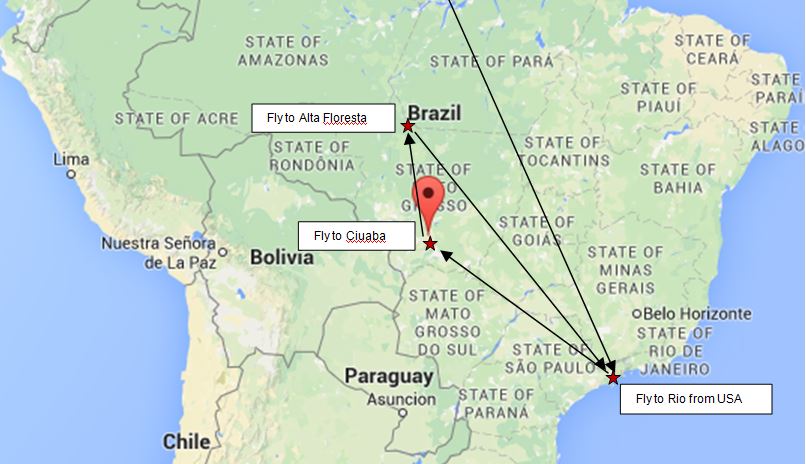
We returned to Cuiaba the morning of September 5 for the 1 hour flight to Alta Floresta, the gateway to the Southern Amazon.  Our destination was the Cristalino Lodge set in an 28,167-acre private reserve along the Cristalino River in the Southern Amazon.   It is just north of Alta Floresta on the map below:

Cristalino Lodge, North of Alta Floresta

We met our guide, Stephan, who was to accompany us during our stay.  That afternoon we visited one of the 165-foot observation towers on the property.  As we approached the tower we could see a large troop of White-whiskered Spider Monkeys feeding in a tree nearby.  These monkeys are endemic (only found here) to the area and were one of the animals I had wanted to see.  We climbed the tower to get a better view of these agile primates.  They swung from branch to branch with ease using their strong prehensile tails.  Many of the females had tiny babies attached to their tummies or hanging onto their backs.

White-Whiskered Spider Monkey

We watched the troop as they fed on the tender new leaves.  As dusk approached the monkeys moved off to more dense vegetation for the night.  One remained behind.  "Was he a sentry keeping a lookout for predators, an old member that couldn't keep up or had the troop simply forgotten him?" I wondered.   From below another monkey climbed back up to the abandoned individual.  "Had she returned to help the elder down?" I naively thought.  Wrong, she had returned for a bit of monkey business!  The couple proceeded to mate high up in the canopy!


White-whiskered Spider Monkeys Mating


We watched as the monkeys unabashedly performed for a good 30 minutes!  When their secret trist was over they nonchalantly resumed feeding.  Wow, what a start to our visit!

The next day we revisited the tower and the monkeys were still feeding in the vicinity.  The monkeys behaved themselves and we were able to focus on the birds.  We saw many species but my favorites were the Black-faced Dacnis and the Curl-crested Aracari.
Black-faced Dacnis

Curl-crested Aracari
That afternoon Stephan took us to a hide set up in the forest.  On the boat ride to the blind, Stephan spotted a small troop of Spix's Red-handed Howler Monkeys in the trees along the river - another new primate species for us.
Spix's Red-handed Howler Monkey


The boat driver dropped us off and we hiked a short distance into the forest to a wooden bench hidden with palm fronds so we could sit and watch the secretive forest birds that came to drink at a "bird bath" set up nearby.  We were concerned that the thunderstorms in the area might prevent the birds from coming but after a slow start they arrived in spades.  A total of 16 species including Snow-capped and White-capped Manakins, Spotted-backed Antbird, White-winged Shrike Tanager and Bare-eyed Antbirds came to drink.

Snow-capped Manakin


Spot-backed Antbird

Bare-faced Antbird
As we returned to the lodge along the river we used a spotlight to search the banks for nocturnal creatures.  Two species of caiman, the Spectacled and the Dwarf, ply the waters here.

Dwarf Caiman

On our second full day we did a hike in the morning to a rocky outcrop above the rainforest.  On the way we passed through a bamboo thicket where we heard Dusky Titi monkeys calling.  These shy primates are nearly impossible to see in the dense tangles of bamboo and we had to settle for hearing them only.  We paused at a dead tree where Stephan challenged us to find the bird.  I had no difficulty.  Can you spot the bird in the following photo?

Can you Find the Bird?

From the viewpoint we could see over miles of unbroken primary rainforest interspersed with dry patches on the higher ridges.

View Over the Rainforest

On the walk back from the viewpoint Stephan became very excited by a tiny bird he spotted in the forest.  The bird perched on a nearby branch giving us great views and many photographic opportunities.  Stephan identified the bird as a Rusty-breasted Nunlet and confirmed that it has only been seen at the lodge 6 times!

Rusty-breasted Nunlet

We were enjoying another delicious lunch when one of the lodge guests told her guide that she spotted some monkeys near the floating dock.  She showed him a photo she had taken and he told her they were White-nosed Bearded Saki Monkeys!  There's no time to eat when there are animals to look at.  I rushed off to see them and arrived as they were foraging low in the trees.  Marc joined me and was able to get some good shots.

White-nosed Bearded Saki Monkey
These monkeys have pink noses, not white.  Where did their name come from?  It turns out these Sakis got their name from a dead specimen where the skin on and around the nose had faded to white. I was thrilled to get such a close look at these endangered monkeys endemic to this region of Brazil.

As we headed back to the restaurant we could hear what sounded like someone chopping down a tree with an ax.  As we peered into the rainforest we could see that the noise was made by the Brown Capuchin monkeys trying to open Brazil nuts!  They were banging the massive nuts against the tree branches in an attempt to crack them open.   
Brown Capuchin with a Brazil Nut


That afternoon we cruised the black water of the Christalino River looking for animals and birds coming to drink. We came around a bend in the river and Stephan spotted a Brazilian Tapir lounging in the water to escape the heat and biting flies.  He fled into the forest at our approach but soon returned and put on quite a show for us.


Brazilian Tapir


The Brazilian or South American Tapir is the largest land mammal in South America.  Tapirs are excellent swimmers and divers and feed on aquatic plants, fruits, grasses and leaves.  They have a mobile snout resembling a mini elephant trunk that they use as a snorkel when swimming.
Brazilian Tapir

We saw 3 more tapirs further upriver but they didn't stick around long.  

After dinner we took a walk around the lodge looking for the resident Azara's Night Monkeys.  We heard a rustling in the forest and went to investigate.  Our torch revealed a Southern Tamandua or Lesser Anteater foraging for termites and ants!

Southern Tamandua

The next morning we visited the second tower on the other side of the river.  

Marc Climbing the Tower

The birds were out in full force feeding on a caterpillar swarm in the nearby trees.  I recorded 33 species but I'm sure Stephan saw many more.  My favorites were the Pompadour Cotinga and the Red-necked Aracari.

Pompadour Cotinga

Red-necked Aracari

On our fourth and final night we went out before dinner in a last attempt to find the night monkeys. Stephan spotted a very tiny mouse hiding under a dried Cecropia leaf and we got a glimpse of a Four-eyed Opposum but no monkeys.  After dinner Marc and I went out to search for the monkeys on our own.  We were down near the floating dock when Stephan came running up.  He and his wife Claudia had found the monkeys near the boat launch!  We rushed off to where Claudia was waiting with the monkeys still in view.  We were actually seeing one of the three subspecies of Azara's Night Monkey, the Feline Night Monkey (Aotus azarae infulatus).  These tiny primates are monogamous with the males staying around to help raise the babies and provide food.


Feline Night Monkey 

On our final walk the following morning we encountered a family of Collared Peccaries trotting down the trail.  They paused just long enough for Marc to get a photo.


Collared Peccaries

Although our stay was brief we managed to find with Stephan's expert help many of Cristalino's spectacular birds.  With a whopping 586 species of birds this area is a birdwatchers' paradise.  We were also very lucky with the mammals seeing at least 14 different species.  Many thanks to Stephan and the staff at Cristalino Lodge for making our stay very rewarding and extremely memorable!
We hope all is well back home.
Peggy and Marc

 
For those of you who have made it to the bottom of this post here is the answer to the bird quiz.  The bird is located in the center of the photo on the right side of the tree.  It is a Common Potoo, a nocturnal bird related to Nightjars.

Thursday, September 10, 2015

Armadillos and Anteaters

Greetings All,
I wondered "How do you top seeing 7 Jaguars and Giant Otters in the Pantanal?"  Although these animals are the Pantanal's most charismatic inhabitants, there are plenty more intriguing creatures to search out.  We returned to Porto Jofre where we were greeted by three beautiful Hyacinth Macaws. The Pantanal is the last stronghold for these endangered parrots whose numbers have been decimated by habitat loss and the pet trade.


Hyacinth Macaws
We drove back up the Transpantaneira Highway passing by a Yellow-tailed Cribo that was sunning itself on the road.  This nonvenomous snake is the longest member of its genus and can grow up to 10 feet in length.

Yellow-tailed Cribo
Our next stop was Araras Eco Lodge, one of the first cattle ranches in the area to be converted to an Eco Lodge.  Here conservation is the focus and the proprietors, Andre Von Thuronyi and his wife Aquilla, run several projects to help the beleaguered Hyacinth Macaws and protect 6,670 acres of wildlife habitat.  We spent a few days searching the trails and smaller rivers for more obscure wildlife.  During our first walk we encountered a pair of Whistling Herons fishing in a weed-choked pond.

Whistling Heron

We arrived at a working farm where many colorful parrots were squawking in the trees.  This part of the property is used to raise cattle, horses and sheep and to also rehabilitate parrots rescued from the pet trade in order to return them to the wild.


Blue-fronted Parrot
At night we went out in search of nocturnal animals.  Our drives invariably turned up Crab-eating Foxes and Crab-eating Raccoons.  As its name implies these raccoons eat crabs and other crustaceans but its diet also includes amphibians, turtle eggs and fruit.

Crab-eating Raccoon
The next day we went canoeing on the Rio Claro.  Tucked in among the vegetation was a secretive Agami Heron considered to be one of the most beautiful herons in the world.  We silently glided alongside it to admire its stunning plumage and impressive bill.

Agami Heron
Emanating from the forest were high-pitched calls.  "A bird?', I asked Tadeu.  "No, a tiny monkey called a Black-tailed Marmoset", he replied.  I desperately wanted to see these primates but they remained hidden in the dense vegetation. We returned to the canoe dock where a buffet lunch complete with a barbecue had been set up for us.  As we were eating, two inquisitive Black-tailed Marmosets came down to check out our picnic spot.  We got wonderful close-up views of these seriously cute monkeys after all!

Black-tailed Marmosets

That evening we walked along a boardwalk to a tower to watch the sun set.  Along the way, a troop of Black-striped Capuchin Monkeys frolicked in the trees over our heads.  One cheeky individual looked at us in utter disdain.  "Who were these terrestrial-bound creatures invading his domain?" I could imagine him thinking.

Black-striped Capuchin

A little further along the boardwalk, an Azara's Agouti scurried along on the forest floor.  Finally we were able to get a look at this shy animal that typically fled and hid at our approach.


Azara's Agouti

We climbed to the top of the tower for a bird's-eye-view over the Pantanal.  At this time of year the wetlands are drying out and the birds, fish and caiman are restricted to shrinking pools of water.

View from the Monkey Tower

On one of our early morning drives we came across a Six-banded or Yellow Armadillo searching for grubs in the dry grass.  This prehistoric-looking animal is covered with a leathery armor shell to protect it from predators.  Armadillos have poor eyesight and we were able to approach closely.  This fellow had to stand on his hind legs in order to get a whiff of us.  Once he caught our scent he scurried off into the bushes.

Yellow Armadillo
On our last afternoon we took a drive along the Transpantaneira Highway in search of more wildlife. A female Capybara was attempting to cross the road with her 4 pups.  They scampered back into the swamp as we approached.


Capybara Family
In the late afternoon a large flock of Great Egrets, Jabiru Stork, Rosette Spoonbills and Wood Storks had gathered for their last meal of the day.

Pantanal Flock
On our final morning walk we encountered another odd creature with very poor eyesight, the Southern Tamandua or Lesser Anteater.  He was searching the savannah for a meal of ants and termites.  He stopped his foraging and stood on his hind legs to better hear or smell us.  He didn't seem overly concerned about our intrusion and ambled off to continue his foraging.

Southern Tamandua
After an amazing week of wildlife viewing, it was time to leave the Pantanal.  A big thanks to our very knowable and fun guide, Tadeu, for sharing his backyard with us.  What a privilege to visit one of the "Wildlife Wonders of the World", Brazil's Pantanal Wetlands!
We hope all is well back home,
Peggy and Marc

Friday, September 04, 2015

Jaguar Jackpot!

Greetings All,
We've attempted to see wild jaguars (Panthera onca) on several previous trips but they have always managed to elude us.  It's difficult to spot an elusive cat that makes the dense rainforest its home.  In recent years jaguars have been discovered to inhabit the giant wetlands in central Brazil called the Pantanal.  They are easily spotted along the rivers during the day often time posing for hours.  So on August 25 we headed to Cuiaba, the gateway to the Northern Pantanal in Brazil.  Here is a map showing you where in the world we are:


Here is a detailed map of the area:


We started with a visit to Chapada Dos Guimarares National Park about an hour's drive northeast from Cuiaba.  Towering waterfalls plunge from ancient cliffs and flow into the Pantanal lowlands.

Veu de Novia Waterfall
The wildlife here is very elusive and not easily observed.  We searched in vain for the Maned Wolf in the early morning hours.  We followed his tracks along the road but he did not reveal himself.  It was time to head to the Northern Pantanal to search for an easier quarry, the jaguar!  We drove back to Cuiaba where we picked up a truck for the drive to Porto Jofre.  The first 110 km to Pocone (where we stopped for lunch) were on a good paved road.  From Pocone the road turned to dirt and is called the Transpantaneira Highway.

One of the 125 bridges on the Transpanteria Highway

The road traverses 145 km through the heart of the northern Pantanal and was built in the 1970's to provide access to the large cattle ranches in the area.  During the dry season from May to October, the wetlands dry out and herds of cattle graze on the lush green grass (not so green toward the end of the dry season).

Cattle Grazing in the Pantanal

It is here that cattle ranchers and Eco-Lodge operators are forced to coexist.  The ranchers view jaguars as a threat to their livelihoods while the lodge owners covet them for drawing tourists here by the thousands to see these magnificent cats.   We arrived in Porto Jofre around 4:00 PM and waited for a motor boat to pick us up and deliver us up the Rio Sao Lourenco to the Jacare Houseboat where we would spend the next four nights.  Colorful Yellow-billed Cardinals, Purplish Jays and Saffron Finches were feeding nearby.

Yellow-billed Cardinals

Enormous Jabiru Storks, Southern Caracaras and Black Vultures were waiting in the wings for castoffs from the local fishermen.  Our boat arrived and we were whisked upriver to the Jacare arriving just as the sun was setting and a huge orange full moon was rising.

Jacare Houseboat

Full Moon Over the Sao Lourenco River
The cooks woke me up the following morning at 4:00 AM but it didn't matter as I was eager to go on our first boat safari to look for jaguars!  We left promptly at 6:00 AM with Tadeu, our guide, and our boat driver.  It was nice having our own boat (the Jacare stays moored while small motor boats go in search for the jaguars).  We encountered many birds along the rivers and other boats searching for jaguars but the cats were nowhere to be found.  Two boats had stopped to photograph something.  "A jaguar?" I hoped.  It was not a jaguar but a family of four Giant River Otters clambering up the steep sandy river bank.  It was a great sighting nonetheless.  Giant River Otters are becoming increasingly rare and to find them so relaxed and unperturbed by our presence was a real treat.  They rolled in the dust, scent-marking their territory before trying to get comfortable for a midday snooze.


Giant River Otters
It was getting hot - real hot as the sun climbed in the sky.  We left the otters and continued up the Three Brothers River, a tributary of the Rio Sao Lourenco and spotted another boat that had stopped close to the river bank.  As we approached we could see a jaguar lying on the top of the bank!  The other boat was too close so we anchored a bit further away to admire this stunning feline.  Through my binoculars I could see he was blind in one eye.  He was totally un-phased by our presence and continued to cat nap.

First Jaguar Sighting

The first boat left and we got the front row viewing position at the proper distance.  The word was out by radio that a jaguar had been spotted and more and more boats began to arrive.  Some people got out on a sandbar on the opposite bank and set up umbrellas to view and photograph the slumbering jaguar.  By now 20 boats had amassed and the "Panthera Paparazzi" was in full force clicking away every time the jaguar moved, yawned or lifted his head.  Of course we were part of the Paparazzi and took our share of photos.  We left "One Eye" to sleep during the heat of the day and returned to the Jacare for lunch.

Part of the "Panthera Paparazzi"
At 2:00 PM we headed out on our second boat safari.  We passed "One Eye" still snoozing while the "Panthera Paparazzi" clicked away.  We passed the otter family and continued upriver at a brisk pace.  Tadeu had a surprise for us.  About 20 minutes further upriver, not one but two jaguars had been spotted!  When we arrived several boats were already positioned including a BBC film crew.  As we jockeyed for a good position, I could see one jaguar lying under a tree and a second lying in a more open area about 30 feet down the bank.  When the second cat got up I could see he was a large male and it became apparent that this was a courting pair!  The male got up and approached the female lying under the tree.

A Male Jaguar Approaches
Their encounter was far from amorous.  The female growled and hissed, chasing the male off.

Courting Jaguars!
"Was she playing hard to get, was she not ready to mate, was this all part of the jaguar courtship?", I wondered.  The male too was trying to figure out the status of the female.  He stopped to sniff the ground to pick up her scent.

The Male Jaguar Sniffs the Ground

He sat up grimacing.  Was her odor that offensive?  Not at all!

Do I Smell that Bad?

The male was displaying the flehmen response.   Male individuals commonly use the flehmen response as an olfactory mechanism for identifying the reproductive state of females based on pheromones in the female's urine.  All this courtship behavior was causing the male to overheat.  He crawled down the bank to cool off in the river.

I Need to Cool Off
He was only 30 feet from the nearest boat!  After his refreshing dip he returned to the bank to resume his pursuit.  This went on for two hours until we had to leave to get back to the Jacare before dark. What an amazing first day of jaguar viewing! 

The next morning we were out by 6:00 AM again.  This time we decided to explore Rio Negrinho, a tributary of the Rio Sao Lourenco about 15 miles downriver.  Although the chances of seeing a jaguar were less, the prospect of having the river to ourselves was appealing.  As we thought we reached the end of the tributary without finding a jaguar but we only encountered 2 other boats.  We did see many beautiful birds, capybara (world's largest rodent) and giant otters along the river.  

Capybara

As we headed back we met up with another boat from the Jacare.  Near the confluence with the Rio Sai Lourenco, Tadeu miraculously spotted 2 jaguars on the bank under the trees!  They turned out to be cubs about a year and a half old.  They were eating a caiman that they presumably caught.  At our approach one of the cubs dragged the caiman off to a more private location.


Jaguar Cub with a Caiman
We radioed the other boat to let them know that we had found jaguars.  It was nice watching the cubs with only two boats around.  They grew tired of us watching and photographing them and dragged their prize into the forest where we could no longer see them.  By now the other boat had left and we began the journey back to the Jacare on our own.  As we entered the Rio Sao Lourenco, Tadeu spotted a third jaguar in the river!  At first I thought he was joking but there she was - staying cool in the river.

Female Jaguar

We assumed that she was the cubs' mother and that soon they would be leaving her for good.  We returned to the Jacare to find out that no jaguars had been spotted in the "Jaguar Hot Zone" that morning.  We had made the right call to explore a different tributary off the Rio Sao Lourenco!  That afternoon we tried yet a different river, the Piquiri, but for the first time we did not find any jaguars.  The next morning we stayed in the "Jaguar Hot Zone" but still no jaguars were spotted.  This dry period in the Hot Zone was unfortunate for some who only had one day to search for jaguars and had to leave without spotting one.  That afternoon was our 6th and final boat safari.  We were hoping for a grand finale.  We stuck to the "Jaguar Hot Zone" along the Three Brothers River.  We ran across a family of 4 Giant River Otters fishing.  Three family members had each caught a catfish and hauled out on a log to enjoy their meal.

Giant River Otters Eating Catfish
We continued up river when we got the call on the "Jaguar Hotline", a jaguar had been spotted on the Piquiri River!  We raced off to get a view with 3 other boats in fast pursuit.  We arrived 20 minutes later to find a stunning male jaguar sitting in full view on the bank of the river!  


Male Jaguar

We were able to view him for about 5 minutes before he decided to get up and disappear into the forest.  For those just arriving it was a bitter disappointment.  The "Panthera Paparazzi" arrived in full force.  About 14 motor boats plied the bank hoping to get a glimpse of the jaguar.  We decided to leave and return to the Three Brothers River.  It was a pleasure to be in the "Jaguar Hot Zone" by ourselves and to enjoy the other creatures that make this river their home.  We didn't find another jaguar but encountered two troops of Black Howler Monkeys.  Only the males are black with the females and juveniles a blond color.

Male Black Howler Monkey
We returned to the Jacare as the sun was setting.  What a glorious end to an exciting 3 days in the Northern Pantanal.  This time the jaguars had not eluded us.  We hit the Jaguar Jackpot!
We hope all is well back home,
Peggy and Marc