Saturday, June 15, 2013

Rarely Seen Creatures and Cheetah Run

Greetings All,
Sorry to hear about all the rain back home.  In Namibia it's dry as a bone -  the summer rains never came and the waterholes are drying up fast.  I hope the animals can survive the dry season and that the rains come in October.  Here at CCF water is pumped from a well called a bore hole but we have to conserve as much as possible.

Our duties and experiences continue to evolve.  One evening we visited another CCF farm called Cheetah View where two scientists, one from Israel and one from SUNY were studying air flow in a termite mound.  They invited us out to watch an experiment they had devised in a lizard burrow to test their model.   A green laser was set up to project horizontally across the burrow and a red pencil laser pointed straight down into the burrow. Smoke was blown into the 45 cm deep hole and it was lit up by the lasers revealing how the air flowed out of the hole.  Green swirls were formed showing the turbulent nature of the air near the entrance to the burrow.

Swirling air at the Entrance to a Lizard Burrow

I'm sure most of you are wondering who cares about air flow in a termite mound? The scientists hope that the same principals can be applied to buildings to improve ventilation.  I'm not sure how practical this information is but it sure made for a cool laser light show.

Part of our duties at CCF is to conduct game counts to assess the availability of prey species in order to develop management strategies.  We drove along a select route noting the number of animals seen at a given location.  We were seeing plenty of oryx, steenbok, warthogs and then an unexpected surprise, an aardvark!  What a crazy looking creature with the ears of a donkey, the snout of a pig and the tail of  a rat.

Aardvark

The aardvark is a nocturnal, burrowing mammal that feeds almost exclusively on ants and termites. It's name means earth or ground pig in the Afrikaans language due to it's burrowing habits.  Marc caught a glimpse of another one on our third game count before it disappeared down its burrow.

On our third game count we encountered another rarely seen animal, an aardwolf!  This is the first aardwolf we've seen on all our trips to Africa.  The aardwolf is in the same family as hyenas but unlike it's carnivorous relatives, the aardwolf eats insects, mainly termites.  It's name means earth wolf in the Afrikaans language.

Aardwolf

It is CCF's mission to get cheetahs back into the wild if possible.  However, there are circumstances that make this impossible.  Nearly three years ago a farmer shot a female cheetah and took her four 3-week old cubs.  They were later confiscated and brought to CCF.  The decision was made to hand rear them and make them ambassadors for their species.  We got the opportunity for a "Meet and Greet" with these beautiful cats.  In the presence of their handlers we were able to get close to the cheetahs and hear their rumbling purrs.   Yes, cheetah purr like overgrown house cats.  We were able to take photos next to the cheetahs.

Peggy with Peter, one of the Ambassadors

Since the Ambassadors were orphaned at such a young age there was no choice but to hand rear them.  Because they are so tame, blood and vaginal swabs can be done without anesthetizing the cats.  This causes less stress to the cheetahs and allows for genetic and cytology studies. In addition, if farmers can get up close to a cheetah and see how magnificent they are, they may be less likely to shoot them.

Peter, One of the Ambassadors

Yesterday morning we got to participate on a "Cheetah Run".  CCF regularly exercises some of their cheetahs for physical exercise but more importantly for mental stimulation.  A set-up similar to the one used to run greyhounds is used.  It consists of rag lure on a rope that is propelled around the field by a battery-operated motor.  The speed and direction of the lure is controlled by a switch.


Peggy holding the Switch of the 'Cheetah run" Set-up

Cheetahs are built for speed making them the fastest land mammal reaching speeds of up to 70 mph!    They have a large heart and lungs to rapidly get oxygen to their muscles. They are lean and have a flexible spine.  When they are at full speed their back legs surpass their front.

"Cheetah Run"

 
Their long muscular tail acts like a rudder and aids in balance.

One of the Ambassadors Chasing a Lure


Unlike most other cats their claws are semi-retractable.  They provide traction and act like cleats on a runner's shoes.

World's Fastest Land Mammal

They catch their quarry in a cloud of dust with claws extended and teeth bared.


Success!

After all the fun and games it was time to feed the cheetahs.  We had to travel to another CCF farm called Bellebeno to feed 12 cheetahs that are kept in a more wild setting in the hopes that they will be able to be released one day.


Bellebeno Cheetah

As we drove into their 64 hectare enclosure, the cheetahs followed us to their feeding pens.


Lunchtime at Bellebeno

It's hard to believe our stay at CCF is almost half over.  Stay tuned for more stories from our next two weeks at CCF.
We hope all is well back home.
Peggy and Marc

Saturday, June 08, 2013

Down on the Farm, Cheetah Style

Greetings All,
We have been working at the Cheetah Conservation Fund (CCF) farm near Otjiwarongo, Namibia for nearly a week.   We arrived last Sunday and settled into our home for the month. 

Marc on the Front Porch of our New Home

We are sharing a 2-bedroom house with another couple from California.  Our bedroom is furnished with two twin beds and a 3-drawer nightstand.  Marc has set up his MiFi so I can work on my iPad from the comfort of my bed.

Peggy in our Cozy Bedroom

We have a little kitchen with a table, chairs, shelves and a sink.


Marc in our Kitchen

We bought an electric kettle so we can make fresh pressed coffee in the morning.  Our first task on Monday was called husbandry.  We helped Ryan, the assistant Cheetah Keeper, feed some of the cheetahs. They are fed approximately 2 kg of meat per day,  6 days per week.  The meat is mostly donkey with some horse (sorry Joanne).  Since there are 50 cheetahs to feed, donkey is the most readily available meat to buy from local farmers.  The cheetahs are fed in small pens where the keepers can observe what they eat and make sure each cat gets its fair share.  They are fed out of enamel bowls which keeps sand out of their food.
 

Lunch Time at CCF

Currently, CCF has 3 cubs around 6 months old.  Each cat has a different story.  Some are orphaned after their mothers were shot by a farmer, others are confiscated from people trying to keep them illegally as pets, while others are found abandoned by their mothers for reasons unknown.  Stitch is a new arrival.  She came from a game lodge that was going out of business.  She has difficulty walking due to a presumed calcium deficiency that has left her bones week.  I had to feed her medicated meat from a wooden spoon with a long handle.

Peggy giving Stitch her Medication

Along with feeding comes cleaning the enclosures.  Some had pooper scoopers for picking up cheetah poo but others had no scoopers so we used our hands.  Fortunately, I had brought a pair of work gloves along.  

Peggy picking up bones & Cheetah Poo

In addition to taking care of the cheetahs, there are dogs, sheep, goats and horses to care for. Anatolian Shepherds are bred as livestock guarding dogs.  CCF works with local farmers to resolve human-wildlife conflicts. The Anatolian Shepherds are effective in protecting sheep and goats from cheetahs.  Over 450 dogs have been placed on farms in the area.  The dogs have to be walked to keep them in good condition.

Marc Walking Felice

Currently, there are two litters of 11 puppies each at CCF that need to be fed twice a day.  It's quite a chore to feed 22 bundles of energy intent on eating their litter-mates food or escaping into another pen.  They settle down once a blue bowl of food is placed in front of them.


All puppies placed on farms have to be spayed or neutered.  CCF has a clinic and vet on hand to preform these surgeries.  Marc got to assist in four neuter operations.  He was in charge of monitoring the puppy's heart rate and respiration.


That's it for now.  Stay tuned for more tails and tales from CCF.  We do have pretty good internet access here so feel free to send questions or comments.
We hope all is well back home.
Peggy and Marc

Saturday, June 01, 2013

Into the Belly of the Snake

Greetings All,
We have completed our 4-day hike in Fish River Canyon.  Around 160 km long, 27 km wide and up to 550 m deep, Fish River Canyon is claimed to be the second largest canyon in the world.  Local legend has it that the canyon was created by a giant dying snake furiously hammering the canyon into stone with her writhing body.  We started our hike from Fish River Lodge, a private 45,000 hectare in-holding on the other side of the canyon from Fish River Canyon National Park.  We had originally booked a 5-day backpack from the National Park side but the government closed the bottom of the canyon due to the drought.

Fortunately there was an alternative - Fish River Lodge offers a fully-supported 4-day hike into the canyon.  Although not the adventure we were seeking, it still allowed us to experience the canyon. From the rim we had a rocky 500 m decent along a gully to a plateau below.


As we clambered down, two Klipspringers bounded off.  It's amazing how agile these antelope are on the steep rocky cliffs.  Once on the mid-plateau we got our first view of Fish River.  There was still water but in isolated pools only.


We were standing on wrinkled black rock resembling elephant skin.  We were told it was limestone.


We made our way around some cliffs and descended gradually to the river.  A lone Oryx ambled off and we spotted a Klipspringer family.  We arrived at the river and our campsite for the night.  Our camp staff had already arrived and had set up our tent and dining table with chairs.  I must admit it's nice having a cold drink after a long hike through the desert.


Here the river narrows as it cuts through limestone.  Pools remain full of catfish that are concentrated due to the drying river.


The next morning it was an easy hop on rocks across the river.


We climbed up over a bench and descended back down into the dry riverbed.  The terrain alternated between deep sand and water-polished rocks.  Despite the dry barren terrain, life manages to survive here.  Devil's thorn was blooming in the sandy riverbed and black beetles scurried along making distinctive tracks in the sand.


Our guide Colin told us about a lone Black Rhino that roams the canyon.  We could hardly believe that such a massive beast could survive on such scant vegetation.  We saw dried rhino dung heaps but they were very old.

We climbed out of the riverbed to our second camp site on the mid-plateau. Near the top was the dried skin and skeleton of a kudu that had broken her neck in a fall.  It was a poignant reminder of how harsh life can be here.  At our campsite we were treated to a glorious sunset over the canyon rim.


The next day we hiked back down to the river and picked our way through sand and rocks.  There were more pools here but they were drying up fast.  Amazingly, a variety of waterbirds were congregating here feeding on stranded fish and crustaceans.  White-breasted Cormorants, Sacred Ibis, Black Stork and Egyptian Geese flew off at our approach.


And then along one of the pools, rhino tracks!  The legendary creature does exist.


In another pool Black-capped Avocets and Black-winged Stilts were moving their bills side to side in the brackish water filtering out what little food remains.


We left the riverbed and climbed to flat black rocks with numerous pictographs.  Some appear to be old possibly created by the San and Nama people that once lived here.


Others were from a more modern age when farmers used to graze their sheep here.


We arrived at our third camp just above the riverbed.  That night were heard the eerie cry of Black-backed Jackals.  The next morning we were treated to a pair of African Fish Eagles that were nesting  on a cliff above the river.


We climbed back to the mid-plateau enjoying our last views of the river before reaching the Oasis and the end of our hike.  Normally there is water here but it has dried up.  A lone Kudu Bull sauntered off  as we approached.


We returned to the lodge via Land Rover encountering a 300 year old Quiver Tree along the way. 


We thoroughly enjoyed our experience in the canyon.  We hope the plants and animals that make this inhospitable place home survive yet another drought and that the dying snake survives.

To break up the long 750 km drive back to Windhoek, we spent last night at the Kalahari Red Dunes Lodge where we were greeted by Toffee, the resident meerkat.  He followed us to our tent and took a nap with me!


This morning we were treated to a game drive.  Some of our favorite photos follow.

Southern Giraffe
 
Black Wilderbeest
 
Eland Bull

Steenbok
 
Tomorrow we rejoin the working world at the Cheetah Conservation Fund's facility near Otjiwarongo where we will be volunteering for a month.

We hope all is well back home.
Peggy and Marc

Sunday, May 26, 2013

Greetings from Namibia

Greetings All,
We have embarked on our next adventure in Namibia in southwest Africa.  After a 14+ hour flight across the pond, we arrived in Johannesburg, South Africa.  We had a tight connection and made it to the gate as our flight to Windhoek, Namibia was boarding.  Our work visas finally arrived via email but we had already boarded the flight to Johannesburg and could not print them out.  We decided to enter Namibia as tourists and deal with our work visas later.  We made it through passport control OK although, the officer did ask what we were going to do in Namibia for 9 weeks.  I replied that we were retired and had more time to travel.

After a good night's sleep, we were ready for the four hour drive to the Kalahari.  We rented a Ford Ranger 4x4 with manual transmission.  With two spare tires in the back, a full tank of diesel, and a cell phone we were ready for our journey south.  The hardest part was backing out of the Guest House driveway. Our first destination was the Bagatelle Kalahari Game Ranch.  As we pulled into reception we were greeted by an Oryx seeking shade in the carpark and Skanky, a female Springbok. Skanky was sporting a pair of stylish horn guards to prevent her from stabbing the tourists.


We went on a game drive in the afternoon and spotted more Oryx, Springbok, Greater Kudu, Plains Zebra and Blue Wilderbeest.

 
Back at the lodge it was time to feed the Cheetahs.  There are three resident male Cheetahs.  They were actually given to the Game Ranch by the Cheetah Conservation Fund, the organization we will be volunteering at the month of June.  All three Cheetahs were orphaned and have been at the Game Ranch for 8 years.  Springbok was on the menu for the evening and the boys chased us after our land rover had entered their enclosure (we were still in the vehicle).  Stephanus threw each cheetah a hunk of springbok which they grabbed and rushed off to eat in peace.

 
We left the Game Ranch around 9:30 this morning to continue our drive south.  Our final destination is Fish River Canyon Lodge.  After the Grand Canyon, the Fish River Canyon is the largest canyon in the world.  The Lodge is perched on the rim of the canyon with spectacular views.


The climate here is arid and not much grows except for clumps of milk bush, a type of euphorbia with poisonous milky latex and bizarre looking quiver trees.  The Quiver Trees can grow up to 300 years old and can store water in their fibrous trunks.  They are called Quiver Trees because the Bushman use the branches to make quivers to carry their arrows.

 
Tomorrow we start a 4-day hike to the bottom of the canyon and along the Fish River.  Unfortunately, Namibia is experiencing a drought.  The rains did not materialize this year.  The Fish River is drying up which is not good for the wildlife.  We'll get a close look tomorrow.

Happy Memorial Day.
Peggy and Marc

Sunday, May 19, 2013

Migrating Marvels

Greetings All,
I have lived in Vermont all my life but it wasn't until this year I discovered the amazing variety of songbirds that migrate through the state each spring.  Follow this link to a table which lists the approximate arrival date of each migrating bird:

Vermont Spring Migration

Our curiosity was piqued after seeing the Green Mountain Club's Taylor Series event on "Birding the Green Mountains: Habitats, Elevational Gradients, and Climate Change" by Dr. Allan Strong of the University of Vermont. We realized we had heard many of these birds after spending countless hours in the Vermont woods hiking or mountain biking but we had never taken the time or effort to identify them.

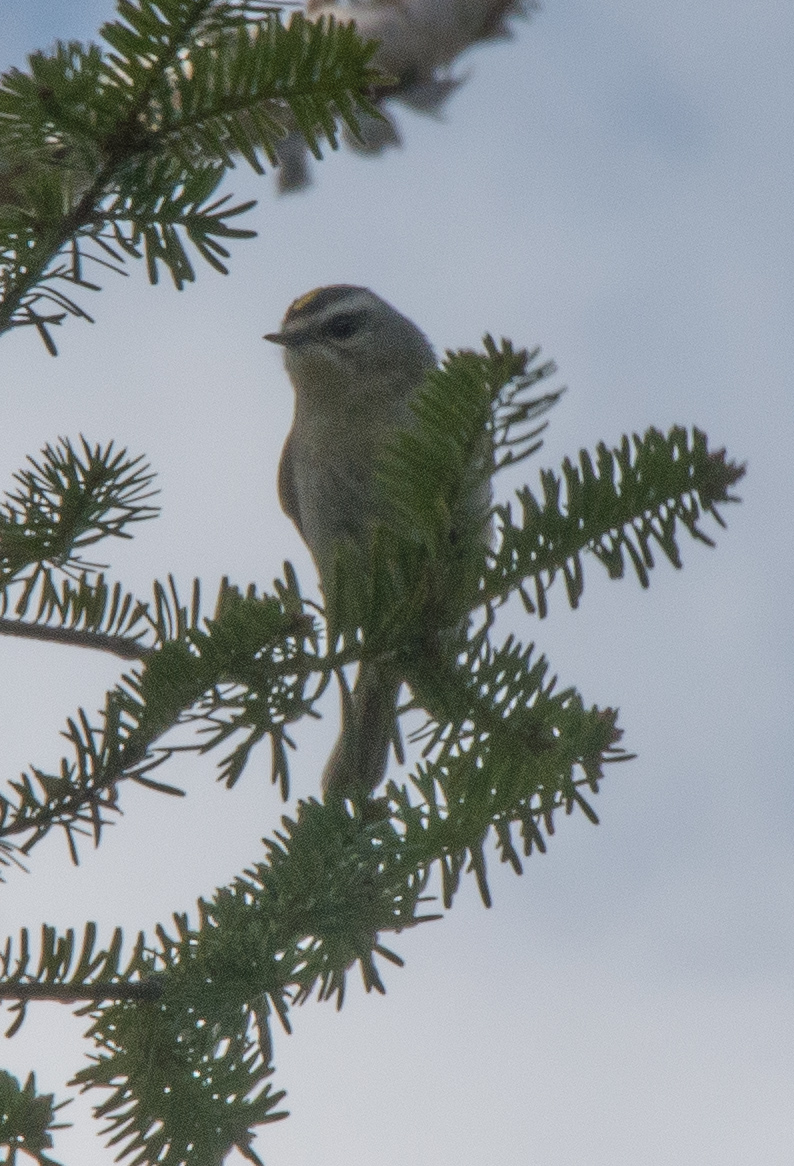
It takes a trained eye and more importantly a trained ear to determine the species.  Our friend Liz Lee suggested we take one of the Green Mountain Audubon Society walks to learn more about birding in Vermont.  We did a practice walk in the Jay Range in the Adirondacks and realized it's more difficult to spot the birds than we thought.  Photographing them is a greater challenge.  In the Adirondacks we managed to photograph a mere three species:  Black-throated Blue Warbler, Golden-crowned Kinglet and Rose-breasted Grosbeak.

Golden-crowned Kinglet
The next morning we went on our first walk with the Green Mountain Audubon Society (GMAS) in Geprags Community Park in Hinesberg.  Led by GMAS board member Bill Mercia, we managed to see or hear a whopping 44 species of birds!  I have to admit, I didn't see or hear all 44.  My favorites were the Golden-winged Warbler, Ruby-crowned Kinglet, American Redstart and Yellow-rumped Warbler.

Golden-winged Warbler
To learn more about the Green Mountain Audubon Society go to:

Green Mountain Audubon Society

We practiced our newly learned skills the next morning at Charlotte Park and Wildlife Refuge.  There was a chorus of bird song but on our own we were having difficulty identifying them.  We did manage to get reasonably good photos of Chestnut-sided Warblers, Gray Catbird and American Redstart.

Gray Catbird
We located a woodpecker nest and saw an adult fly out but were unable to identify it.  Our best guess is a Northern Flicker.

On the morning of May 17, we joined Mike Winslow, staff scientist for the Lake Champlain Committee, for a bird walk in Oakledge Park in Burlington.  We managed to spot about 20 species. Marc got a great photo of a Red-eyed Vireo.

Red-eyed Vireo
For more information about the Lake Champlain Committee and Bird Friday go to:

Lake Champlain Committee

We did our final bird walk of the season this morning at Honey Hollow in Jonesville.  Right from the parking lot we spotted Baltimore Oriole, Common Yellowthroat, Chestnut-sided Warbler and Song Sparrow.


Common Yellowthroat
Baltimore Oriole

A little further up the road we heard then spotted a magnificent Indigo Bunting.

Indigo Bunting
The Ovenbirds, Vireos and Wood Thrushes were singing from the thick understory.  We couldn't always spot them but at least we had learned what they were from their calls.  A female Blackburnian Warbler (thanks, Liz) was collecting spider's web for her nest on a branch over the road.

Female Blackburnian warbler
I spotted a Red-breasted Nuthatch feeding it's chick in a nest cavity but when we approached both adult and chick disappeared.  We also spotted a Rose-breasted Grosbeak by his melodic song.
Unfortunately, the Warbler migration is starting to wind down and the leaves are popping out.  It's making it more difficult to spot the birds.  I encourage all to grab a pair of binoculars and get out early to look for these beautiful birds.  I look forward to next spring when the colorful warblers will once again be migrating through our woods!

For more bird photos go to:

Marc's Spring Migration 2013 Collection

Marc's Spring Migration 2014 Collection

Marc's Spring Migration 2015 Collection

Marc's Spring Migration 2016 Collection

Marc's Spring Migration 2017 Collection

Marc's Vermont Birds 2018 Collection

Marc's Vermont Birds 2019 Collection

Marc's Vermont Birds 2020 Collection

We moved to southeast Arizona in late 2021.  Here are bird photos from Arizona: